
Most Valuable Blastoise Cards: Ultimate Collector & Price Guide
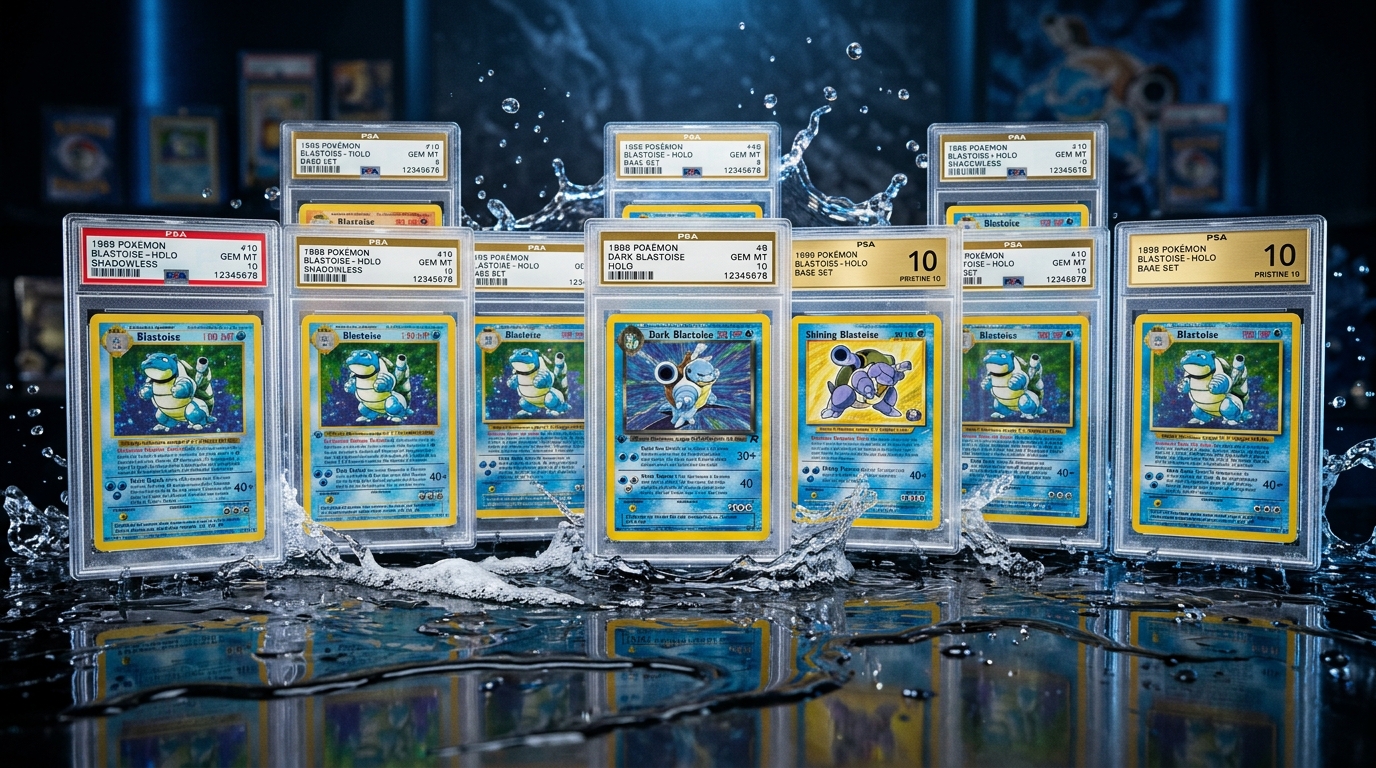
Navigating the collector market for the most valuable blastoise cards requires a comprehensive understanding of early prototype distributions, vintage Wizards of the Coast print variations, and certified gem-mint auction records. While Charizard often claims the highest mainstream headlines, Blastoise—the final evolution of the beloved Generation I water-type starter Squirtle—holds an equally venerable standing in the Pokémon Trading Card Game pantheon. From adorning the original 1998 packaging of Pokémon Blue Version for the Nintendo Game Boy to starring on historic corporate presentation test prints that command hundreds of thousands of dollars, Blastoise represents a cornerstone pillar of vintage and modern card investing.
Whether you are evaluating a childhood binder retrieved from long-term storage or tracking blue-chip modern alternate arts, understanding which specific printings constitute the most prized treasures is essential. In this comprehensive guide, we examine the historical significance, scarcity metrics, population reports, and current market values of the greatest Blastoise cards ever produced. We also review essential authentication tactics, condition pitfalls, and digital appraisal strategies alongside our companion deep dives on most valuable Pokémon cards and professional Pokémon card grading.
Market Milestone: In January 2021, a 1998 Wizards of the Coast Blastoise Commission Presentation Galaxy Star Holo card graded CGC 8.5 hammered down at Heritage Auctions for a historic $360,000, standing as one of the most expensive Pokémon trading cards ever traded in public auction history.
The Historical Significance of Blastoise in the Pokémon TCG
When Media Factory launched the Pokémon Card Game in Japan in October 1996, followed by the English rollout orchestrated by Wizards of the Coast (WotC) in January 1999, Blastoise immediately emerged as an unstoppable tournament force and an iconic collector centerpiece.
The Shellfish Titan of the 1999 Base Set
In competitive gameplay, Base Set Blastoise #2 was legendary due to its groundbreaking Pokémon Power, “Rain Dance.” This ability permitted players to attach an unlimited number of Water Energy cards to their Water Pokémon during each turn, enabling lightning-fast offensive setups that dominated the early competitive metagame through devastating “Hydro Pump” sweeps.
Outside the competitive arena, Ken Sugimori’s imposing artwork of Blastoise—cannons extended, stance resolute, set against a shimmering holographic background—became etched into the cultural memory of millions of 90s collectors. Alongside Charizard #4 and Venusaur #15, Blastoise formed the sacred “Big Three” holy trinity of the 1999 Base Set. While Charizard captured the fire-breathing hype, Blastoise emerged as the disciplined collector’s champion, commanding fierce bidding wars among vintage enthusiasts who recognize that gem-mint copies are extraordinarily difficult to acquire.
Key Factors That Drive Blastoise Card Values
Evaluating the pricing trajectory of any high-end Blastoise collectible requires analyzing several structural hobby mechanics:
- Print Era and Scarcity: Prototype prints, early 1st Edition Shadowless runs, and low-distribution promotional cards exhibit true physical scarcity that cannot be replicated.
- Holographic Foil Vulnerability: The silver water-themed holofoil paper stock utilized by Wizards of the Coast and early Japanese manufacturers was notoriously soft, prone to roller lines, print lines, and silvering.
- Third-Party Grading Population Reports: Published census reports from PSA, BGS, and CGC demonstrate that high-grade survival rates for vintage Blastoise holos are microscopic relative to modern print runs.
- Artistic Distinction & Sub-Rarities: Cards featuring illustrations by legendary artists like Ken Sugimori, Mitsuhiro Arita, or Naoyo Kimura, as well as e-Reader crystals and modern Secret Illustration Rares, consistently retain strong liquidity.
Top 10 Most Valuable Blastoise Cards of All Time
Below is the definitive ranking of the most valuable, historically significant, and sought-after Blastoise cards in the Pokémon Trading Card Game, verified through verified auction records and market data.
1. 1998 Wizards of the Coast Blastoise Commission Presentation Galaxy Star Holo
- Estimated Market Value: $360,000+ (CGC 8.5)
- Year of Release: 1998
- Key Distinctions: Blank back or Magic: The Gathering card back, square corners, prototype Wizards of the Coast typography.
Before Wizards of the Coast was officially granted the North American licensing rights to produce the Pokémon Trading Card Game in English, Cartamundi printed a tiny handful of presentation test cards in mid-1998 to pitch Nintendo of America executives. Commissioned directly by WotC brass, this legendary prototype features Sugimori’s iconic Blastoise art printed using a shimmering Galaxy Star holofoil sheet. Only four copies are verified to exist: two featuring blank white backs and two bearing standard Magic: The Gathering card backs. In January 2021, Heritage Auctions sold the CGC 8.5 MTG-back copy for $360,000, solidifying its status alongside the Pikachu Illustrator and 1st Edition Charizard as the holy grails of cardboard investment.
2. 1999 Base Set 1st Edition Shadowless Holo Blastoise #2
- PSA 10 Value: $25,000 – $45,000+
- PSA 9 Value: $3,500 – $5,500
- Year of Release: 1999
- Key Distinctions: “Edition 1” circular stamp on the left margin, lack of drop shadow beneath the right frame border, 1999 Wizards copyright date.
The flagship holy grail for retail collectors is the 1999 Base Set 1st Edition Blastoise #2. Printed during the first commercial run in North America, this card is distinguished by the iconic “Edition 1” black stamp and the absent drop shadow behind the illustration frame (Shadowless). Due to rough handling by children in 1999 and severe factory centering variance, the PSA 10 gem-mint population sits at approximately 100 copies worldwide. Pristine gem-mint copies represent an elite asset class that commands immense attention whenever presented at premier auction houses like Goldin or PWCC.
3. 1996 Japanese Topsun Holofoil Blastoise (Unnumbered Blue Back)
- PSA 10 Value: $15,000 – $30,000
- PSA 9 Value: $2,500 – $4,500
- Year of Release: 1996
- Key Distinctions: Prism holographic foil, unnumbered error print, bright blue reverse side.
Distributed in Japanese vending machines prior to the formal launch of the Media Factory TCG, the 1996 Topsun series contains the earliest officially licensed trading card depictions of the original 151 Pokémon. While common Topsun cards are non-holo, a very small subset received a dazzling square prism holographic finish. The rarest of all are the earliest unnumbered variants, which accidentally omitted the Pokédex number (#009) in the header. A Gem Mint PSA 10 Topsun Holo Blastoise represents a museum-tier artifact of early franchise history.
4. 1999 Base Set Shadowless Holo Blastoise #2 (Non-1st Edition)
- PSA 10 Value: $4,500 – $8,000
- PSA 9 Value: $800 – $1,400
- Year of Release: 1999
- Key Distinctions: Shadowless frame layout, standard 1999 Wizards copyright, no 1st Edition stamp.
After the initial 1st Edition production batch completed, Wizards of the Coast printed an intermediate “Shadowless” run before redesigning the frame aesthetics to add the familiar drop shadow seen in the mass-market Unlimited edition. Base Set Shadowless Blastoise cards feature the exact same thin font and vivid color saturation as 1st Edition cards, but lack the edition stamp. Because the production window was remarkably short, surviving copies in true gem-mint condition are drastically scarcer than standard Unlimited versions, providing a premium alternative for discerning investors.
5. 2003 Skyridge Blastoise Holo #H4
- PSA 10 Value: $3,000 – $5,200
- PSA 9 Value: $650 – $1,100
- Year of Release: 2003
- Key Distinctions: e-Reader barcode strip, “H” designated holographic numbering, illustrated by Kouki Saitou.
Skyridge stands as the final set published by Wizards of the Coast before Nintendo brought the trading card game license in-house. Due to waning retail interest in 2003, Skyridge had an exceptionally low print run, making unopened booster boxes and pristine holographic singles among the rarest modern-vintage items in existence. Blastoise #H4 features a stunning dynamic artwork by Kouki Saitou with water vortexes swirling across the e-Reader canvas. Finding copies with zero scratching on the sensitive e-Reader foil borders makes high grades elusive.
6. 2000 Team Rocket 1st Edition Dark Blastoise Holo #3
- PSA 10 Value: $2,500 – $4,500
- PSA 9 Value: $400 – $750
- Year of Release: 2000
- Key Distinctions: Team Rocket “R” symbol, Mitsuhiro Arita artwork, “Hydrocannon” attack text.
The Team Rocket expansion marked the first time Pokémon were introduced with corrupted, sinister personas under Giovanni’s crime syndicate. Illustrated by master artist Mitsuhiro Arita, Dark Blastoise features intense, aggressive posturing with dual steel hydro cannons primed to fire. Collectors prize the 1st Edition holographic version #3, particularly specimens showcasing full holographic swirls in the upper foil quadrant. Additionally, a famous non-holo error version exists where the card was misprinted with a holo foil number, creating a niche pursuit for variant specialists.
7. 2002 Expedition Base Set Blastoise Holo #4
- PSA 10 Value: $2,000 – $3,500
- PSA 9 Value: $400 – $700
- Year of Release: 2002
- Key Distinctions: First e-Reader series, full card border data tracks, Naoyo Kimura illustration.
The 2002 Expedition Base Set ushered in the e-Reader era with thicker left and bottom borders designed to be swiped through the Game Boy Advance e-Reader peripheral. Blastoise #4 showcases Naoyo Kimura’s majestic, photorealistic modeling of Blastoise resting majestically in a rocky riverbed. The holographic foil on Expedition singles extends across the entire illustration window, making surface scratches and edge chipping on the wide yellow borders instant grade killers.
8. 2004 EX FireRed & LeafGreen Blastoise ex #104
- PSA 10 Value: $1,800 – $3,200
- PSA 9 Value: $350 – $650
- Year of Release: 2004
- Key Distinctions: Silver holographic border, “ex” mechanic, Hikaru Koike illustration.
The EX series introduced the “Pokémon-ex” mechanic, conferring higher hit points and devastating attacks at the cost of giving up two Prize cards upon defeat. In the EX FireRed & LeafGreen set celebrating the Game Boy Advance remakes, Blastoise ex #104 served as the top chase card alongside Charizard ex #105. Featuring a sleek, metallic silver holofoil border and 3D computer-generated art by Hikaru Koike, this card frequently suffers from edge wear and corner peeling, leaving the PSA 10 population exceptionally tight.
9. 2019 Sun & Moon Cosmic Eclipse Blastoise & Piplup GX Alternate Art #215
- PSA 10 Value: $500 – $900
- PSA 9 Value: $120 – $200
- Year of Release: 2019
- Key Distinctions: Secret rare alternate art, TAG TEAM mechanic, illustrated by Sayami.
The TAG TEAM era of Sun & Moon produced some of the most celebrated, emotionally resonant artwork in modern card collecting. Blastoise & Piplup GX #215 pairs the mighty Water titan with the spunky Gen 4 starter Piplup enjoying a refreshing water spray. Because this card is a Secret Rare Alternate Art with notoriously low pack-pull odds from Cosmic Eclipse, collector demand has skyrocketed. It stands as the quintessential modern crossover grail combining cuteness, nostalgia, and elite modern aesthetics.
10. 2023 Pokémon 151 Blastoise ex Special Illustration Rare #200
- PSA 10 Value: $150 – $300
- PSA 9 Value: $45 – $75
- Year of Release: 2023
- Key Distinctions: Special Illustration Rare (SIR), underwater thematic artwork by Mitsuhiro Arita.
The release of Scarlet & Violet: 151 revitalized the entire collector hobby by celebrating the original Kanto Pokédex with modern textured printing techniques. Illustrated once again by Mitsuhiro Arita, Blastoise ex #200 depicts the colossal turtle swimming underwater through sunlit ocean depths, looking upward as schools of small fish swim nearby. The textured foil treatment and vibrant color palette made this card an instant modern classic. For newer collectors entering the hobby, this card represents an accessible entry point with strong long-term appreciation potential.
Market Price Comparison: Top Blastoise Cards
To provide a clear comparative baseline for portfolio valuation, the following table summarizes historical sales ranges, grading populations, and rarity tiers for the top Blastoise grails:
| Card Description | Release Year | Rarity / Variant | Ungraded / Raw Value | PSA 9 Mint Value | PSA 10 Gem Mint Value |
|---|---|---|---|---|---|
| WotC Commission Presentation | 1998 | Prototype (Galaxy Foil) | $100,000+ | $200,000+ (Est.) | $360,000+ (Record) |
| 1999 Base Set 1st Edition #2 | 1999 | 1st Edition Shadowless | $1,200 – $2,500 | $3,500 – $5,500 | $25,000 – $45,000 |
| 1996 Topsun Holofoil (No #) | 1996 | Prism Holo Japanese | $800 – $1,800 | $2,500 – $4,500 | $15,000 – $30,000 |
| 1999 Base Set Shadowless #2 | 1999 | Shadowless Holo | $250 – $500 | $800 – $1,400 | $4,500 – $8,000 |
| 2003 Skyridge Holo #H4 | 2003 | e-Reader Holo | $200 – $450 | $650 – $1,100 | $3,000 – $5,200 |
| 2000 Team Rocket 1st Ed Dark #3 | 2000 | 1st Edition Holo | $120 – $250 | $400 – $750 | $2,500 – $4,500 |
| 2002 Expedition Base Set #4 | 2002 | e-Reader Holo | $100 – $220 | $400 – $700 | $2,000 – $3,500 |
| 2004 EX FireRed & LeafGreen #104 | 2004 | Holo ex | $90 – $180 | $350 – $650 | $1,800 – $3,200 |
| 2019 Cosmic Eclipse Tag Team #215 | 2019 | Alternate Art Secret Rare | $80 – $140 | $120 – $200 | $500 – $900 |
| 2023 Pokémon 151 SIR #200 | 2023 | Special Illustration Rare | $40 – $65 | $45 – $75 | $150 – $300 |
Authentication & Condition Inspection: How to Spot Fakes and Flaws
Because early vintage Blastoise cards command thousands of dollars in high grades, counterfeits and altered cards circulate widely in online marketplaces. Conducting rigorous authentication checks is paramount before executing any transaction.
Identifying the Famous “No Stage” Blastoise Error
One of the most celebrated factory errors in vintage Pokémon collecting is the “No Stage” Base Set Blastoise. On standard copies, a small rectangular box in the top-left corner features the text “Stage 2 - Evolves from Wartortle.” On an early batch of Unlimited printings, the word “Stage” was accidentally omitted, leaving only a blank colored bar. While not as valuable as a 1st Edition Shadowless copy, authentic “No Stage” error cards command significant premiums over standard Unlimited cards among error collectors.
Physical Authentication Markers
When examining a raw vintage Blastoise card, check these key authentication markers:
- The Light Transmission Test: Genuine vintage Pokémon cards manufactured by Wizards of the Coast feature a dense black graphite interlayer between two sheets of bleached paperboard. Counterfeit cards printed on cheap white card stock allow light from a phone flashlight to pass straight through, whereas authentic cards reveal only a faint, diffused glow.
- The Rosetta Pattern: Under a 30x jeweler’s loupe, authentic Pokémon cards reveal a precise hexagonal rosette dot matrix created by four-color offset printing. Modern laser-printed fakes display erratic digital dithering or blurry pixel clusters, especially on the crisp black border lettering of “Blastoise” and the HP values.
- Foil Swirl Positioning: On vintage WotC cards featuring the Galaxy/Cosmos holofoil pattern (such as Team Rocket Dark Blastoise, Skyridge, and Base Set 2), complete circular holographic swirls can appear anywhere across the foil sheet. Swirls located near Blastoise’s water cannons or mouth add an extra 15% to 35% liquidity premium among specialized swirl collectors.
Grading Strategy: Maximizing ROI with Professional Grading
Deciding whether to submit a raw Blastoise card to professional grading authorities like PSA, BGS, or CGC requires a methodical cost-benefit calculation. For vintage cards, the value spread between an ungraded “raw” condition copy and a certified PSA 9 or 10 is enormous.
Pre-Grading Inspection Checklist
Before submitting cards and paying grading service fees, inspect the four fundamental pillars of grading:
- Centering (Front and Back): PSA guidelines permit up to 55/45 to 60/40 centering on the front for a PSA 10 Gem Mint grade, and up to 75/25 on the reverse. Measure the left-to-right and top-to-bottom yellow borders carefully.
- Surface Scratches: Vintage water-type holofoil scratches under the slightest friction. Use an angled LED light or UV lamp to detect microscopic hairline scratches, surface indentations, or binder ring dents.
- Corner Whitening: Check each of the four card corners against a black velvet background. Even a microscopic spec of exposed white paperboard can drop a vintage card from a PSA 10 to a PSA 8.5 or 9.
- Edge Silvering: Early Japanese and WotC factory cutters often dulled quickly, creating “silvering” where the reflective foil underneath peeled or chipped along the border.
Leveraging AI Pre-Grading Tools
Submitting raw cards blind can result in disappointing grades and wasted grading fees. Collectors increasingly utilize cutting-edge solutions like AI card grading to scan high-resolution imagery and receive automated computer vision analysis of border centering ratios and surface micro-imperfections. When preparing high-value submissions, pairing automated pre-grading assessments with an up-to-date Pokémon price checker ensures you only submit cards that have a mathematical probability of delivering a positive return on investment.
If your collection includes a diverse mix of trading cards beyond Pokémon, reviewing historical trends in sports card value and learning the trade-offs in our guide to how to sell Pokémon cards will give you the edge needed to navigate both modern auctions and private treaty transactions. For collectors exploring other franchise icons, compare market dynamics against our deep dive on most valuable Charizard cards.
Frequently Asked Questions
What is the single most valuable Blastoise card in the world?
The single most valuable Blastoise card in the world is the 1998 Wizards of the Coast Blastoise Commission Presentation Galaxy Star Holo card, which sold for $360,000 in January 2021 at Heritage Auctions. Printed by Cartamundi as an internal prototype to pitch Nintendo of America, only four copies are confirmed to exist, two of which feature Magic: The Gathering card backs.
How can I tell if my Base Set Blastoise is Shadowless or Unlimited?
To determine if your 1999 Base Set Blastoise is Shadowless, examine the right and bottom border of the character illustration frame. A standard Unlimited card features a dark drop shadow to create a three-dimensional depth effect, whereas a Shadowless card lacks this shadow, resulting in a flat transition. Additionally, Shadowless cards feature the copyright date “1999 Wizards” displayed twice in the bottom copyright footer (“1995, 96, 98, 99 Nintendo… 1999 Wizards”), whereas Unlimited cards only state “1999 Wizards” once.
What is the “No Stage” Blastoise error, and how much is it worth?
The “No Stage” Blastoise error is a vintage printing anomaly found on an early production batch of Unlimited 1999 Base Set cards where the words “Stage 2” were omitted from the evolution box in the top-left corner. Instead of indicating “Stage 2 - Evolves from Wartortle,” the header box displays only a blank blue background. Authentic copies in near-mint condition typically trade for $300 to $600 raw, with graded PSA 9 and PSA 10 copies commanding $1,500 to $3,500+.
Is Blastoise ex from Pokémon 151 a good long-term hold?
Yes, the Blastoise ex Special Illustration Rare #200 from Scarlet & Violet: 151 is widely considered one of the strongest modern Pokémon investment candidates. Illustrated by the legendary Mitsuhiro Arita, the card captures iconic Generation I nostalgia with modern textured foil finishes. Because 151 booster packs are heavily opened and beloved by collectors worldwide, gem-mint graded copies in PSA 10 condition offer an affordable yet blue-chip entry point for collectors seeking steady long-term appreciation.
Pre-Grade & Track Values Instantly with CardMint
CardMint is the ultimate all-in-one scanner for sports card and TCG collectors, saving you time and money.
Simply scan the front of your card. Our AI instantly identifies the card details, checks current pricing metrics, and gives you a centering and wear pre-grade report before you submit to PSA/BGS.
