
Most Valuable Mew Cards: Price Guide & Investment Analysis (2026)
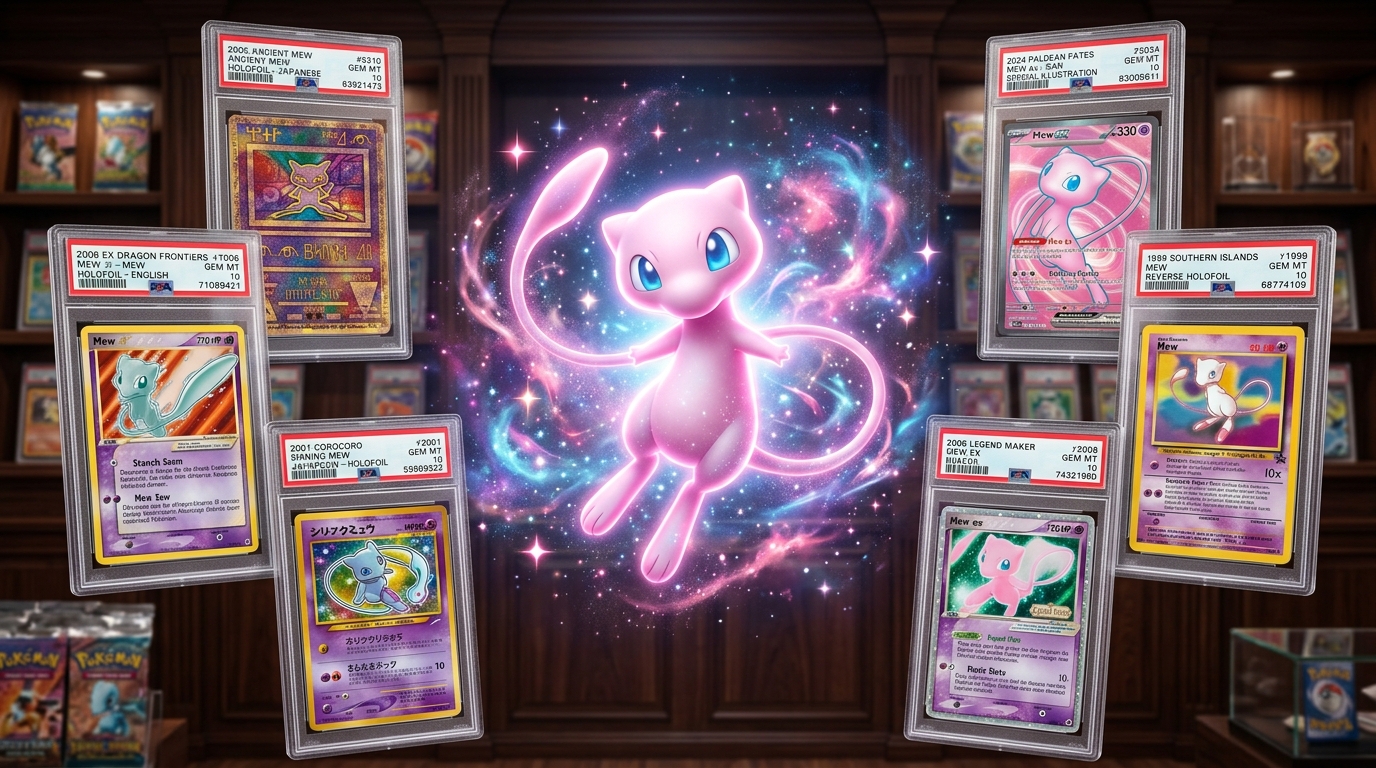
Collecting and investing in the most valuable Mew cards is widely regarded as one of the most exciting and financially lucrative pursuits in the modern Pokémon Trading Card Game hobby. As the mythical progenitor of all Pokémon and the genetic source material for its formidable counterpart Mewtwo, Mew occupies a legendary status that transcends both competitive gameplay and speculative card collecting. Since the clandestine introduction of Mew in the original 1996 Game Boy titles by programmer Shigeki Morimoto, this elusive psychic feline has captured the imaginations of millions of collectors worldwide.
Over the past three decades of Pokémon TCG history, the market for vintage and modern Mew cards has exploded into a multi-million dollar asset class. From ultra-scarce Japanese exclusive magazine promos featuring sparkling cosmos holofoil to glittering EX-era Gold Star cards and viral modern masterpieces like the Paldean Fates “Bubble Mew,” high-grade Mew cards routinely shatter records on premier auction platforms such as Heritage Auctions, Goldin, and eBay Vault. Understanding which Mew cards represent true blue-chip grails versus temporary market hype is crucial for collectors looking to protect and grow their capital.
In this definitive collector’s price guide and market analysis, we provide an in-depth breakdown of the most valuable Mew cards ever printed. We examine certified population reports from top grading services like PSA and Beckett, analyze historical auction data, investigate the specific authentication markers needed to avoid high-end fakes, and demonstrate how modern digital scanning tools streamline condition assessment.
Key Investment Takeaway: The long-term appreciation of top-tier Mew cards is anchored by extreme condition sensitivity, vintage Japanese promotional distribution limits, and modern alternate art visual excellence. While vintage icons like the 2006 EX Dragon Frontiers Gold Star and 2001 CoroCoro Shining Mew anchor the blue-chip market, modern chase cards such as the Fusion Strike VMAX and Paldean Fates Special Illustration Rare boast massive trading liquidity across international collector markets.
Why Mew Cards Command Massive Collectible Premiums
To understand why Mew cards consistently rank alongside the most valuable Pokemon cards and most valuable Mewtwo cards, one must evaluate how franchise lore, aesthetic execution, and structural scarcity converge within the collectibles market.
Several structural factors explain why Mew remains one of the most blue-chip characters in the Pokémon franchise:
- The Origin of Mythical Lore: Mew was originally coded into the Pokémon Red and Green cartridges secretly without Nintendo’s prior knowledge, giving rise to decades of urban legends, playground rumors, and truck-glitch folklore. That authentic mystique translated directly into card collecting when Wizards of the Coast and Media Factory released promotional items that could only be obtained through theatrical screenings, magazine inserts, and sanctioned leagues.
- Distinctive Aesthetic Variations: Unlike standard evolutionary lines, Mew has been rendered in some of the most striking artistic treatments in card gaming history. From the shimmering blue form of Shiny Mew to hieroglyphic holographic runic borders and vibrant pastel dreamscapes, artists like Hironobu Yoshida, Masakazu Fukuda, and USGMEN have created cards with profound visual appeal.
- The Gold Star and EX Era Supply Bottleneck: The mid-2000s EX era coincided with what historians call the “dark age” of Pokémon card print runs. Pack production was significantly lower than during either the original Base Set boom or the modern Sword & Shield surge. As a result, pulling a Gold Star Mew was not only statistically improbable (approximately 1 in 72 packs or 2 booster boxes), but the absolute number of existing boxes was minuscule compared to today’s print quantities.
- Universal Demographic Appeal: Mew appeals to every quadrant of the hobby: nostalgic millennials who remember obtaining the theatrical Ancient Mew promo at the cinema in the year 2000, competitive TCG players who piloted Mew VMAX to multiple World Championship top cuts, and modern art collectors drawn to vibrant Special Illustration Rares.
Top 8 Most Valuable Mew Cards Ranked by Market Value
The following cards represent the highest echelon of Mew collecting, ranked by documented auction milestones, population scarcity in Gem Mint 10 condition, and sustained secondary market value.
+-------------------------------------------------------------------------------+
|                        TOP VALUABLE MEW CARDS SUMMARY                         |
+------------------------------------------------------+------------------------+
| Card Description                                     | PSA 10 Auction Range   |
+------------------------------------------------------+------------------------+
| 2006 Pokemon EX Dragon Frontiers Mew Star #101       | $4,500 - $14,000+      |
| 2001 Japanese CoroCoro Comics Shining Mew Promo      | $2,000 - $5,200+       |
| 1999/2000 Pokemon Movie Ancient Mew (Nintedo/Eng)   | $600 - $3,500+         |
| 2002 Expedition Base Set Mew Holo #19                | $900 - $2,600+         |
| 2001 Southern Islands Mew Promo #1                   | $400 - $1,100+         |
| 2005 EX Holon Phantoms Mew ex Holo #100              | $750 - $2,100+         |
| 2021 Fusion Strike Mew VMAX Alt Art #269             | $220 - $480+           |
| 2024 Paldean Fates Mew ex SIR #232 ("Bubble Mew")    | $240 - $520+           |
+------------------------------------------------------+------------------------+
1. 2006 Pokemon EX Dragon Frontiers Mew Star (Gold Star) #101
- Estimated PSA 10 Value: $4,500 – $14,000+
- Raw / Ungraded Value: $650 – $1,400
- Release Era: EX Series (Dragon Frontiers)
- Key Identifiers: Gold foil star adjacent to the name “Mew”, striking artwork by Masakazu Fukuda showing Shiny Mew in light blue, and silver holofoil border.
The 2006 EX Dragon Frontiers Mew Star is the crown jewel of Mew collecting. Distributed toward the end of the EX era, Dragon Frontiers introduced Delta Species Pokémon, but the Gold Star cards retained their normal typing while featuring shiny Pokémon breaking out of their illustration frames.
Because children regularly played with these cards unsleeved on asphalt playgrounds during 2006, finding a copy without severe edge silvering, scratched foil, or bent corners is extraordinarily rare. Of the thousands of cards submitted to PSA, only a tiny fraction have managed to earn the elusive Gem Mint 10 grade. When a PSA 10 or BGS 9.5 specimen enters the open market, institutional collectors and high-net-worth investors bid aggressively, placing this card in the same prestige conversation as the legendary Umbreon and Rayquaza Gold Stars.
2. 2001 Japanese CoroCoro Comics Shining Mew Holo Promo
- Estimated PSA 10 Value: $2,000 – $5,200+
- Raw / Ungraded Value: $150 – $380
- Release Era: Neo Era (Japanese CoroCoro Magazine Exclusive)
- Key Identifiers: Distinctive speckled galaxy holofoil pattern extending across the entire card surface, illustrated by Hironobu Yoshida.
Issued exclusively as an unpeeled insert inside the May 2001 edition of Japan’s CoroCoro Comic magazine, the Shining Mew promo is revered as one of the most artistic and historically significant rare Pokemon cards ever created. Unlike standard holographic cards where foil is restricted to the artwork window or the card border, CoroCoro Shining Mew features an ethereal, all-over glittering surface treatment where hundreds of miniature stars and swirls dance across the frame.
The packaging method—being glued into a physical paper magazine alongside comic book pages—inflicted immediate factory damage on countless copies. Pristine copies that avoided peel tears, glue residue, corner dings, and surface scratches are treasures of Japanese vintage collecting. In certified Gem Mint condition, this card has experienced tremendous compound appreciation over the past decade.
3. 1999/2000 Ancient Mew Promo (The Power of One / Lugia Movie)
- Estimated PSA 10 Value: $600 – $3,500+ (depending on variant)
- Raw / Ungraded Value: $30 – $120
- Release Era: Wizards of the Coast Promotional / Japanese Theatrical Release
- Key Identifiers: Hieroglyphic runic card text, intricate holographic foil across the front and back, unique ancient card backing.
Ancient Mew is arguably the single most culturally recognizable promotional card in gaming history. Created as a marketing tie-in for Pokémon: The Movie 2000 (The Power of One), millions of theatergoers received this mysterious artifact at box offices worldwide. However, serious collectors know that not all Ancient Mew cards are created equal.
The card exists in several distinct printings that differ wildly in rarity:
- Japanese Version 1 (“Nintedo” Misprint): Released in 1999 Japanese theaters, this initial print run features a famous typo at the bottom copyright line reading “Nintedo” instead of “Nintendo”. This error variant is the rarest and most expensive Ancient Mew, commanding up to $3,500+ in PSA 10.
- Japanese Version 2 (Corrected): Fixed the copyright spelling with the same cosmic foil. Highly sought-after in Gem Mint condition ($800–$1,400).
- Japanese Version 3 (Speckled Foil): Printed with a revised holofoil pattern for the 2000 movie home video release.
- English / International Version: Distributed throughout North America and Europe in 2000. While raw copies remain affordable due to high supply, Gem Mint PSA 10 copies trade for $600 to $900 because the fragile card stock scratched easily inside the original cellophane wrappers.
4. 2002 Pokemon Expedition Base Set Mew Holo #19
- Estimated PSA 10 Value: $900 – $2,600+
- Raw / Ungraded Value: $80 – $220
- Release Era: e-Card Series (Expedition Base Set)
- Key Identifiers: Large “Dot Code” e-Reader strip on the left and bottom margins, card number 19/165, artwork by Christopher Rush.
The Expedition Base Set ushered in the beloved e-Reader era, featuring wide tech borders engineered for scanning into the Game Boy Advance e-Reader peripheral. Mew #19 holds special acclaim because its artwork was painted by Christopher Rush—the legendary fantasy illustrator best known for designing Magic: The Gathering’s iconic Black Lotus.
Rush’s interpretation of Mew, floating gracefully through a surreal purple cosmic sphere, gave the card instant crossover appeal among trading card enthusiasts. The e-Reader series suffered from aggressive surface scuffing and heavy border edge wear right out of the booster packs. As a result, certified Gem Mint 10 copies command an immense multiplier over raw cards.
5. 2001 Pokemon Southern Islands Mew Holo #1
- Estimated PSA 10 Value: $400 – $1,100+
- Raw / Ungraded Value: $45 – $110
- Release Era: Promo Collection (Southern Islands Rainbow Island Set)
- Key Identifiers: Set symbol featuring a palm tree with a tropical island, card number 1, artwork by Keiko Fukuyama.
The Southern Islands collection was released in 2001 to coincide with the second Pokémon feature film, distributed in two three-card binder folders (Tropical Island and Rainbow Island). Mew was the headline card of the Rainbow Island set, illustrated with a whimsical, storybook aesthetic as Mew peers curiously from behind tropical island palm fronds.
Because the cards were housed in clear plastic binder pages, many copies suffered binder ring indentations and surface impressions. A pristine PSA 10 or BGS 9.5 Southern Islands Mew is considered an essential cornerstone for any vintage promo master set.
6. 2005 Pokemon EX Holon Phantoms Mew ex Holo #100
- Estimated PSA 10 Value: $750 – $2,100+
- Raw / Ungraded Value: $70 – $180
- Release Era: EX Series (Holon Phantoms)
- Key Identifiers: Silver foil “ex” border, 100 HP, card number 100/110, illustrated by Ryo Ueda.
The EX era was famous for its high-powered “Pokémon-ex” mechanics, and Mew ex from Holon Phantoms is one of the most visually balanced cards of the era. Illustrated by 3D computer graphics pioneer Ryo Ueda, this card portrays Mew charging a sphere of psychic energy with vivid holographic gradients extending through the entire card frame.
The delicate foil borders on mid-2000s ex cards are notorious for “silvering”—a manufacturing defect where the underlying foil shows through the edges of the card directly from the factory cut. Finding a copy with razor-sharp borders and zero holo fogging requires scanning dozens of candidate cards.
7. 2021 Pokemon Fusion Strike Mew VMAX Alternate Art Secret Rare #269
- Estimated PSA 10 Value: $220 – $480+
- Raw / Ungraded Value: $80 – $160
- Release Era: Sword & Shield Series (Fusion Strike)
- Key Identifiers: Card number 269/264, Alternate Art depiction of a giant Mew interacting with urban city streets, illustrated by USGMEN.
During the Sword & Shield era, Alternate Art Secret Rares revolutionized the collector landscape. Mew VMAX #269 from Fusion Strike quickly earned iconic status due to its playful, charming artwork depicting a towering Dynamax Mew gleefully wandering through a bustling miniature city while holding a tiny subway car.
Beyond its artistic genius, Mew VMAX dominated the competitive tournament scene for over two years, piloting multiple players to Regional and International championships. That rare double-threat status—beloved by high-end collectors and demanded by tournament players—ensured relentless pack-cracking and massive transaction volume on secondary markets.
8. 2024 Pokemon Paldean Fates Mew ex Special Illustration Rare #232 (“Bubble Mew”)
- Estimated PSA 10 Value: $240 – $520+
- Raw / Ungraded Value: $90 – $180
- Release Era: Scarlet & Violet Series (Paldean Fates)
- Key Identifiers: Card number 232/091, Special Illustration Rare (SAR), featuring Shiny blue Mew floating among translucent bubbles, illustrated by USGMEN.
Known colloquially across hobby forums and TikTok streams as “Bubble Mew,” this card became the undisputed chase card of the Scarlet & Violet: Paldean Fates expansion. Illustrated once again by artist USGMEN, the artwork showcases Shiny light-blue Mew gently floating inside a transparent bubble while playing with friends against a pastel-colored dreamscape.
Modern Special Illustration Rares feature intricate diagonal micro-texturing that shimmers under light. Because Paldean Fates was opened at historic volumes, mint raw copies are actively traded, but strict centering standards and print lines from factory roller bars mean that true Gem Mint 10 grades command substantial market premiums.
Historical Price Analysis & Value Comparison Across Grading Tiers
When analyzing the price dynamics of Mew cards, condition is the single greatest determinant of realized valuation. The price gap between an ungraded raw card and a certified PSA 10 can range from a 3x multiplier on modern releases to more than a 15x multiplier on vintage holos.
The table below outlines current market price estimates across key grading tiers, synthesized from verified sales across eBay, Heritage Auctions, and PWCC:
| Card Name | Set & Year | Ungraded (Raw) | PSA 8 (NM-MT) | PSA 9 (Mint) | PSA 10 (Gem Mint) |
|---|---|---|---|---|---|
| Mew Star (Gold Star) #101 | EX Dragon Frontiers (2006) | $850 | $1,800 | $3,600 | $10,500+ |
| Shining Mew Holo Promo | CoroCoro Comics (2001) | $220 | $450 | $950 | $3,400 |
| Ancient Mew (“Nintedo” Error) | Japanese Promo (1999) | $120 | $320 | $750 | $2,800 |
| Ancient Mew (English Release) | Movie 2000 Promo (2000) | $40 | $90 | $210 | $650 |
| Mew Holo #19 | Expedition Base Set (2002) | $110 | $240 | $550 | $1,850 |
| Southern Islands Mew #1 | Southern Islands (2001) | $65 | $140 | $310 | $850 |
| Mew ex Holo #100 | EX Holon Phantoms (2005) | $110 | $220 | $480 | $1,600 |
| Mew VMAX Alt Art #269 | Fusion Strike (2021) | $115 | $130 | $165 | $320 |
| Bubble Mew ex SAR #232 | Paldean Fates (2024) | $125 | $140 | $180 | $360 |
| Mew ex Metal Promo #205 | Scarlet & Violet 151 (2023) | $35 | $60 | $110 | $380 |
Collectors should consult our dedicated Pokemon card price guide to monitor real-time shifts in these valuations as market liquidity fluctuates.
Grading Standards & Condition Factors for Rare Mew Cards
Submitting a rare Mew card for third-party authentication can unlock immense financial equity, but only if the card meets rigorous grading criteria. Before sending raw specimens to PSA or Beckett, collectors must examine four critical sub-grades:
+-------------------------------------------------------------------------------+
|                       KEY GRADING SUB-GRADE FACTORS                           |
+-------------------------------------------------------------------------------+
| 1. CENTERING: 55/45 to 60/40 ratio on front borders for PSA 10 eligibility.  |
| 2. CORNERS: Inspection under 10x loupe for whitening, fraying, or blunting.  |
| 3. EDGES: Factory silvering detection along vintage Japanese and ex borders.  |
| 4. SURFACE: Micro-scratches, print roller lines, hollow bubbles, holo clouding.|
+-------------------------------------------------------------------------------+
1. Centering Ratios
For modern cards like Bubble Mew or Fusion Strike Mew VMAX, off-center borders are the most common reason cards fall to PSA 9. PSA allows a 60/40 tolerance on the front and 75/25 on the back for Gem Mint 10, whereas BGS requires a strict 50/50 for a Pristine 10.
2. Surface Inspection
Vintage holofoil cards from the Neo and e-Card eras utilized softer card stocks and delicate reflective layers. Even gentle storage in PVC plastic sleeves can cause clouding, micro-scratches, or foil peeling. Always utilize an LED inspection lamp and a microfiber cloth before preparing cards for submission. For a detailed breakdown of grading company rubrics, review our PSA vs BGS grading comparison.
3. Pre-Grading with the CardMint Mobile App
Rather than spending hundreds of dollars on grading fees only to receive disappointing PSA 7s or 8s, modern collectors leverage the CardMint AI Card Scanner. By pointing your smartphone camera at any raw or encased card, CardMint’s neural network instantly analyzes centering percentages, identifies edge wear, highlights microscopic surface abrasions, and delivers an instant pre-grade prediction on a 1.0 to 10.0 scale. This automated workflow ensures you only submit cards guaranteed to yield a positive return on investment.
Proven Investment & Collection Strategies
Navigating the high-stakes trading card market requires disciplined asset allocation. Whether your budget is $200 or $20,000, consider the following strategic principles when building a Mew collection:
Buy the Grade, Not Just the Card
On ultra-high-end vintage items like the 2006 Dragon Frontiers Gold Star, the price difference between a PSA 9 and a PSA 10 can exceed $8,000. In many instances, purchasing an exceptionally clean PSA 9 offers superior downside protection and strong capital preservation compared to paying an exorbitant premium for a Gem Mint slab.
Target Iconic Japanese Promos
Historical data consistently demonstrates that Japanese exclusive promotional cards experience steadier price appreciation than mass-market English unlimited print runs. Items like CoroCoro Shining Mew or the Japanese Version 1 “Nintedo” Ancient Mew carry geographic exclusivity and fixed print caps that can never be diluted by subsequent reprint waves.
Verify Authenticity and Detect Counterfeits
Because Mew cards command steep prices, counterfeiters frequently produce high-quality fake cards, particularly for Ancient Mew, Gold Star Mew, and modern alternate arts. Always check:
- The “Black Layer” Core: Authentic Pokémon cards are manufactured using a triple-layer paper sandwich featuring a thin black graphite light-blocking core in the center. Counterfeits often use cheap single-layer white cardstock that allows bright light to pass right through.
- Surface Texturing: Modern cards like Bubble Mew possess sharp, fingerprint-like textured ridges. Counterfeit prints are usually completely flat and overly glossy.
- Font and Energy Symbols: Inspect the font kerning and energy symbol alignment against verified database scans in the CardMint mobile app.
Before putting your cards up for sale, make sure to read our comprehensive tutorial on how to sell Pokemon cards to maximize your net proceeds and avoid transaction fees.
Frequently Asked Questions
What is the single most valuable Mew card ever printed?
The single most valuable Mew card in the Pokémon TCG is the 2006 Pokémon EX Dragon Frontiers Mew Star (Gold Star) #101. In certified PSA 10 Gem Mint condition, verified private transactions and auction milestones range between $4,500 and $14,000+, driven by extreme mid-2000s box scarcity, a minuscule pull rate of approximately 1 in 72 packs, and heavy condition sensitivity on the card’s delicate silver foil borders.
How can I differentiate between the different versions of Ancient Mew?
Ancient Mew has four major variations identified by their bottom copyright text and holofoil pattern. The most valuable version is the 1999 Japanese Version 1, which features a famous printing error misspelling Nintendo as “Nintedo”. The Japanese Version 2 corrected this typo with cosmic star foil, while Version 3 utilized a speckled glitter foil. The English 2000 theatrical release features standard English copyright credits and a slightly different holographic sheen.
Why has the Paldean Fates Bubble Mew increased so rapidly in price?
The 2024 Paldean Fates Mew ex Special Illustration Rare #232 (affectionately called “Bubble Mew”) experienced rapid price appreciation due to artist USGMEN’s highly viral, light-hearted pastel artwork, the enduring appeal of Shiny light-blue Mew, and notoriously difficult pull rates in Paldean Fates booster packs. As sealed Paldean Fates products dry up on retail shelves, collectors have aggressively competed for raw and PSA 10 copies.
Should I grade my raw vintage Mew card with PSA, BGS, or CGC?
If your vintage Mew card appears to be in near-mint or mint condition with sharp corners and clean surface foil, submitting it for professional authentication is highly recommended. PSA generally provides the greatest liquidity and market premium for vintage Pokémon cards, while BGS is favored for cards with immaculate 50/50 centering targeting a Pristine 10 or Black Label. Using the CardMint app’s AI pre-grading tool allows you to evaluate your card’s sub-grades before paying grading submission fees.
How does the CardMint app help collectors identify and value rare Mew cards?
CardMint utilizes proprietary computer vision to instantly identify any Mew card—including complex Japanese promos, error variants, and set numbering—within milliseconds of scanning with your smartphone camera. The app tracks real-time market sales across global auction platforms, calculates current fair market value by condition tier, and provides automated collection tracking so your portfolio value updates automatically as market prices move.
Pre-Grade & Track Values Instantly with CardMint
CardMint is the ultimate all-in-one scanner for sports card and TCG collectors, saving you time and money.
Simply scan the front of your card. Our AI instantly identifies the card details, checks current pricing metrics, and gives you a centering and wear pre-grade report before you submit to PSA/BGS.
