
Most Valuable Venusaur Cards: Ultimate Collector & Price Guide (2026)
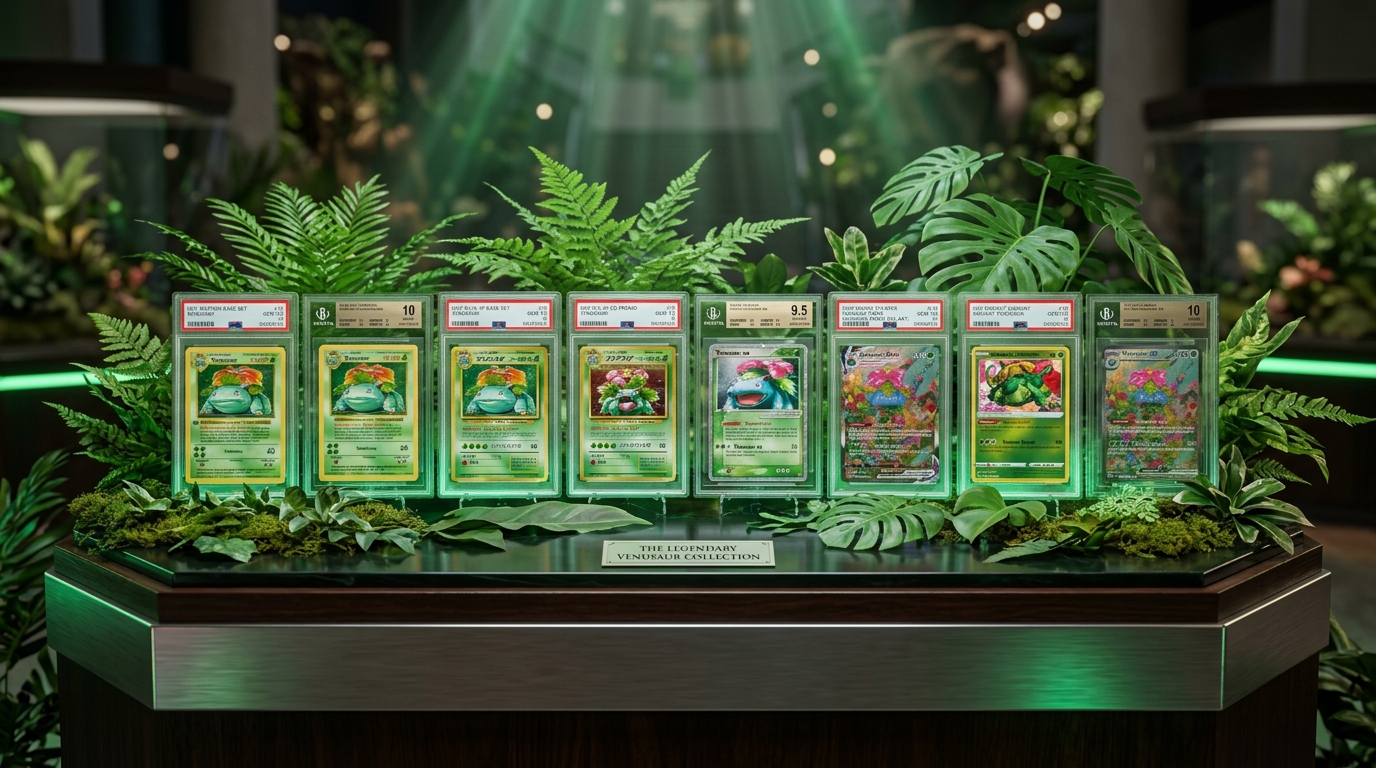
Navigating the collector market for the most valuable venusaur cards requires an in-depth understanding of vintage Wizards of the Coast print variations, elusive Japanese promotional distributions, and certified gem-mint population reports. As the final evolution of Bulbasaur—Pokémon #001 in the National Pokédex—Venusaur stands as a founding pillar of the franchise. While Charizard frequently dominates mainstream auction headlines and Blastoise commands devout tactical reverence, Venusaur represents the third and indispensable titan of the original Generation I Kanto starter trinity.
From gracing the original 1996 packaging of Pokémon Green Version in Japan to headlining premier modern expansions like Scarlet & Violet: 151, Venusaur cards have sustained exceptional value velocity. Vintage holofoils, rare e-Reader printings, and low-pop Japanese tournament promos have surged into blue-chip collectibles commanding tens of thousands of dollars at public auction.
Whether you are evaluating a childhood binder discovered in your attic or strategically allocating capital into vintage cardboard assets, this comprehensive price guide provides everything you need. Below, we break down auction records, analyze foil vulnerabilities, provide step-by-step authentication checklists, and show how digital scanning tools make identifying grade-worthy copies effortless. For broader collection strategies, be sure to explore our foundational guides on most valuable Pokémon cards, most valuable Charizard cards, and most valuable Blastoise cards.
Market High-Water Mark: In November 2021, a pristine 1999 Pokémon Base Set 1st Edition Shadowless Venusaur #15 graded PSA 10 Gem Mint crossed the auction block for an astonishing $25,200, solidifying Venusaur’s rightful status among the most elite investment-grade assets in trading card history.
The Historical Legacy of Venusaur in the Pokémon TCG
When Media Factory unveiled the Pokémon Card Game in Japan in October 1996, followed by the landmark English launch by Wizards of the Coast (WotC) in January 1999, Venusaur immediately cemented its legacy as an offensive juggernaut and collector centerpiece.
+-------------------------------------------------------------------------------+
|                       VENUSAUR TCG TIMELINE & MILESTONES                      |
+-------------------------------------------------------------------------------+
| Oct 1996: Japanese Base Set No-Rarity     | First printing without rarity star|
| Jan 1999: English WotC Base Set Release   | 1st Edition Shadowless holos debut|
| Dec 1998: Japanese CD Promo Distribution  | Ken Sugimori art with Toshinao CD |
| Aug 2000: Gym Challenge 1st Edition       | Erika's Venusaur #4 enters hobby  |
| Sep 2002: Expedition Base Set (e-Reader)  | Dot-code technology & holo shifts |
| May 2002: Legendary Collection Fireworks  | Iconic reverse holo foil laminate |
| Sep 2004: EX FireRed & LeafGreen ex #112  | Ultra-rare silver-bordered ex card|
| Nov 2019: Cosmic Eclipse Alt Art #249     | Venusaur & Snivy GX Tag Team grail|
| Sep 2023: Scarlet & Violet: 151 SIR #198  | Modern masterwork by Yoriyuki     |
+-------------------------------------------------------------------------------+
The Grass-Type Titan of the 1999 Base Set
In competitive play during the WotC era, Base Set Venusaur #15 was revered for its iconic Pokémon Power: “Energy Trans.” This game-changing ability allowed players to move Grass Energy cards between their Pokémon as often as desired during their turn. When paired with high-HP tanks or strategic healing cards like Pokémon Center and Scoop Up, Venusaur formed the backbone of defensive, attrition-based tournament decks.
Artistically, Mitsuhiro Arita’s original portrait of Venusaur—crouched low among blooming foliage with its massive tropical flower unfurled against a radiant green holofoil background—defined the childhood of an entire generation. Along with Charizard #4 and Blastoise #2, Venusaur completed the sacred starter triumvirate. Collectors pursuing master sets recognize that completing the trio in Gem Mint condition is an extraordinarily challenging feat due to the notorious fragility of the vintage holofoil cardstock.
Why Vintage Venusaur Cards Are Exceptionally Hard to Grade
While Charizard and Blastoise enjoy tremendous collector visibility, vintage Venusaur holos present unique preservation hurdles that make high-grade surviving copies remarkably scarce:
- Emerald Holofoil Scratch Vulnerability: The specific green holographic foil layer used on Base Set Venusaur reflects light in a manner that reveals micro-scratches, roller marks, and print lines far more visibly than darker background foils.
- Heavy Play Attrition: Because Bulbasaur was the optimal starter choice for breezing through the first two Pokémon gym leaders (Brock and Misty), Venusaur was frequently beloved by younger players who shuttled their raw cards into schoolyard battles without protective card sleeves.
- Centering & Print Runs: Early 1999 uncut sheets suffered from notorious horizontal centering skews. Gem Mint PSA 10 and BGS 9.5 specimens represent a tiny fraction of total submissions, ensuring fierce competitive bidding whenever one hits the market.
Top 10 Most Valuable Venusaur Cards of All Time
The following ranking details the ten most valuable, historically significant, and sought-after Venusaur cards in the Pokémon Trading Card Game, verified through public auction records, eBay completed sales, and auction house archives.
+-------------------------------------------------------------------------------+
|                 TOP 10 VENUSAUR CARDS AUCTION RECORDS AT A GLANCE             |
+-------------------------------------------------------------------------------+
| 1. 1999 Base Set 1st Edition Shadowless #15      --> $18,000 - $25,200 (PSA 10)|
| 2. 1996 Japanese Base Set No-Rarity Symbol #68   --> $12,000 - $18,500 (PSA 10)|
| 3. 2002 Expedition Base Set Holo #67 (e-Reader)  --> $3,500 - $6,200 (PSA 10)  |
| 4. 2002 Legendary Collection Reverse Holo #18    --> $2,500 - $4,800 (PSA 10)  |
| 5. 2004 EX FireRed & LeafGreen Venusaur ex #112  --> $2,000 - $3,800 (PSA 10)  |
| 6. 1998 Japanese CD Promo Holo (Trade Please)    --> $1,800 - $3,200 (PSA 10)  |
| 7. 2000 Gym Challenge 1st Edition Erika's #4     --> $1,200 - $2,200 (PSA 10)  |
| 8. 1999 Base Set Shadowless (Non-1st Edition)    --> $800 - $1,500 (PSA 10)    |
| 9. 2019 Cosmic Eclipse Venusaur & Snivy GX #249  --> $400 - $750 (PSA 10)      |
| 10. 2023 Scarlet & Violet: 151 SIR #198          --> $180 - $350 (PSA 10)      |
+-------------------------------------------------------------------------------+
1. 1999 Base Set 1st Edition Shadowless Holo Venusaur #15
- PSA 10 Value: $18,000 – $25,200
- PSA 9 Value: $2,500 – $3,500
- Year of Release: 1999
- Key Distinctions: “Edition 1” circular stamp on the left-hand border, absent drop shadow beneath the right side of the art frame, and “1999 Wizards” copyright credit line.
The undisputed crown jewel of English Venusaur collecting. Printed in the initial commercial release of the Pokémon TCG in North America, the 1st Edition Shadowless Venusaur #15 features the signature “Edition 1” stamp and thin, lighter card borders without the dark drop shadow added in later Unlimited print runs.
With a PSA 10 population hovering around just 140 copies worldwide out of thousands of submissions, finding a flawless copy is exceptionally rare. Edge wear, corner whitening on the dark blue Pokémon card back, and surface scratching on the delicate emerald holofoil prevent the vast majority of raw submissions from crossing the Gem Mint threshold. Whenever a certified PSA 10 copy surfaces at Goldin Auctions or Heritage Auctions, competitive bidding quickly pushes values past the $20,000 mark.
2. 1996 Japanese Base Set No-Rarity Symbol Venusaur #68
- PSA 10 Value: $12,000 – $18,500
- PSA 9 Value: $3,000 – $5,000
- Year of Release: 1996
- Key Distinctions: Absence of the black star rarity symbol in the bottom-right corner, Japanese card back, glossy cardstock finish.
True card historians recognize that before English 1st Edition cards existed, Media Factory printed the original 1996 Japanese Base Set. The very first print batch left off the standard star rarity symbol in the bottom-right margin.
These “No-Rarity” cards represent the absolute genesis of the Pokémon Trading Card Game. Because Japanese booster packs in 1996 were opened without any understanding of future hobby values, finding an undamaged No-Rarity Venusaur #68 is a monumental challenge. With fewer than 15 copies graded PSA 10 in existence, this grail represents one of the most elite vintage trophies across all Japanese pocket monster memorabilia.
3. 2002 Expedition Base Set Holo Venusaur #67 (e-Reader)
- PSA 10 Value: $3,500 – $6,200
- PSA 9 Value: $650 – $1,100
- Year of Release: 2002
- Key Distinctions: Wide e-Reader left and bottom borders with barcode dot code technology, Ken Sugimori artwork, card #67/165.
The e-Reader era ushered in an experimental phase for Pokémon cards, incorporating scannable dot-code strips readable by the Game Boy Advance e-Reader accessory. Expedition Base Set was the inaugural set of this innovative era, showcasing a magnificent full-body render of Venusaur illustrated by art director Ken Sugimori.
Due to the heavy ink absorption on the thick border strips and the matte holofoil texture, Expedition cards are notoriously difficult to grade in Gem Mint condition. The PSA 10 population for Holo #67 is under 90 copies. In high grade, this card has experienced tremendous appreciation as vintage e-Reader collectors aggressively snap up surviving copies.
4. 2002 Legendary Collection Reverse Holo Venusaur #18
- PSA 10 Value: $2,500 – $4,800
- PSA 9 Value: $600 – $950
- Year of Release: 2002
- Key Distinctions: Full-surface “fireworks” holographic foil laminate across the entire card face, including text boxes and borders.
When Wizards of the Coast released Legendary Collection in 2002, they introduced a revolutionary radiant foil treatment known among hobbyists as the “Fireworks” or “Cracked Ice” reverse holo. Every square millimeter of the card face—excluding the artwork box itself—shimmers with explosive prismatic fireworks.
The manufacturing process utilized a fragile laminate overlay prone to edge peeling, corner flaking, and severe clouding over time. As a result, finding a reverse holo Venusaur #18 without cloudy surface scuffs or silvered edges is nearly impossible. A PSA 10 copy commands thousands of dollars, making it one of the premier targets for alternate foil enthusiasts.
5. 2004 EX FireRed & LeafGreen Venusaur ex #112
- PSA 10 Value: $2,000 – $3,800
- PSA 9 Value: $450 – $800
- Year of Release: 2004
- Key Distinctions: Metallic silver reflective card borders, Ryo Ueda CGI illustration, 150 HP, card #112/112.
Following Nintendo’s reclamation of the Pokémon card license under The Pokémon Company International, the EX era introduced hyper-powerful “Pokémon-ex” cards. In the iconic EX FireRed & LeafGreen set—celebrating the Game Boy Advance remakes of the original Kanto adventures—Venusaur ex was released as the ultimate secret chase card.
The metallic silver borders of mid-2000s EX cards are notorious for showing microscopic edge chipping straight out of factory foil booster packs. Coupled with relatively low print volume during the hobby’s post-WotC lull, the surviving PSA 10 population remains tiny, driving high premiums among collectors focusing on the ex era.
6. 1998 Japanese CD Promo Holo Venusaur (Trade Please!)
- PSA 10 Value: $1,800 – $3,200
- PSA 9 Value: $350 – $600
- Year of Release: 1998
- Key Distinctions: Bundled with the official “Trade Please!” Pokémon CD single, Ken Sugimori dynamic forward-facing artwork, lightning bolt holo pattern.
Distributed exclusively in Japan alongside the CD release of the catchy single “Trade Please!” (Torikaekko Please), this promotional card features an exclusive Ken Sugimori illustration of Venusaur lumbering forward with massive power.
Unlike the calm, crouched stance of the Base Set art, this dynamic pose was an immediate hit with collectors. Many copies suffered damage while being extracted from the plastic jewel case CD packaging, leaving high-grade PSA 10 copies in high demand. It remains one of the most culturally iconic Japanese promotional cards of the late 1990s.
7. 2000 Gym Challenge 1st Edition Erika’s Venusaur Holo #4
- PSA 10 Value: $1,200 – $2,200
- PSA 9 Value: $250 – $400
- Year of Release: 2000
- Key Distinctions: Celadon City Gym Leader Erika’s portrait icon, “Growth” Pokémon Power, 1st Edition stamp, card #4/132.
The Gym Heroes and Gym Challenge expansions allowed collectors to wield cards owned by Kanto’s premier gym leaders. Erika’s Venusaur was the flagship Grass-type holo in Gym Challenge, boasting 90 HP and an ability that allowed accelerated Grass Energy attachments from the player’s hand.
Illustrated by Ken Sugimori, this card captures the symbiotic harmony between the nature-loving Erika and her formidable starter. First Edition stamped copies in PSA 10 slabs continue to appreciate steadily, serving as a pillar for Gym Challenge master set builders.
8. 1999 Base Set Shadowless (Non-1st Edition) Venusaur #15
- PSA 10 Value: $800 – $1,500
- PSA 9 Value: $200 – $350
- Year of Release: 1999
- Key Distinctions: Absent drop shadow on the art frame, thinner font typography, 1999 Wizards copyright line, lacks the “Edition 1” stamp.
Between the ultra-rare 1st Edition print run and the ubiquitous Unlimited printing, WotC produced an interim batch known as “Shadowless.” These cards feature the identical clean borders and vibrant colors of the 1st Edition run, but without the black circular 1st Edition stamp.
Because many collectors were unaware of this intermediate transition print for years, thousands of copies were played unsleeved. Today, a pristine Shadowless PSA 10 serves as an attractive alternative for collectors seeking vintage holy grail aesthetics without paying five-figure 1st Edition prices.
9. 2019 Sun & Moon Cosmic Eclipse Venusaur & Snivy GX Alt Art #249
- PSA 10 Value: $400 – $750
- PSA 9 Value: $100 – $180
- Year of Release: 2019
- Key Distinctions: Full-art Secret Rare, Mitsuhiro Arita artwork, Tag Team GX mechanic, card #249/236.
During the late Sun & Moon era, Tag Team GX cards revolutionized modern aesthetics. The Secret Rare alternate art of Venusaur & Snivy GX from Cosmic Eclipse reunited legendary artist Mitsuhiro Arita with the Grass-type icon.
The artwork presents a whimsical, sun-drenched forest glade where Snivy perches playfully atop Venusaur’s massive tropical flower. As modern alternate arts have established themselves as premier collector targets, this card has enjoyed substantial secondary market growth, proving that modern cards can achieve prestigious status alongside vintage classics.
10. 2023 Scarlet & Violet: Pokémon 151 Special Illustration Rare (SIR) Venusaur ex #198
- PSA 10 Value: $180 – $350
- PSA 9 Value: $50 – $80
- Year of Release: 2023
- Key Distinctions: Textured foil finish, Special Illustration Rare gold star rarity, masterwork artwork by Yoriyuki Ikegami, card #198/165.
Released in the blockbuster Scarlet & Violet: 151 expansion, this Special Illustration Rare (SIR) captured the imagination of modern and vintage collectors alike. Illustrated by Japanese fine artist Yoriyuki Ikegami, the card depicts Venusaur basking in a lush, impressionistic rainforest canopy with dappled sunlight filtering through tropical flora.
As the definitive modern tribute to the original Bulbasaur evolution line, raw copies are constantly submitted for third-party evaluation. Gem Mint PSA 10 copies carry a healthy premium over raw singles, making it an accessible modern entry point for any serious Venusaur collection.
Key Factors That Determine Venusaur Card Values & Grading
Whether inspecting a childhood binder find or bidding on graded slabs, accurate condition assessment is the single most critical skill in card collecting. A single grade discrepancy—such as dropping from a PSA 10 to a PSA 9—can cause a 70% to 85% reduction in realized market value.
+-------------------------------------------------------------------------------+
|                       GRADING CRITERIA WEIGHT MATRIX                          |
+-------------------------------------------------------------------------------+
| Centering (25%):    Front borders must meet 55/45 or 60/40 for PSA 10        |
| Corners (25%):      Zero edge-chipping, rounding, or white cellulose fraying  |
| Edges (25%):        Clean factory cut without silvering or rough blade chatter|
| Surface (25%):      Flawless holofoil free of print lines, scratches, or dents|
+-------------------------------------------------------------------------------+
1. Foil Surface Sensitivity and Holo Scratching
The emerald-green foil utilized on vintage Venusaur cards is among the softest holographic cardstock ever manufactured. Even minor friction against cardboard binder pages can cause microscopic hairline scratches that instantly disqualify a card from receiving a Gem Mint grade. When evaluating raw copies under a direct 5000K LED inspection lamp, tilt the card at 45-degree angles to detect:
- Horizontal Print Lines: Factory roller defects from printing presses.
- Holo Clouding: Micro-abrasions caused by dust particles inside sleeves.
- Binder Indentations: Small D-ring depressions near the inner card edge.
2. Centering Ratios and Corner Whitening
Wizards of the Coast sheets produced in 1999 were notorious for top-to-bottom and left-to-right drift. To achieve a PSA 10 Gem Mint grade:
- Front centering must not exceed 55/45 to 60/40 on all four margins.
- Back centering can tolerate up to 75/25 as long as corners remain razor sharp.
- Inspect the dark blue perimeter on the card back; even a pinprick of white cellulose fiber showing on a corner will typically drop the grade to PSA 9 or PSA 8. Review our comparative analysis on PSA vs BGS to decide which grading service best matches your card’s subgrade profile.
3. Population Reports & Scarcity Dynamics
Before purchasing high-end slabs, always cross-reference the certification number with the grading service’s online population census. For modern cards like the 151 SIR, PSA 10 gem rates can exceed 60%, meaning raw copies carry modest margins. In contrast, vintage Base Set 1st Edition holos have gem rates below 8%, explaining why collector competition remains intense at major auctions. For full grading protocols, consult our detailed walkthrough on Pokémon card grading.
Spotting Counterfeit & Repackaged Venusaur Cards
Because vintage Venusaur holos command thousands of dollars, counterfeiters frequently attempt to produce modern reproductions, altered stamps, or fake proxies. Protect your investment by executing these three verification tests:
+-------------------------------------------------------------------------------+
|                      AUTHENTICATION VERIFICATION CHECKLIST                    |
+-------------------------------------------------------------------------------+
| [ ] Black Core Layer:  Inspect middle wafer layer with 30x jeweler's loupe    |
| [ ] 1st Edition Stamp: Crisp, clean ink typography with non-fuzzy edges       |
| [ ] Rosette Dot Pattern: Clear CMYK offset print pattern without inkjet bleed |
| [ ] Weight & Thickness: 1.65g - 1.75g weight; ~0.30mm standard cardstock      |
| [ ] Light Transmission: Card should block strong LED flash without total bleed|
+-------------------------------------------------------------------------------+
1. The Light & Cardstock Core Test
Authentic Pokémon cards manufactured by WotC and The Pokémon Company use a specialized three-ply sandwich cardstock featuring an opaque black graphite core layer between two outer paper layers. When viewed from the side under a 30x jeweler’s loupe, you should clearly see this thin dark core. Furthermore, shining a smartphone flashlight directly behind an authentic card will result in muted, diffused light transmission; fake cards printed on cheap white paper will glow translucent.
2. Typography & Energy Symbol Resolution
Counterfeiters often struggle to duplicate vintage typography:
- The font used for Pokémon attacks and descriptions should be razor-sharp with crisp serifs.
- The Grass Energy symbols in Venusaur’s attack costs must have clean leaf contours and deep green shading, rather than muddy circular borders.
- On 1st Edition copies, inspect the “1” and the word “EDITION”. Fake stamps are often stamped aftermarket onto Unlimited copies; genuine stamps sit flush into the cardstock without glossy ink bleed or misaligned angles. For advanced authentication tactics, read our guide on how to spot fake sports cards and trading cards.
How to Value and Track Venusaur Cards with CardMint
Evaluating cards accurately in a rapidly shifting collector market requires real-time data and automated precision. The CardMint mobile application empowers collectors with instant computer vision scanning, comprehensive price indexing, and automated grading diagnostics.
+-------------------------------------------------------------------------------+
|                   THE CARDMINT SCANNING & VALUATION WORKFLOW                  |
+-------------------------------------------------------------------------------+
| 1. Instant Camera Scan     --> Point camera at any raw or slabbed card        |
| 2. AI Card Identification  --> Instantly detects exact set, print run & promo |
| 3. Centering Pre-Check     --> Measures pixel-perfect front & back border ratios|
| 4. Live Market Comps       --> Aggregates verified completed sales in real time|
| 5. Digital Portfolio Sync  --> Tracks total collection valuation 24/7         |
+-------------------------------------------------------------------------------+
With CardMint installed on your device:
- Differentiate Elusive Variations: Never confuse an Unlimited Base Set card with an interim Shadowless printing again. CardMint’s neural network instantly identifies border lighting, copyright lines, and set codes.
- Pre-Screen for Grading: Measure your card’s centering borders to millimeter precision before paying third-party grading submission fees.
- Track Real-Time Portfolio Equity: Connect your physical collection to dynamic price tracking, pulling verified transaction data across eBay, Heritage, and Goldin. Check out our comprehensive Pokémon card price guide and discover how to sell Pokémon cards at peak market value.
Frequently Asked Questions
What is the most expensive Venusaur card ever sold?
The most expensive Venusaur card ever sold in public auction is the 1999 Base Set 1st Edition Shadowless Venusaur #15 graded PSA 10 Gem Mint, which achieved a record sale price of $25,200 at PWCC/Heritage. Pristine Japanese No-Rarity Symbol copies from 1996 have also approached the $18,000 threshold in private transactions.
How can I tell if my Base Set Venusaur is 1st Edition Shadowless?
A 1st Edition Shadowless Venusaur #15 features two defining characteristics: a circular black “Edition 1” logo stamped on the middle-left margin just below the art frame, and the absence of a dark drop shadow along the right and bottom edges of the illustration box. Additionally, the copyright line at the very bottom reads “1995, 96, 98, 99 Nintendo, Creatures, GAMEFREAK. ©1999 Wizards.”
Why is the green holofoil on vintage Venusaur cards harder to grade?
The vibrant emerald-green holofoil used on vintage Base Set Venusaur cards is chemically softer than modern foil laminates and reflects direct light in a way that magnifies tiny hairline surface abrasions. Even minor friction against binder pages or non-penny sleeve storage can cause microscopic scratches that lower the surface subgrade.
Is Erika’s Venusaur more valuable than Base Set Unlimited Venusaur?
Yes, in comparable top grades, a 2000 Gym Challenge 1st Edition Erika’s Venusaur Holo #4 consistently commands higher auction prices ($1,200 to $2,200+ in PSA 10) than a standard 1999 Base Set Unlimited Venusaur #15 (which typically trades between $500 and $800 in PSA 10). The smaller 1st Edition print run of Gym Challenge drives superior scarcity.
Which modern Venusaur card has the highest long-term investment potential?
The 2023 Scarlet & Violet: Pokémon 151 Special Illustration Rare (SIR) #198 and the 2019 Sun & Moon Cosmic Eclipse Venusaur & Snivy GX Secret Rare Alt Art #249 currently demonstrate the strongest collector demand and liquidity. Both feature acclaimed custom artwork by renowned illustrators and celebrate iconic Generation I nostalgia.
How do I check the real-time value of my Venusaur card using CardMint?
You can determine the current market value of any Venusaur card simply by opening the CardMint app and scanning the card with your smartphone camera. The app automatically recognizes the exact set, edition, and language variation, instantly displaying recent verified sales data, historical pricing graphs, and estimated values by grade.
Pre-Grade & Track Values Instantly with CardMint
CardMint is the ultimate all-in-one scanner for sports card and TCG collectors, saving you time and money.
Simply scan the front of your card. Our AI instantly identifies the card details, checks current pricing metrics, and gives you a centering and wear pre-grade report before you submit to PSA/BGS.
