
Most Valuable Michael Jordan Cards: Complete Collector Price Guide & Grading ROI
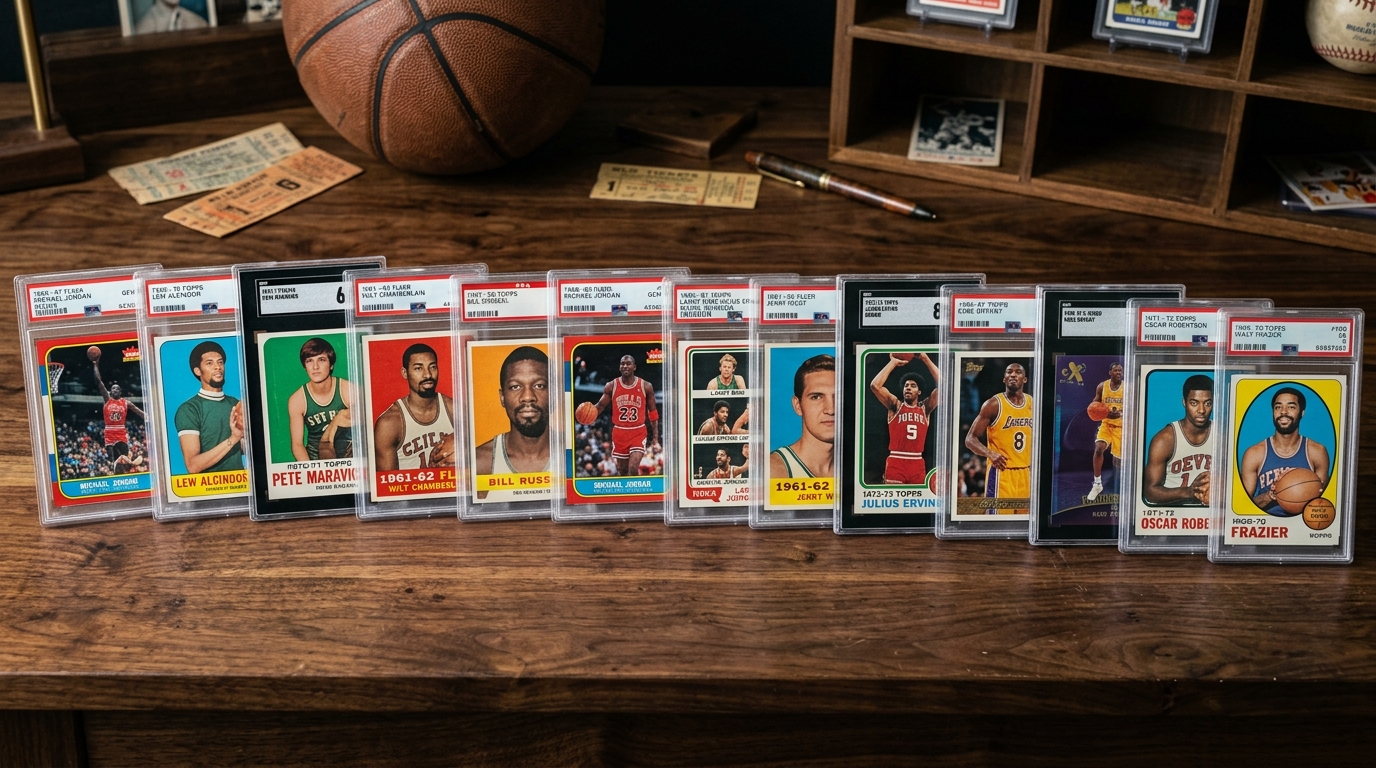
Our ultimate guide to the most valuable michael jordan cards breaks down vintage rookie grails, rare 90s parallel inserts, record-breaking auction prices, and how modern grading impacts market value. Michael Jordan is universally acknowledged not only as an all-time basketball icon, but as the single most important athlete in the history of sports card collecting. His market dominance spans four distinct decades, from his iconic 1986 Fleer rookie card to ultra-exclusive 1990s insert serial numbers and million-dollar modern patch autographs.
Whether you are a seasoned investor analyzing pop reports or a casual collector who just discovered a box of vintage cards in an attic, understanding the valuation metrics of Jordan cards is essential. In this comprehensive guide, we will analyze the highest-value Jordan cards in existence, dissect key condition factors like centering and surface integrity, explore real-world auction records, and explain how to leverage ai card grading to maximize your portfolio returns.
Market Insight: While vintage baseball cards established the hobby’s foundation, Michael Jordan single-handedly transformed sports card collecting into a liquid, global financial asset class. A PSA 10 Gem Mint 1986 Fleer Jordan rookie has appreciated by over 10,000% over the past fifteen years.
The Holy Grail: 1986 Fleer Michael Jordan #57 Rookie Card
The 1986-87 Fleer Basketball set is widely regarded as the most famous basketball card set ever produced, and card #57—Michael Jordan’s flagship rookie—is its crown jewel. Produced during an era when basketball card production was relatively low compared to the junk wax baseball era of the late 80s, the 1986 Fleer Jordan features a vibrant red, white, and blue border surrounding a dramatic photo of Jordan soaring for a slam dunk against the New Jersey Nets.
Because basketball cards were packaged in wax packs with hard sticks of gum and sold in convenience stores, pristine copies are exceedingly rare. The dark colored borders are highly susceptible to corner wear, edge chipping, and print spot defects.
PSA 10 Gem Mint Valuation & Auction History
The price disparity across different grades of the 1986 Fleer #57 card highlights why card condition is paramount when evaluating sports card value. Out of more than 25,000 copies submitted to Professional Sports Authenticator (PSA), fewer than 320 have ever earned the coveted PSA 10 Gem Mint designation.
| Grade | Population (Approx.) | Average Market Price (2025–2026) | Historical Peak Price |
|---|---|---|---|
| PSA 10 (Gem Mint) | ~318 | $600,000 – $750,000 | $840,000+ |
| PSA 9 (Mint) | ~2,950 | $35,000 – $45,000 | $95,000 |
| PSA 8 (NM-MT) | ~8,400 | $6,500 – $8,500 | $18,000 |
| PSA 7 (Near Mint) | ~6,100 | $3,200 – $4,200 | $8,500 |
| PSA 6 (EX-MT) | ~3,500 | $2,000 – $2,600 | $5,000 |
As shown in the data table above, moving just one step up from a PSA 9 (Mint) to a PSA 10 (Gem Mint) multiplies the card’s secondary market value by roughly 15x to 20x. That astronomical multiplier is why knowing how to grade sports cards before submitting them to third-party services like PSA, BGS, or SGC is a critical step for collectors.
Identifying Counterfeits & Off-Center Factory Cuts
Because of its high financial value, the 1986 Fleer #57 is one of the most heavily counterfeited cards in the entire hobby. Fraudulent reproductions range from crude home printer copies to sophisticated counterfeit offset press runs. Key authentication markers include:
- The Fleer Premier Logo: On genuine cards, the yellow arrow inside the “Premier” logo on the front exhibits a distinct crisp dot-matrix pattern under 10x magnification. Fake copies often have solid or blurry yellow ink.
- The Bulls Logo Detail: On the card back, the red Chicago Bulls logo should show crisp black eyes and sharp detail in the basketball lines. Counterfeits frequently display smudged lines around the horns and eyes.
- Border Centering Ratios: Factory cutting machines in 1986 were notorious for misaligned cuts. To achieve a PSA 10 Gem Mint grade, front centering must not exceed 60/40, while back centering must be 75/25 or better.
Top 10 Most Valuable Michael Jordan Cards Ever Sold
While the 1986 Fleer #57 is Jordan’s most iconic rookie card, it is far from his most expensive. The explosion of high-end 1990s parallel inserts and early game-used jersey autographs has produced sales exceeding $1 million to $2.7 million. Here is a breakdown of the top sales recorded in public auctions:
1. 1997 Upper Deck Game Jersey Autograph #GJ13M (/23) – Sold for $2.7 Million
Released in 1997 Upper Deck Series 1, this card revolutionized the sports card industry by introducing the first-ever game-worn jersey swatch paired with an authentic Michael Jordan hand signature. Serial numbered to just 23 copies (matching his jersey number), a BGS 8 / Auto 10 copy smashed records when it fetched $2.7 million at auction. It stands alongside the most expensive baseball card sales as one of the prized holy grails of sports collectibles.
2. 1997 Metal Universe Precious Metal Gems (PMG) Green #23 (/10) – Sold for $915,000
The 1997 Metal Universe Precious Metal Gems set features a distinctive metallic foil finish that peels and chips at the slightest touch. The parallel set consists of 100 total cards: numbers 1–10 were printed in an emerald green foil, while numbers 11–100 were printed in red foil. With only 10 Green PMGs of Jordan ever produced, an BGS Authentic copy realized $915,000. Higher grade copies, if ever brought to market, are estimated to be worth well over $2 million.
3. 1998 Upper Deck MJ All-Star Jersey Autograph #MJ-AS (/23) – Sold for $840,000
Featuring an actual swatch of the jersey Jordan wore during the 1992 NBA All-Star Game in Orlando, this card combines historical nostalgia with extreme scarcity. Signed in blue ink and hand-numbered out of 23, high-grade examples represent the pinnacle of premium most valuable basketball cards.
4. 1986 Fleer Michael Jordan #57 PSA 10 (Gem Mint) – Sold for $840,000
During the peak card market boom in 2021, two separate PSA 10 Gem Mint copies of the 1986 Fleer rookie card sold for $840,000 each in Heritage Auctions and Goldin Auctions sales.
5. 1997 E-X2000 Essential Credentials Now #46 (/9) – Sold for $650,000
The Essential Credentials parallel set from SkyBox/E-X2000 featured translucent plastic card stock with shimmering rainbow foil. The “Essential Credentials Now” parallel was serial numbered based on the player’s card number in the set. Because Jordan was card #46, only 9 copies were created worldwide, making it one of the rarest 90s basketball inserts in existence.
6. 1997 Metal Universe Precious Metal Gems Red #23 (/90) – Sold for $480,000
Though slightly less scarce than the Green variant, the Red PMG Jordan is numbered to 90 copies. Given the extreme fragility of the red foil surface, finding a copy in Mint condition is almost unheard of. A PSA 8 NM-MT copy set an auction record near half a million dollars.
7. 1986 Fleer Sticker #8 PSA 10 (Gem Mint) – Sold for $250,000
Inserted at a rate of one sticker per wax pack in 1986 Fleer boxes, the Jordan sticker card features a photo of MJ driving past defenders. Because the stickers were positioned on the top or bottom of pack stacks, they suffered severe wax staining and miscut borders. Only a tiny fraction exist in PSA 10 condition.
8. 1998 SP Authentic Sign of the Times Gold #MJ (/23) – Sold for $230,000
Upper Deck’s SP Authentic brand is famous among collectors for clean, card-stock autograph designs. The Gold parallel on-card autograph remains one of the premier 90s Jordan signables available on the secondary market.
9. 1996 Topps Chrome Refractor #138 PSA 10 – Sold for $180,000
1996 marked the inaugural release of Topps Chrome Basketball. Featuring metallic chromium technology and rainbow refractors, the Jordan Refractor parallel #138 in PSA 10 Gem Mint condition has grown into a cornerstone investment piece for modern basketball card enthusiasts.
10. 1997 Ultra Stars Gold #1 PSA 10 – Sold for $140,000
Distributed in Fleer/Ultra packs with long odds (1:2,880 packs), the Ultra Stars Gold insert features a shining die-cut design. High-grade copies routinely fetch 6-figure bids due to low population counts in gem mint holders.
1990s Parallel Inserts & Low-Numbered Autographs
To understand the market dynamics of Jordan collecting, one must appreciate the revolutionary shift that occurred in the hobby between 1996 and 1999. Card manufacturers transitioned away from massive print runs of standard paper cards to limited parallel runs, rainbow refractor technology, and serial-numbered insert inserts.
       1980s Vintage Era                        1990s Innovation Era
+-------------------------------+       +-------------------------------+
|  Flagship Fleer Wax Packs     |  -->  |  Serial-Numbered Parallels    |
|  Standard Card Stock          |  -->  |  Chromium & Refractor Tech    |
|  High Base Print Runs         |  -->  |  Game-Worn Jersey Swatches    |
|  Focus on Rookie Cards        |  -->  |  On-Card Autographs & PMGs    |
+-------------------------------+       +-------------------------------+
The Magic of 90s Refractors & Die-Cuts
Before patch autographs dominated card sets, die-cut refractors were the gold standard of rarity. Brands like Topps Chrome, Bowman’s Best, and SkyBox Finest produced stunning inserts that required special manufacturing processes:
- Topps Chrome Refractors: Coated with a light-diffracting metallic film that creates a rainbow sheen when turned under sunlight.
- Flair Legacy Collection: Serial numbered to 100 copies with blue-emerald etched foil borders and thick 35pt card stock.
- SkyBox Z-Force Big Men on Court (BMOC): Features a unique laser-cut design around Jordan’s shooting silhouette, making corner protection nearly impossible.
When evaluating these 90s parallels alongside most valuable rookie cards, condition is the dominant pricing factor. A single edge chip on a black-bordered Skybox Rubies card can reduce a card’s grade from a BGS 9.5 to a BGS 7.0, reducing market value by thousands of dollars.
Factors Driving Value: Grading, Centering, and Surface Inspection
Why do two identical-looking Michael Jordan cards have a $50,000 price difference? The answer lies in the microscopic condition metrics assessed during professional card grading.
The Four Pillars of Card Grading Ratios
When grading cards, professional authenticators evaluate four sub-grades:
- Centering: The proportion of left-to-right and top-to-bottom borders. A PSA 10 requires 60/40 or better front centering. A BGS Pristine 10 demands 50/50 precision.
- Corners: Sharpness of all four corners under 10x magnification. Any paper fiber lifting or white core showing drops the score instantly.
- Edges: Straightness and cleanliness of the card cut. Factory dull-blade cutting creates fuzzy edges or color chipping.
- Surface: Scratching, print lines, foil fading, wax stains, or surface dimples.
AI Pre-Grading and Surface Inspection
Before spending hundreds of dollars on third-party grading submission fees, modern collectors utilize automated vision diagnostics to scan their cards. Using ai card grading tools allows you to:
- Detect Micro-Scratches: AI algorithms highlight surface abrasions invisible to the naked eye under ambient room lighting.
- Calculate Exact Centering Pixels: Compute front and back centering ratios down to 0.1% accuracy.
- Estimate PSA/BGS Grade Probability: Get an accurate prediction of whether your Jordan card will score a 10, 9, or 8 before sending it to a grading house.
By identifying defects early, collectors avoid submitting cards with hidden surface creases or severe off-center cuts, protecting their profit margins when buying or selling most valuable basketball cards.
Investment Strategy & Market Dynamics for Jordan Collectors
Investing in Michael Jordan cards requires a clear strategy based on your budget, risk tolerance, and time horizon.
                   JORDAN CARD INVESTMENT SPECTRUM

  [Low Risk / High Stability]           [High Risk / Exponential Upside]
  ----------------------------------------------------------------------
  * 1986 Fleer #57 PSA 7-9             * 1990s Low-Numbered PMGs
  * 1987-1989 Fleer Base PSA 9/10      * Ultra-Rare Chrome Refractors
  * Early Topps Chrome Base PSA 10     * Hand-Signed Patch Autographs
1. The Blue-Chip Vintage Strategy
For steady capital preservation, focus on graded copies of Jordan’s early base cards from 1986 to 1990. The 1986 Fleer #57, 1987 Fleer #59, 1988 Fleer #21, and 1989 Fleer #21 in PSA 8 or PSA 9 condition offer strong historical liquidity and consistent demand across all market cycles.
2. The 90s Insert & Autograph Growth Strategy
For investors seeking maximum capital appreciation, high-grade 1990s refractors, serial-numbered parallels (/100 or less), and certified Upper Deck autographed cards offer incredible upside. Because print runs were strictly capped, demand outstrips supply as new international collectors enter the basketball market.
3. Verification and Storage Best Practices
To maintain the value of your Jordan cards over time:
- Store raw cards in acid-free penny sleeves inside rigid top loaders or semi-rigid card savers.
- Keep graded slabs in UV-protective sleeve bags to prevent acrylic scratching and light fading.
- Store cards in a climate-controlled room with stable humidity (40–50% RH) to avoid card bowing or foil separation.
- Periodically check the market values using a reliable sports card value tracking service to keep insurance coverage up to date.
Frequently Asked Questions
What is the single most expensive Michael Jordan card ever sold?
The single most expensive Michael Jordan card ever sold is his 1997 Upper Deck Game Jersey Autograph #GJ13M serial numbered 23/23, which sold for $2.7 million at auction. It features an authentic piece of game-worn jersey from the 1992 NBA All-Star Game and Jordan’s certified hand signature.
How can I tell if my 1986 Fleer Michael Jordan rookie card is real or fake?
To verify if a 1986 Fleer #57 Michael Jordan card is authentic, examine the “Fleer Premier” yellow ribbon logo on the front under 10x magnification to confirm a sharp dot pattern. Additionally, inspect the red Chicago Bulls logo on the back for crisp lines around the eyes and horns. Authentic cards also feature correct card-stock thickness and color bleeding characteristics that cheap reprints fail to replicate.
Is it worth grading a 1986 Fleer Michael Jordan card if it has minor corner wear?
Yes! Even in lower grades such as PSA 5 (EX) or PSA 6 (EX-MT), an authentic 1986 Fleer Michael Jordan rookie card commands thousands of dollars on the secondary market. Having the card professionally authenticated and encapsulated in a slab protects it from further damage and provides buyers with guaranteed authenticity.
What makes 1997 Precious Metal Gems (PMG) Jordan cards so valuable?
1997 Metal Universe Precious Metal Gems (PMG) cards are valuable due to extreme rarity and condition difficulty. Only 100 total PMG Jordan cards were produced (10 Green parallels and 90 Red parallels). The delicate metallic foil finish chips very easily, making high-grade copies nearly non-existent and driving collector bids near or above $1 million.
Pre-Grade & Track Values Instantly with CardMint
CardMint is the ultimate all-in-one scanner for sports card and TCG collectors, saving you time and money.
Simply scan the front of your card. Our AI instantly identifies the card details, checks current pricing metrics, and gives you a centering and wear pre-grade report before you submit to PSA/BGS.
