
AI Card Grading & Condition Analysis
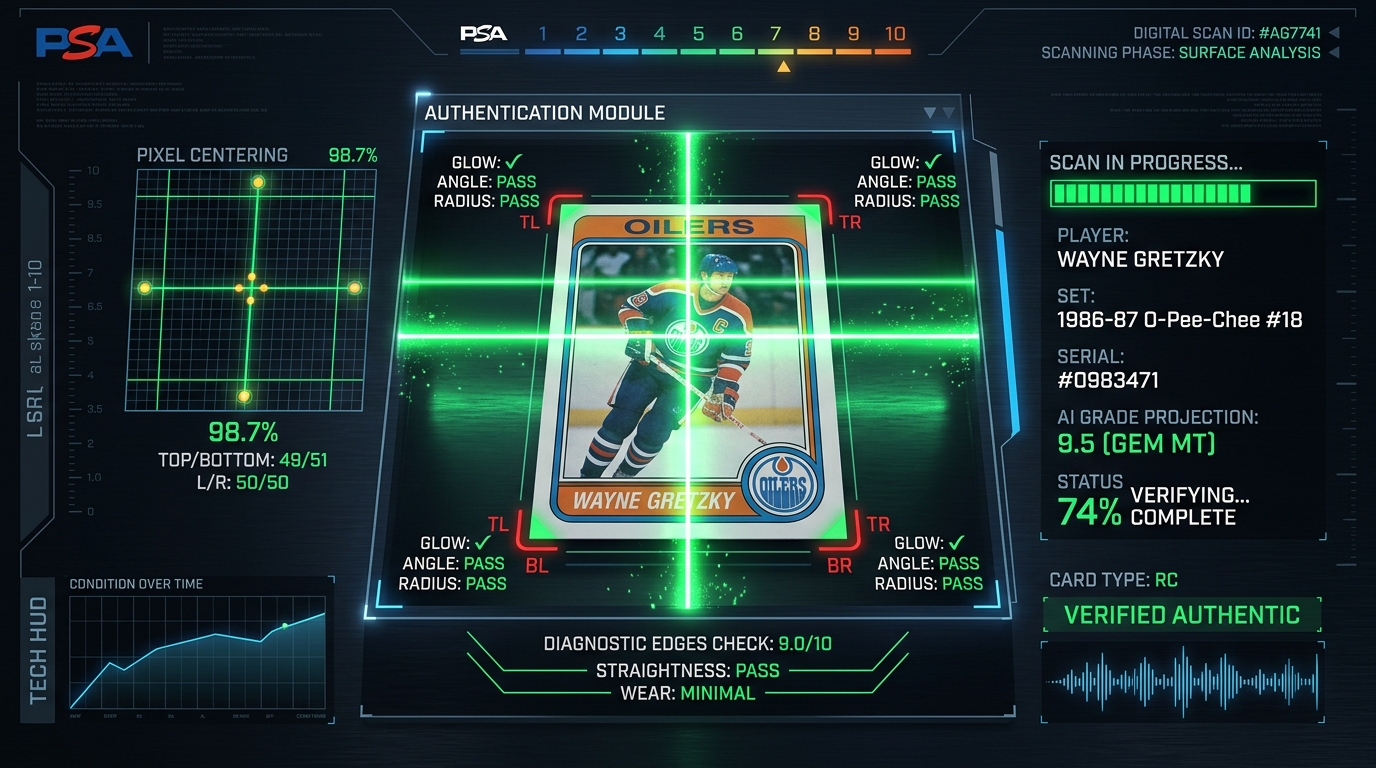
Our comprehensive guide to ai card grading explains how computer vision and machine learning evaluate a trading card’s physical condition and predict the grade a professional service would assign. In the high-stakes world of trading card collecting, condition is everything. A single microscopic scratch or a fraction of a millimeter alignment shift can be the difference between a card worth thousands of dollars and one worth pocket change. Traditionally, collectors had to rely on subjective self-evaluation, magnifying glasses, and hope when preparing cards for third-party grading submissions. With the advent of artificial intelligence, that process has been revolutionized.
Today, AI-powered pre-graders analyze high-resolution scans and photos in seconds. They offer pixel-level diagnostics, calculating centering ratios and scanning for surface anomalies that the human eye would miss. For collectors who submit cards to major agencies like Professional Sports Authenticator (PSA), Beckett Grading Services (BGS), or Sportscard Guaranty Corporation (SGC), AI pre-grading is an essential step that saves hundreds or thousands of dollars in wasted submission fees.
Key Takeaway: AI pre-grading checks the four core pillars of professional grading—Centering, Corners, Edges, and Surface—in milliseconds using pixel-level computer vision, helping you avoid costly rejections.
The Four Pillars of Card Grading
Every professional grading company—PSA, BGS, SGC—evaluates cards against the same four fundamental criteria. Understanding each pillar is essential if you want to determine your card’s worth before committing to a grading submission. Let’s look at what each of these pillars entails, the specific math behind their evaluation, and the exact defects graders look for.
1. Centering
Centering measures how well the card’s printed image is aligned within the card’s physical cardboard borders. When cards are printed, large sheets containing dozens of cards are run through high-speed cutting machines. Slight alignment shifts during printing or cutting can result in uneven borders. A perfectly centered card has equal border widths on the top-to-bottom and left-to-right axes.
Grading companies use exact ratio tolerances to determine grades:
- PSA 10 (Gem Mint): Requires centering no worse than 60/40 on the front and 75/25 on the back.
- BGS 10 (Pristine): Demands 50/50 centering on both the front and the back—essentially flawless alignment.
- BGS 9.5 (Gem Mint): Allows up to 55/45 front and 70/30 back centering.
- SGC 10 (Gem Mint): Requires centering no worse than 55/45 on the front and 60/40 on the back.
On vintage cards, where print quality control was far less precise, off-center borders are the most common reason cards miss a high grade. AI pre-graders solve this by detecting the exact boundaries of the printed artwork and the outer card edge, measuring the pixels on opposing sides, and outputting an exact ratio (e.g., 52/48 front centering). This eliminates the need for plastic centering cards and manual measurement.
2. Corners
Corners are the most fragile part of any trading card. The sharp point of a newly opened card corner can easily degrade due to handling, shipping, or improper storage. Graders inspect all four corners under 10x magnification to identify three primary corner defects:
- Whitening (Corner Wear): Paper cards are constructed from multiple layers of paper board laminated together. When the corner is bumped, these layers separate slightly, exposing the white core underneath the colored ink layer. Even a tiny, microscopic speck of corner whitening can drop a card from a PSA 10 to a PSA 8.
- Rounding (Soft Corners): Repeated handling or storing cards loose in boxes wears the corner down from a sharp point into a soft, rounded shape.
- Fraying: This occurs when the corner fibers peel back or split, creating a fuzzy, loose texture.
For high-value cards, such as the most valuable Pokémon cards, a single touched corner can reduce the card’s market value by thousands of dollars. AI pre-graders look at corners under high-resolution magnification, checking for paper fiber lifting and color contrast variations to spot whitening that isn’t visible to the naked eye.
3. Edges
Edges are the borders running along all four sides of the card. The quality of the edge is heavily dependent on the cutting blades used during manufacturing. If the factory blade was dull, the card will have rough cuts or paper fibers hanging off the edges. Common edge issues include:
- Chipping: Small pieces of the printed surface flake off along the cut line, exposing the white paper core. This is especially common on cards with dark or black borders (e.g., 1st Edition Pokémon cards or certain sports card sets like 2020 Topps Chrome).
- Rough Cuts: A jagged, fuzzy, or uneven edge caused by worn factory blades.
- Indentations: Small dings or dents along the edge from being dropped or pushed into a top loader too aggressively.
Back edges are particularly susceptible to chipping and whitening because collectors often handle cards by their edges. AI models analyze the straightness and color consistency along the edges, identifying uneven contours and pixel-level chips.
4. Surface
The surface of a card is arguably the most complex pillar to evaluate. A card has two surfaces (front and back), both of which are exposed to a variety of environmental hazards. Graders inspect the surface under bright, angled light sources to identify:
- Print Lines: Factory defects where a thin, vertical or horizontal line runs across the holographic foil or print layer. These are highly common on modern Chromium-style cards.
- Scratches: Fine hairline abrasions on the surface, usually caused by cards sliding against one another, dirty card sleeves, or rough handling.
- Creases: Bends in the card stock that disrupt the paper fibers. A crease on either side is an automatic deal-breaker, capping the card’s maximum grade at a PSA 4 or lower.
- Dimples and Indents: Tiny depressions in the card surface caused by dust or debris during the printing process.
- Foil Peeling & Fading: Loss of the shiny holographic finish or fading due to UV light exposure.
Because many surface issues are only visible when the card is tilted at specific angles under direct light, they are the most common source of “disappointment grades” from PSA or BGS. AI surface scanning uses multi-directional light mapping to identify surface anomalies by comparing the card’s micro-texture against a database of flawless specimens.
The Technology Behind AI Card Grading
How does a computer vision algorithm evaluate a physical piece of cardboard with high accuracy? The technology behind AI pre-grading is a complex pipeline combining computer vision, deep neural networks, and image preprocessing.
Image Preprocessing and Alignment
The first challenge for the AI is ensuring the image is perfectly straight and clear. When you upload a photo or scan, the software applies a perspective correction algorithm. It identifies the four outer corners of the card to establish a bounding box, then rotates and skews the image to create a perfectly flat, front-facing digital model.
Computer Vision for Edge and Centering Measurement
To calculate centering, the AI uses traditional computer vision techniques like Canny edge detection or Hough line transforms. The algorithm detects the contrast boundary where the card edge ends and the background begins. Next, it detects the boundaries of the inner printed artwork frame. By measuring the physical distance (in pixels) from the inner frame to the outer edge on the top, bottom, left, and right sides, the AI calculates the centering ratios down to a fraction of a percent.
Convolutional Neural Networks (CNNs) for Defect Detection
For corners, edges, and surface wear, AI models utilize Deep Convolutional Neural Networks (CNNs). These networks are trained on datasets containing hundreds of thousands of high-resolution images of cards that have already been graded by PSA, BGS, and SGC.
- The CNN breaks down the card image into microscopic grid segments.
- It analyzes each segment for features like color variance (whitening), texture disruption (scratches), and geometric deformation (rounding).
- By comparing the feature map of the uploaded card with patterns linked to specific grades in its training data, the AI assigns a score and confidence level for each pillar.
AI Pre-Grading vs. Traditional Human Grading
To understand why pre-grading has become so popular, it is useful to compare AI pre-grading with traditional human-led grading.
| Parameter | AI Pre-Grading | Traditional Human Grading (PSA/BGS) |
|---|---|---|
| Speed | Instant (typically under 10 seconds) | Weeks to months (unless paying massive express fees) |
| Cost | Free or low-cost (a few dollars per scan) | $15 to $150+ per card, plus shipping and insurance |
| Consistency | 100% consistent (same card will yield same result) | Variable (subject to grader fatigue, mood, and subjective bias) |
| Flaw Detection | Highly accurate for centering and corners | Superior for fine surface scratches and foil dimples under physical light |
| Market Value | Provides information; does not add direct value | Multiplies value by encapsulating and authenticating the card |
The Human Factor: Subjectivity and Fatigue
Human grading is inherently subjective. A grader examining cards at 9:00 AM on a Monday may assign slightly different scores than a grader working at 4:30 PM on a Friday. Grader fatigue is a well-known issue in the hobby, and “grades pop” variance can be frustrating. A card sent back for re-grading might return a different score without any changes made to the card itself.
AI pre-grading removes this subjectivity. The algorithm has no fatigue, no bad days, and evaluates every card against the exact same mathematical parameters. However, AI is limited by the quality of the image it receives. If a surface scratch is only visible at a 45-degree angle under a specific bulb, a flat scanner image might miss it. This is why a hybrid approach—using AI as a filter before human grading—is the optimal strategy for collectors.
Practical Guide: Preparing Your Cards for AI Pre-Grading and Submission
Getting the most accurate pre-grade and maximizing your chances of a professional Gem Mint grade requires careful preparation. Follow these steps to prepare your cards:
Step 1: Clean Your Workspace and Tools
Never handle cards on a dirty surface. Use a clean, lint-free mat. Keep the following tools nearby:
- Microfiber Cloth: A high-quality, clean microfiber cloth is essential for gently wiping away fingerprints and dust from the card surface.
- Bulb Air Blower: Use a rubber air blower (similar to those used for camera lenses) to blow away loose dust and particles. Never blow on a card with your mouth, as moisture can damage the surface.
- Soft Brush: A fine-tipped, soft makeup brush can help remove stubborn dust particles without scratching the card.
- Nitrile Gloves: Wearing powder-free nitrile gloves prevents oils from your hands transferring to the card edges or surface.
Step 2: Handle the Card Correctly
Always hold the card by its side edges. Never pinch the corners or apply direct pressure to the front or back surfaces. When picking a card up, gently slide it off the edge of your cleaning mat or table rather than digging your fingernail under the edge.
Step 3: Capture a High-Quality Scan or Photo
The accuracy of an AI pre-grade is directly tied to the image quality.
- For Flatbed Scanners: Set the resolution to a minimum of 600 DPI. Clean the scanner glass with glass cleaner and a microfiber cloth before placing the card down. Use a black sheet of paper behind the card to create a high-contrast boundary for the edge-detection algorithm.
- For Smartphone Cameras: Place the card on a flat surface in a well-lit room. Use diffused, natural light to avoid harsh glare or shadows. Hold the phone directly above the card (parallel to the surface) to prevent perspective distortion. Ensure the card is in sharp focus before snapping the photo.
Step 4: Review and Submit
Once you’ve run your card through the pre-grader, review the report. If the AI detects centering at 55/45 or better, corners with no whitening, clean edges, and a spotless surface, it is a strong candidate for submission.
Maximizing ROI: The Economics of Grading
Grading cards is an investment. To ensure a positive return on investment (ROI), you must analyze the economics before spending money. Let’s look at the factors to consider:
Understanding the Grading Premium
The “grading premium” is the increase in market value that a card gains when it receives a high grade from a respected agency. This premium varies wildly depending on the card’s grade:
- Gem Mint (PSA 10 / BGS 9.5 / SGC 10): Typically commands a massive premium. For highly liquid cards, a PSA 10 can be worth 3x to 10x the value of a raw card.
- Mint (PSA 9): Often sells for slightly above or equal to the raw card value. After subtracting grading and shipping fees, submitting a card that returns a PSA 9 is often a break-even or loss-making endeavor.
- Near-Mint to Mint (PSA 8 or lower): For modern cards, a PSA 8 is usually worth less than a raw card, as buyers assume raw cards have a chance at grading higher. Vintage cards, however, still maintain a premium at lower grades due to rarity.
Calculate Your Expected ROI
Before submitting, use this simple formula to determine if grading is financially viable:
$$\text{Expected ROI} = \text{Graded Market Value} - (\text{Raw Card Value} + \text{Grading Fee} + \text{Shipping/Insurance})$$
Let’s look at two hypothetical scenarios:
Scenario A: Modern Rookie Card (Panini Prizm Football)
- Raw Card Value: $20
- Grading Fee (Bulk): $19
- Shipping/Insurance: $5 (allocated per card in a bulk order)
- Total Investment: $44
- If PSA 10 (90% probability under AI pre-grade): Graded Value = $150. Net Profit = +$106
- If PSA 9 (10% probability): Graded Value = $35. Net Profit = -$9
Here, the AI pre-grade acts as a high-confidence filter. If the pre-grade indicates a high chance of a 10, the submission is highly profitable. If the pre-grade warns of a corner flaw, saving the card from submission prevents a loss.
Scenario B: Lower-Demand Collectible
- Raw Card Value: $5
- Grading Fee: $19
- Shipping/Insurance: $5
- Total Investment: $29
- PSA 10 Graded Value: $35
- Net Profit: +$6 (Assuming it gets a 10)
For low-value cards, even a perfect grade barely covers the submission costs. These cards are better off being sold raw or in lots.
Always make sure to price your sports cards for selling using completed sales data from platforms like eBay to ensure your graded value projections are realistic. For rookie cards, learn what RC means on a sports card to understand why rookies command such high grading premiums compared to veteran cards.
How CardMint’s AI Grader Helps
CardMint’s built-in AI card grading system is designed to make the pre-grading process accessible and simple for every collector:
- Direct Scanning: Scan your card using your phone’s camera directly inside the CardMint app.
- Granular Diagnostics: Receive a detailed pre-grade report breaking down centering ratios, corner sharpness, edge quality, and surface condition.
- Predicted Grades: View predicted grades for PSA, BGS, and SGC, accompanied by a statistical confidence score.
- Collection Tracking: Attach condition reports to every card in your digital collection, helping you track the value of your portfolio over time.
By utilizing CardMint, you can easily spot fake cards and ensure that only your absolute best cards are sent to grading companies, saving you money and maximizing your returns.
Frequently Asked Questions
How accurate is AI card grading compared to PSA or BGS?
Current AI grading tools achieve roughly 85% to 90% accuracy when predicting whether a card will receive a PSA 10 versus a PSA 9. AI is exceptionally good at identifying objective physical flaws like off-center borders or corner whitening. However, extremely subtle surface scratches that require multi-angle physical light inspection can sometimes be missed, making AI best suited as a pre-screening tool rather than a final appraisal.
Can AI grading detect fake or altered cards?
Yes, advanced AI algorithms can detect signs of counterfeiting or alteration by scanning printing patterns (like the “rosette pattern” used in offset lithography), measuring card thickness, checking edge cut angles, and verifying foil reflection. However, to be completely safe, you should always combine AI results with manual physical checks — learn how to spot fake cards in our detailed guide.
Is it worth grading a card that AI predicts as a PSA 8?
For modern cards, it is rarely worth grading if the predicted score is a PSA 8 or lower, as the grading costs will likely exceed the increase in value. For vintage cards (pre-1980), however, even a PSA 8 or lower can command a massive premium. Always consult a sports card value and price guide to compare raw and graded prices.
Does AI grading work for all trading cards?
Yes, the four grading pillars—centering, corners, edges, and surface—are universal across all trading card games (TCGs) and sports cards. The AI handles Pokémon, Magic: The Gathering, Yu-Gi-Oh, baseball, basketball, and football cards equally well. It automatically adjusts centering and border templates based on the specific card database.
How does AI calculate centering on cards without borders?
For cards with full-art or borderless designs (common in modern Pokémon sets), the AI measures the alignment of key graphical elements (like the text box, energy symbols, or character portrait) relative to the outer physical edge of the card. This ensures that even borderless cards can be evaluated with high precision.
Pre-Grade & Track Values Instantly with CardMint
CardMint is the ultimate all-in-one scanner for sports card and TCG collectors, saving you time and money.
Simply scan the front of your card. Our AI instantly identifies the card details, checks current pricing metrics, and gives you a centering and wear pre-grade report before you submit to PSA/BGS.
