
How to Grade Sports Cards: Complete Collector's Guide (2026)
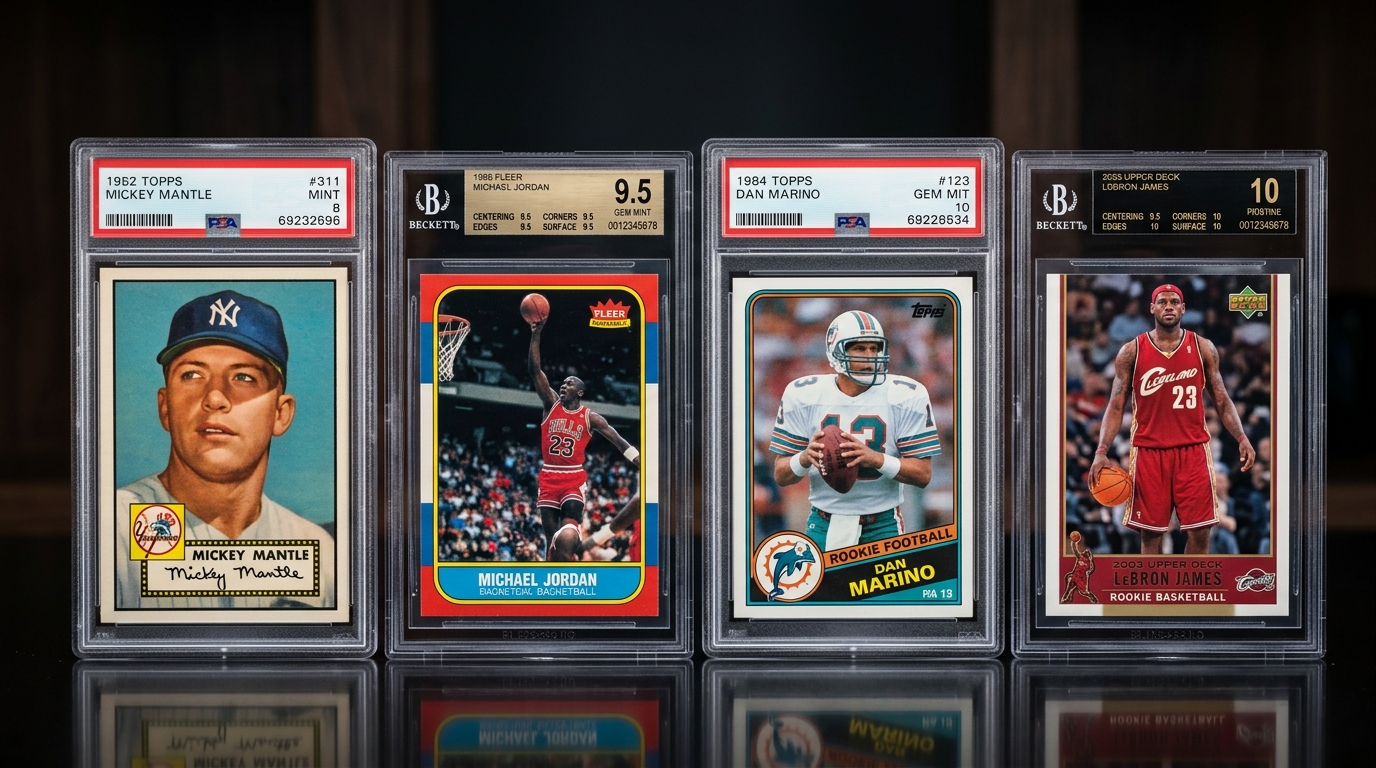
If you want to protect your valuable card collection and maximize resale value, understanding how to grade sports cards is the single most critical skill every collector must master. The sports card market has experienced an unprecedented resurgence over recent years. High-end modern rookie cards and iconic vintage classics now trade hands for thousands—and sometimes millions—of dollars. However, in today’s sophisticated collecting ecosystem, an ungraded or “raw” card will rarely command top dollar on the open market.
Third-party authentication and professional grading have fundamentally shifted how sports cards are bought, sold, and traded. Whether you collect baseball cards from the Golden Era, vintage 1980s basketball cards, or ultra-modern football patch autographs, the physical condition of your card dictates over 90% of its market value. In this comprehensive guide, we will walk you through the entire process of how to grade sports cards, explain the rigorous scoring criteria used by major grading companies, compare top grading services like PSA, BGS, and SGC, and teach you how to pre-grade your cards at home using modern tools.
Why Professional Sports Card Grading Matters
Before diving into condition evaluation, it is essential to understand why professional third-party grading carries such tremendous weight in the sports card industry. A raw card presented in a penny sleeve or top-loader leaves room for subjective interpretation and dispute. Buyers are naturally cautious about unverified seller condition claims, hidden surface scratches, altered borders, or counterfeit cards.
Professional grading solves these issues by providing three key guarantees:
- Third-Party Authentication: Expert graders examine the card under high-powered magnification and ultraviolet light to ensure the card is authentic, untampered, and un-restored (e.g., free from trimming, recoloring, or re-creasing).
- Standardized Condition Rating: Professional graders assign a numerical score on a strict 1-to-10 scale based on physical inspection of centering, corners, edges, and surface quality.
- Protective Encapsulation: Graded cards are permanently sonically sealed inside rigid, tamper-evident acrylic holders (“slabs”). These UV-resistant slabs shield delicate paper and chrome card stock from environmental degradation, moisture, and handling damage.
The financial incentive to grade your cards can be astonishing. A card that looks “clean” to the naked eye might sell for $50 raw. If that same card earns a Gem Mint 10 grade from a top grading service, its value can skyrocket by 10x to 50x. Consider how condition impacts real market valuation across famous sports cards:
| Card / Athlete | Estimated Raw Value | PSA 9 (Mint) | PSA 10 (Gem Mint) |
|---|---|---|---|
| 1986 Fleer Michael Jordan Rookie #57 | $2,500 | $6,000 | $180,000+ |
| 1989 Upper Deck Ken Griffey Jr. Rookie #1 | $75 | $180 | $1,800 |
| 2000 Playoff Contenders Tom Brady Auto Rookie | $4,500 | $12,000 | $85,000 |
| 1952 Topps Mickey Mantle #311 | $35,000 (Low Grade) | $250,000+ | $12,600,000 (SGC 9.5) |
| 2018 Panini Prizm Luka Doncic Silver Rookie | $150 | $320 | $1,400 |
Understanding how physical defects reduce grades allows you to estimate your card’s potential ROI before spending money on grading submission fees. For more insights on market trends and valuations, explore our detailed analysis of sports card value and our breakdown of the most valuable basketball cards.
The Four Key Pillars of Sports Card Condition
When professional grading companies evaluate a card, they break down physical inspection into four distinct categories known in the hobby as the “Four Subgrades.” Mastering how to evaluate these four pillars is the foundation of pre-grading.
1. Centering (Front and Back)
Centering measures how accurately the card’s artwork, photo frame, and borders are aligned relative to the outer edges of the card stock. Poor centering is a manufacturing flaw that occurred during original factory printing and sheet cutting.
- 50/50 Centering: Perfect alignment where top-to-bottom and left-to-right borders are equal on all sides.
- 60/40 Centering: Slight off-center alignment acceptable for most PSA 9 or PSA 10 grades depending on company tolerances.
- Off-Center (OC) Qualifier: When borders exceed 70/30 or 75/25 alignment, the grade drops significantly, and some companies assign an “OC” qualifier designation.
Note that while back centering matters, grading companies are generally slightly more lenient on back centering than front centering.
2. Corners (Sharpness and Wear)
Corners are often the first part of a card to sustain damage from handling, storage, or factory pack insertion. Graders inspect corners under 10x to 20x optical magnification.
- Gem Mint Corners: Razor-sharp point with zero whitening, fraying, or fiber separation.
- Mint Corners: Sharp to the naked eye, but micro-magnification reveals minuscule imperfection or tiny touch of white on one corner.
- Near Mint Corners: Slight rounding, minor dings, or visible white paper showing through the color printing.
3. Edges (Roughness and Chipping)
Edges run along the entire perimeter of the card. Paper stock cards (like 1980s Topps) and foil/chrome stock cards (like Panini Prizm or Bowman Chrome) exhibit different types of edge flaws.
- Foil/Chrome Chipping: Dark-bordered chrome cards frequently show white chips where the foil layer separated from the cardboard substrate during factory die-cutting.
- Paper Flaking and Rough Cut: Factory blades can leave rough, fuzzy edges or small paper flakes attached to the border.
- Dents and Creases: Indentations along the edge caused by binder clips or rubber bands severely hurt the overall grade.
4. Surface (Print Defects, Scratches, and Stains)
Surface inspection is often the trickiest category because many surface flaws are invisible under normal room lighting. Graders use raking light (angling light across the card surface) to expose hidden defects.
- Print Defects: Factory ink spots, print lines, color bleeding, or missing print gloss (“fish eyes”).
- Physical Scratches: Micro-hairline scratches on chrome refractor coating or glossy foil overlays.
- Creases and Wrinkles: Any visible crease through the paper stock will immediately cap a card’s maximum possible grade at a PSA 5 or lower.
- Fingerprints and Wax Stains: Vintage cards packaged with chewing gum frequently have wax residue stains on the back surface. Modern cards can retain natural skin oils if handled without cotton gloves.
Top Sports Card Grading Companies: PSA vs BGS vs SGC
Not all grading companies are created equal. Choosing the right grading service depends on the era of your card, your budget, turn-around time requirements, and intended sales venue. Here is how the big three sports card grading services compare:
Professional Sports Authenticator (PSA)
Founded in 1991, PSA is undisputed as the market leader in sports card grading volume and secondary market liquidity. PSA slabs consistently command the highest resale premiums for modern sports cards and vintage classics.
- Grading Scale: Standard 1 to 10 scale (with PSA 10 Gem Mint being the holy grail for collectors).
- Strengths: Highest market demand, best registry community, strong resale values on eBay and major auction houses.
- Best For: High-value modern rookie cards, vintage baseball, and collectors looking for maximum resale value.
- Learn more about sport-specific grading standards in our guide to baseball card grading.
Beckett Grading Services (BGS)
Beckett has been a trusted brand in sports card collecting for decades. BGS pioneered subgrades (individual scores for Centering, Corners, Edges, and Surface printed right on the metallic label) and inner protective sleeves.
- Grading Scale: 1 to 10 scale with half-grade steps (e.g., 9.5 Gem Mint). BGS offers two legendary top-tier grades: BGS 10 Pristine (gold label) and BGS 10 Black Label (where all four subgrades receive a perfect 10).
- Strengths: Subgrade transparency, premium heavy-duty slabs, highly respected for modern thick patch-autograph cards.
- Best For: High-end modern rookie autographs, thick jersey patch cards, and collectors who demand exact subgrade breakdowns.
Sportscard Guarantor (SGC)
Known affectionately in the hobby as “The Tuxedo” service because of its sleek black foam insert slab design, SGC has grown rapidly due to lightning-fast turnaround times and reasonable pricing.
- Grading Scale: 1 to 10 scale, including SGC 9.5 Mint+ and SGC 10 Gem Mint (plus SGC 10 Pristine).
- Strengths: Fast turnaround times, affordable pricing tier options, excellent customer service, and stunning visual presentation for vintage cards.
- Best For: Vintage sports cards (pre-1980), mid-tier modern cards, and collectors who want quick turnarounds without breaking the bank.
- Check out our overview of valuable football cards to see how vintage and modern football cards perform across grading services.
Here is a summary matrix comparing the three leading grading services:
| Feature | PSA (Professional Sports Authenticator) | BGS (Beckett Grading Services) | SGC (Sportscard Guarantor) |
|---|---|---|---|
| Market Share | ~70-75% | ~10-15% | ~10-15% |
| Top Grade Label | PSA 10 Gem Mint | BGS 10 Black Label / Gold Pristine | SGC 10 Pristine / Gem Mint |
| Subgrades Offered | No (Standard slab) | Yes (Optional / Standard) | No (Standard black slab) |
| Resale Premium | Highest overall | High (Extreme premium for Black Label) | Strong (Especially for vintage) |
| Slab Aesthetic | Red & White banner, clear holder | Metallic gold/silver label, thick slab | Sleek black foam border (“Tuxedo”) |
Step-by-Step Guide on How to Grade Sports Cards at Home
Submitting cards for grading blindly without pre-screening is one of the quickest ways to lose money in the hobby. Grading fees usually range from $15 to $50+ per card. If you send in a card expecting a PSA 10 and it returns as a PSA 7, you may spend more on grading fees than the card is worth. Follow these four actionable steps to pre-grade your sports cards at home.
Step 1: Inspect Under Magnification and Bright Lighting
Set up a clean workspace equipped with a high-lumen LED desk lamp. Do not attempt to pre-grade under warm ambient room lighting.
- Use a 10x Jeweler’s Loupe or a lighted digital USB microscope to examine all four corners.
- Slowly tilt the card under your desk lamp at a 45-degree angle to inspect the surface gloss for micro-scratching or dimples.
- Check the foil stamping and holographic layers on modern Chrome or Prizm cards for print lines.
Step 2: Clean Surface Defects Safely
Many raw cards returned with lower surface scores simply had removable surface dust, factory wax, or skin oil fingerprints.
- Use an ultra-soft, lint-free microfiber cloth (the kind used for eyeglasses or optical lenses).
- Gently wipe the surface in small circular motions from the center toward the edges.
- NEVER use chemical cleaners, water, rubbing alcohol, or abrasive polishing compounds on paper or chrome cards. Attempting to physically alter or alter paper stock can cause your card to be rejected as “Altered”.
Step 3: Measure Centering with a Grading Ruler
You can purchase inexpensive clear acrylic card centering rulers or download digital overlay tools.
- Line up the grid ruler with the outer borders of the card artwork.
- Count the grid units on the left border versus the right border, and top versus bottom.
- Calculate the ratio: For example, if the left border is 2mm and the right border is 3mm, your centering ratio is 40/60.
- Verify whether your centering meets PSA 10 criteria (requires 55/45 to 60/40 on front) or BGS 9.5 criteria (requires 50/50 to 55/45).
Step 4: Use AI Pre-Grading Tools Like CardMint
Manual visual inspection with a ruler and loupe takes time and remains subject to human bias. That is why modern collectors increasingly rely on AI-powered card inspection platforms like CardMint.
By using high-resolution computer vision algorithms trained on thousands of certified graded slabs, CardMint can automatically detect:
- Sub-millimeter border centering ratios across all four edges.
- Corner sharpness and edge fiber fraying.
- Subtle surface scratches, print defects, and indentations.
Pre-grading with AI gives you an unbiased grade prediction (e.g., Estimated Grade: PSA 9.4 - Gem Mint Candidate) before you lock up your capital in grading submissions. Explore how artificial intelligence is transforming sports and TCG valuation in our guide on ai card grading.
How to Safely Package and Submit Your Sports Cards
Once you have selected the cards worthy of grading, improper packaging during transit is the final hazard to avoid. A card damaged in transit due to loose packaging will fail to earn its target grade.
Follow this standard submission packaging protocol:
- Insert into Penny Sleeves: Carefully slide each card into a fresh, clean polypropylene penny sleeve. Scissors-cut a tiny diagonal notch in the top corner of the penny sleeve before insertion to prevent the sharp card corner from catching on the sleeve edge.
- Place inside Card Savers: Slide the sleeved card into a semi-rigid holder (such as Card Saver 1). Grading companies prefer Card Savers over rigid top-loaders because cards can be easily removed by graders without applying pressure to the edges.
- Use Painter’s Tape: Fold a small tab of painter’s tape over the top of the Card Saver opening to prevent the card from sliding out during shipping. Never use regular tape or packing tape directly on holders.
- Sandwich with Sturdy Cardboard: Stack your Card Savers between two thick pieces of corrugated cardboard and secure the bundle with rubber bands.
- Pack in Bubble Wrap and Sturdy Box: Wrap the cardboard bundle in multiple layers of bubble mailer wrap and pack securely inside a sturdy shipping box. Use tracked and insured shipping (USPS Registered Mail, FedEx, or UPS) with full signature confirmation.
Before sending off your cards, it is always a good idea to double-check authenticity indicators. Learn how to protect your investment in our detailed guide on how to spot fake sports cards.
Frequently Asked Questions
How much does it cost to grade a sports card?
Grading costs vary depending on the grading company, declared card value, and turnaround speed. Standard value-tier submissions at PSA typically range from $19 to $25 per card with a turnaround of 30 to 60 days. Bulk submission discounts through authorized group submitters can drop prices to $15–$18 per card. Higher declared value tiers or expedited 5-day turnarounds can cost $75 to $300+ per card.
Is it worth grading a sports card with minor imperfections?
It depends on the card’s base raw value and popularity. For ultra-high-demand vintage cards or iconic rookie cards (such as a 1986 Fleer Michael Jordan or 1952 Mickey Mantle), even lower grades like PSA 5 or PSA 6 carry significant monetary value and authentication benefits. However, for modern base cards printed in massive quantities, earning anything less than a Gem Mint 10 or Mint 9 often results in a net loss after accounting for grading submission fees.
How long does sports card grading take?
Turnaround times depend on the service tier selected. Value and economy tiers typically take between 30 and 75 business days. Express and Super Express tiers at PSA or BGS can turn around cards in 5 to 10 business days. SGC is widely recognized for fast turnarounds, often delivering completed submissions in 5 to 10 business days even on economy tiers.
What is the difference between PSA 9 Mint and PSA 10 Gem Mint?
A PSA 10 Gem Mint card is defined as a virtually flawless card. It exhibits perfect full gloss, razor-sharp corners under magnification, clean edges, and centering that does not exceed approximately 55/45 to 60/40 on the front. A PSA 9 Mint card is a superb condition card that exhibits one minor flaw—such as slightly off-center borders (65/35), a minute touch of white on one corner, or a minor microscopic surface printing speck. On high-end cards, the price gap between PSA 9 and PSA 10 can be exponential.
How can I pre-grade sports cards before sending them to PSA or BGS?
To pre-grade sports cards effectively at home, examine the card under bright LED light using a 10x jeweler’s loupe, measure border ratios with a transparent centering ruler, wipe surface dust gently with a clean microfiber cloth, and scan the card using an AI pre-grading platform like CardMint. Pre-grading eliminates guesswork and ensures you only submit cards with a high probability of earning profitable grades.
Pre-Grade & Track Values Instantly with CardMint
CardMint is the ultimate all-in-one scanner for sports card and TCG collectors, saving you time and money.
Simply scan the front of your card. Our AI instantly identifies the card details, checks current pricing metrics, and gives you a centering and wear pre-grade report before you submit to PSA/BGS.
