
Best Sports Cards to Invest In: Top Picks & ROI Strategy (2026)
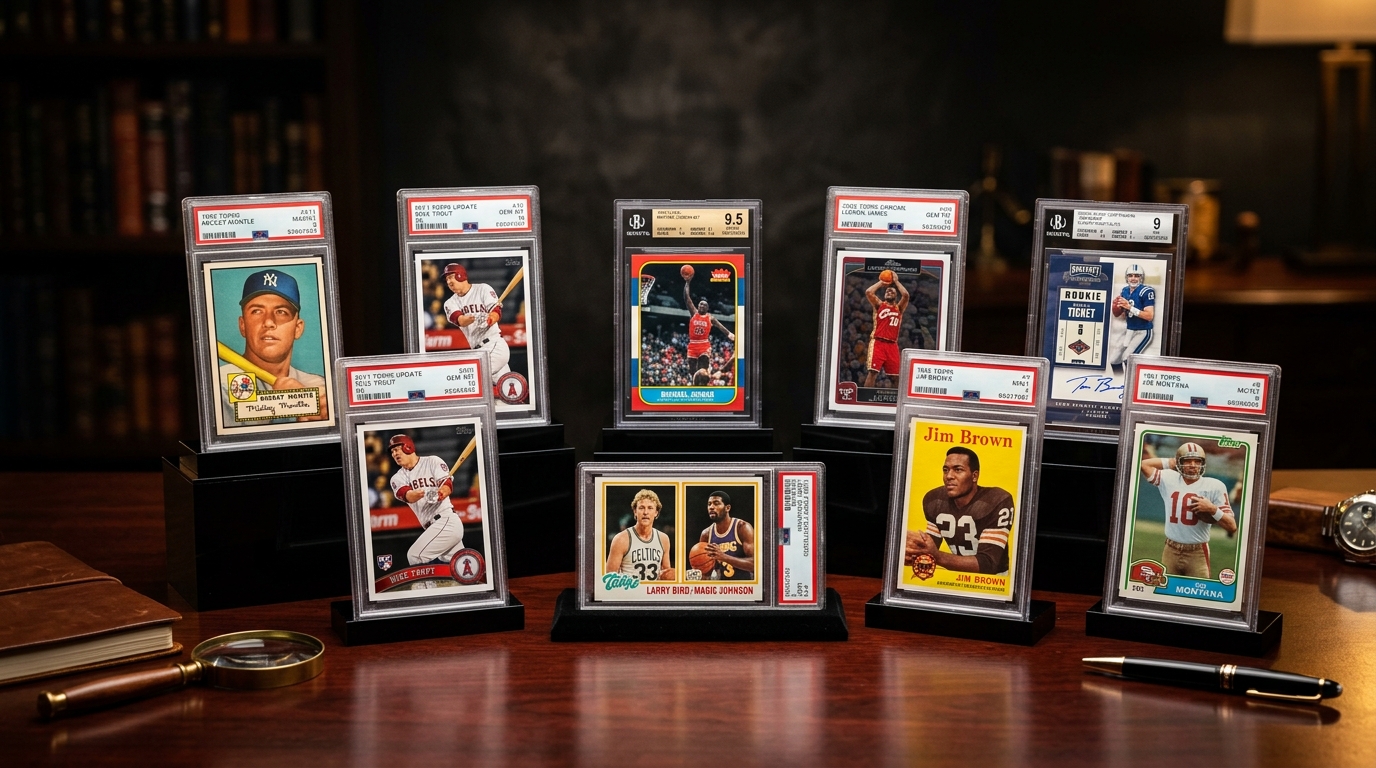
If you are looking to build a high-performing sports memorabilia portfolio in 2026, identifying the best sports cards to invest in is essential for maximizing long-term financial growth and avoiding costly market pitfalls. The sports card market has evolved from a nostalgic hobby into a multi-billion-dollar alternative asset class. Modern sports cards are actively tracked, traded, and auctioned with the same quantitative precision as blue-chip equities, real estate, and fine art.
However, navigating the sports card market requires a disciplined framework. Not all sports cards appreciate in value, and speculative buying without underlying fundamentals often leads to financial losses. Whether your focus is vintage baseball legends, modern basketball phenoms, or elite football quarterbacks, success depends on understanding population counts, grading tier dynamics, and long-term liquidity. In this definitive guide, we analyze the top vintage and modern sports cards to invest in, break down portfolio management strategies, and explain how to evaluate risk versus reward across different sports categories.
Fundamentals of Sports Card Investing
Before allocating capital into individual cards, investors must understand the core economic drivers that govern card valuations. Unlike traditional equities, sports cards do not generate dividend income; their value is determined entirely by supply, demand, player performance, historical significance, and physical condition.
Scarcity, Population Reports, and Provenance
Scarcity is the primary catalyst for long-term appreciation in the sports card market. When evaluating a card’s investment potential, seasoned investors inspect third-party population reports (such as PSA, BGS, and SGC census data). A population report details the exact number of copies graded at each numeric tier.
- Low-Population Slabs: A card may have millions of total raw copies produced, but if only 50 copies exist in Gem Mint 10 condition due to poor quality control, that PSA 10 slab functions as an ultra-rare asset.
- Serial-Numbered Parallels: Modern sports card releases feature limited-edition parallels numbered to /99, /25, /10, or 1-of-1 “Superfractors.” These guaranteed low-print runs create artificial scarcity that sustains investor demand regardless of base card print runs.
- Historical Provenance: Provenance—the documented ownership history of an iconic piece—adds substantial premiums to high-end vintage items.
Third-Party Grading ROI & Slab Premium
The physical condition of a sports card dramatically impacts its market liquidity and resale value. Raw (ungraded) sports cards carry inherent risk because minor surface scratches, micro-creases, or soft corners can be overlooked by the naked eye. Third-party authentication and professional grading remove subjectivity, assigning a standardized score from 1 to 10.
| Card Condition Grade | Market Premium Factor | Investment Suitability |
|---|---|---|
| Raw (Ungraded) | Baseline Fair Market Value | Speculative / Pre-grading candidate |
| PSA 8 (Near Mint-Mint) | 1.5x - 2.5x Raw Value | Vintage blue-chips only |
| PSA 9 (Mint) | 3x - 6x Raw Value | Stable growth / High liquidity |
| PSA 10 (Gem Mint) | 10x - 50x+ Raw Value | Premium investment target |
Understanding how grading multiplies asset value is essential for calculated investing. To learn more about evaluating card condition before submitting cards for authentication, review our guide on how to grade sports cards and explore specialized baseball card grading standards.
Liquidity and Market Capitalization
An asset is only as valuable as the price a willing buyer will pay in a timely transaction. High liquidity allows investors to exit positions quickly during market shifts without accepting heavy discounts. Blue-chip vintage cards (e.g., Mickey Mantle, Michael Jordan, Wayne Gretzky) and tier-one hall-of-fame rookie cards enjoy massive daily trading volumes across major auction platforms. Conversely, niche regional issues or unproven prospects often suffer from low liquidity, locking up capital. For a comprehensive overview of liquidity metrics across sports categories, refer to our detailed breakdown of sports card value.
Top Vintage Sports Cards to Invest In (Blue-Chip Anchors)
Vintage sports cards (typically defined as cards produced prior to 1980) serve as the foundation of any conservative sports card portfolio. These classic items possess fixed, unalterable supply curves, proven multi-decade historical appreciation, and timeless cultural appeal.
1952 Topps Mickey Mantle #311 (Baseball)
The 1952 Topps Mickey Mantle #311 is widely recognized as the single most iconic sports card in human history. While not Mantle’s true rookie card (his true rookie is the 1951 Bowman #253), the 1952 Topps release represents Topps’ inaugural annual set and features striking hand-painted artwork, bold borders, and legendary scarcity in high grade due to Topps dumping unsold stock into the Atlantic Ocean in 1960.
- Investment Profile: Ultra-blue-chip capital preservation asset.
- Key Target Grades: PSA 1 to PSA 4 for accessible entry points; PSA 6+ for institutional-grade portfolios.
- Growth Driver: Irreplaceable historical significance and global collector awareness.
1986 Fleer Michael Jordan #57 (Basketball)
Michael Jordan’s 1986 Fleer #57 is the undisputed king of modern basketball collecting. As the quintessential rookie card of the greatest basketball player of all time, the 1986 Fleer Jordan features vibrant red, white, and blue borders that are notoriously susceptible to chipping, making high-grade copies exceptionally scarce.
- Investment Profile: High-liquidity macro growth asset.
- Key Target Grades: PSA 8 or PSA 9 for balanced growth; PSA 10 for pinnacle collectors.
- Growth Driver: Global NBA brand reach and universal crossover investor demand. Explore more top-tier hoops investments in our guide to the most valuable basketball cards.
1958 Topps Jim Brown #62 (Football)
Jim Brown is widely regarded as the most dominant football player to ever walk onto a gridiron. His 1958 Topps rookie card #62 features a bright yellow background and dark borders that highlight print flaws and surface wear. Finding well-centered copies with clean corners is notoriously difficult.
- Investment Profile: Undervalued vintage football cornerstone.
- Key Target Grades: PSA 6 to PSA 8.
- Growth Driver: Historical stature combined with strict population constraints in NM-MT condition. For additional gridiron opportunities, check out our report on valuable football cards.
Modern Era Rookie Cards & High-Upside Growth Assets
While vintage cards offer stability, modern sports cards (produced from 2000 to present) provide explosive capital appreciation potential driven by player performance, MVP awards, championship titles, and low-numbered parallel chasing. Modern investors focus heavily on rookie card designations. To understand how rookie badges are designated across card sets, review our guide on what does RC mean.
2000 Playoff Contenders Tom Brady Auto Rookie #144
Tom Brady’s 7 Super Bowl championships firmly establish him as the football GOAT. His 2000 Playoff Contenders autographed rookie card is the Holy Grail of modern football card collecting. Featuring an authentic rookie ticket design and on-card signature, high-grade copies command six-figure and seven-figure sums at major auction houses.
+-----------------------------------------------------------------------+
|                 MODERN BLUE-CHIP INVESTMENT TIER                      |
+-----------------------------------------------------------------------+
|  Player / Card                           | Primary Driver             |
+------------------------------------------+----------------------------+
|  2000 Playoff Contenders Tom Brady Auto  | 7x Super Bowl GOAT Status  |
|  2003 Topps Chrome LeBron James #111     | All-Time NBA Scoring King  |
|  2011 Topps Update Mike Trout #US175     | 3x MLB MVP / Modern Icon   |
|  2018 Panini Prizm Luka Doncic Silver    | Global NBA Megastar        |
+-----------------------------------------------------------------------+
2003 Topps Chrome LeBron James Rookie #111 (Refractor)
LeBron James entered the NBA in 2003 with unprecedented expectations and surpassed every single one. The 2003 Topps Chrome rookie card #111—specifically the metallic Refractor parallel numbered out of 500—is the flagship modern basketball investment. Its silver chrome finish and pristine optical clarity make it a mandatory holding for serious sports memorabilia funds.
2011 Topps Update Mike Trout #US175
Mike Trout dominated Major League Baseball throughout the 2010s, earning 3 MVP awards and 9 Silver Slugger honors. The 2011 Topps Update #US175 represents the gold standard of 21st-century baseball rookie cards. With a massive population in PSA 10, it serves as an ultra-liquid macro indicator for the broader sports card market.
Critical Factors When Choosing Sports Cards to Buy
Building a profitable portfolio requires rigorous pre-purchase due diligence. Avoid making emotional purchases; instead, apply strict analytical criteria before committing funds to any card.
Centering, Surface, and Corner Inspection
When evaluating raw cards or pre-grading submissions, inspect four distinct physical components:
- Centering: Measure top-to-bottom and left-to-right border ratios. PSA allows 60/40 centering for a Gem Mint 10 grade, but 50/50 visual balance commands premium pricing.
- Corners: Examine corner tips under 10x magnification. Look for sharpness, color retention, and freedom from fraying or layering.
- Edges: Inspect edge borders for chipping, silvering (common on chrome stock), and micro-dents caused by factory blades.
- Surface: Scan card fronts and backs under directional LED light to spot subtle print lines, wax stains, fingernail indents, or refractor dimples.
To protect your investments from counterfeiters, altered cards, or doctored surfaces, read our technical walkthrough on how to spot fake sports cards.
Liquidity Channels: Auctions vs Fixed-Price Marketplaces
Understanding where and how to buy sports cards dictates your acquisition cost and profit margins:
- Premier Auction Houses (Goldin, Heritage, PWCC): Ideal for acquiring six-figure blue chips and rare 1-of-1 items. Auction dynamics can yield buying opportunities during off-season lulls.
- Fixed-Price Platforms (eBay, Buy-It-Now): Excellent for sourcing graded PSA/BGS slabs. Utilize price tracking software and historical sales databases (e.g., CardMint valuation tools) to negotiate below-market deals.
- Card Shows and Conventions: Perfect for cash transactions, trading up, and conducting in-person inspections of high-grade raw inventory.
Portfolio Allocation & Risk Management
Professional sports card investors employ a structured asset allocation model to balance stability with growth upside:
- 70% Core Vintage Slabs: Allocate the vast majority of capital to hall-of-fame vintage legends (Mantle, Jordan, Gretzky, Jim Brown, Babe Ruth). These assets exhibit low volatility and consistent long-term appreciation.
- 20% Established Modern Superstars: Invest in proven active or recently retired modern icons (LeBron James, Tom Brady, Steph Curry, Mike Trout, Shohei Ohtani).
- 10% High-Upside Prospect Speculation: Allocate a minor fraction of capital to young rookie prospects. While high-risk, hitting on a breakout superstar can yield 5x to 10x returns in a single season.
Frequently Asked Questions
What are the best sports cards to invest in for beginners?
For beginners entering the sports card market, the best cards to invest in are PSA 9 or PSA 10 graded rookie cards of established, hall-of-fame caliber athletes such as Michael Jordan (1986 Fleer), Ken Griffey Jr. (1989 Upper Deck), or LeBron James (2003 Topps Chrome). Sticking to high-grade slabs of iconic legends provides strong market liquidity, minimal downside risk, and transparent historical pricing data.
Are vintage cards safer investments than modern rookie cards?
Yes, vintage sports cards (produced before 1980) are generally considered safer investments than modern rookie cards. Vintage cards feature a strictly fixed, unalterable supply, decades of documented price history, and immune defense against modern print runs or over-saturation. Modern cards offer higher short-term growth potential but carry higher volatility tied to player injuries, slump streaks, and production volume.
How does PSA 10 grading impact sports card investment value?
A PSA 10 (Gem Mint) grade drastically increases a card’s investment value, often commanding a 10x to 50x price premium over an ungraded raw copy or a lower numeric grade. Third-party authentication eliminates condition ambiguity, protects the card inside a tamper-evident slab, and satisfies investor demand for top-tier population scarcity.
What is the 70/20/10 sports card investment strategy?
The 70/20/10 sports card investment strategy is a risk-managed portfolio allocation framework: allocate 70% of your total capital into blue-chip vintage Hall of Famers for long-term stability, 20% into established modern superstars with proven achievements, and 10% into speculative high-upside rookie prospects for short-term upside.
How can I verify the authenticity of an expensive sports card?
To verify authenticity, purchase cards encapsulated in certified third-party grading slabs from reputable companies like PSA, BGS, or SGC. Always check the slab’s certification number on the official grader’s online database, verify the security hologram and UV watermarks, and scan for signs of slab tampering, cracking, or fake labels.
Pre-Grade & Track Values Instantly with CardMint
CardMint is the ultimate all-in-one scanner for sports card and TCG collectors, saving you time and money.
Simply scan the front of your card. Our AI instantly identifies the card details, checks current pricing metrics, and gives you a centering and wear pre-grade report before you submit to PSA/BGS.
