
Most Valuable Charizard Cards: Ultimate Collector & Price Guide
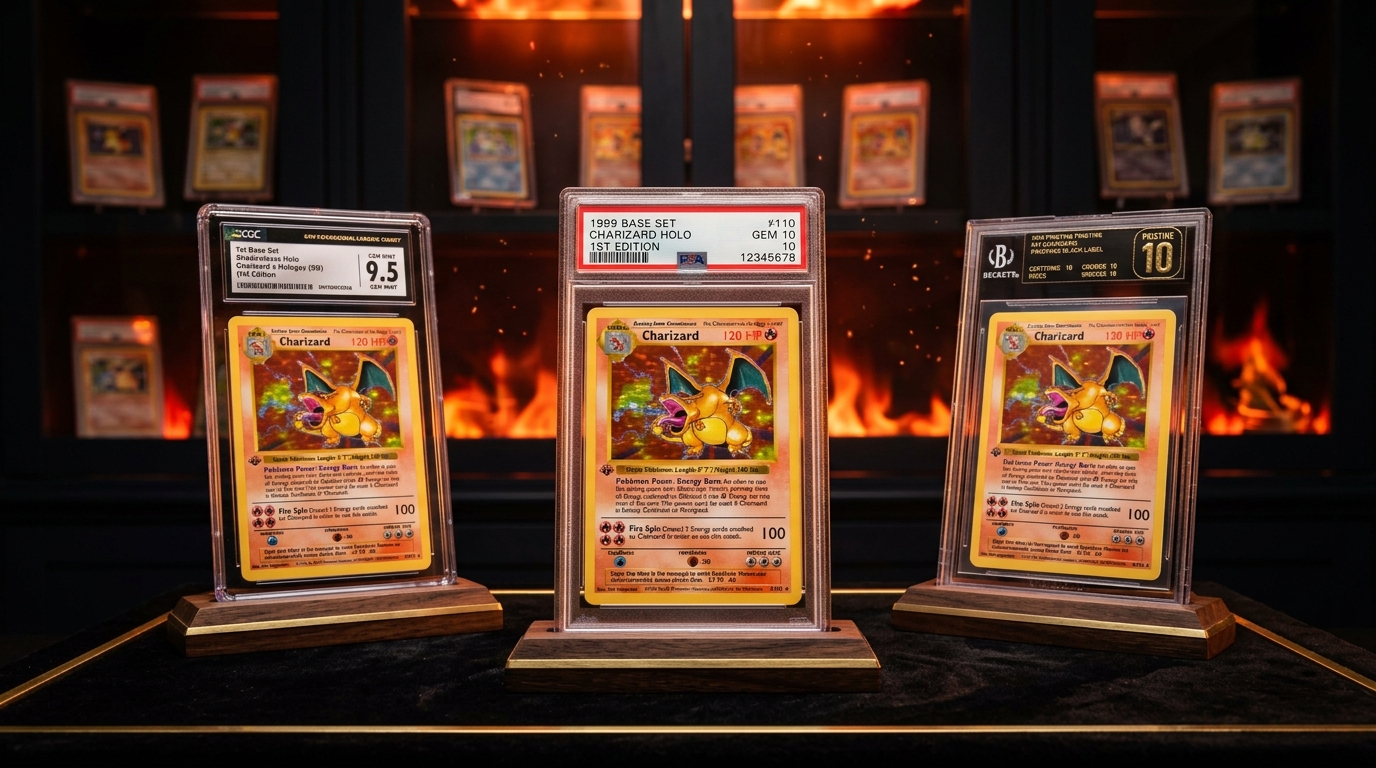
The market for the most valuable charizard cards represents the absolute pinnacle of Pokémon TCG collecting, where iconic vintage holos and ultra-rare modern grails regularly command six-figure sums at public auction. Ever since Wizards of the Coast released the original English Base Set in 1999, the fire-breathing dragon Charizard has stood as the undisputed mascot of trading card investment and pop culture nostalgia.
Whether you are a seasoned investor searching for gem-mint vintage trophies or a passionate collector evaluating childhood binder pulls, understanding the historical significance, scarcity metrics, and valuation drivers behind these iconic cards is crucial. In this ultimate guide, we analyze the top vintage and modern Charizard grails, detail step-by-step authentication methods, and explain how to leverage modern appraisal tools to maximize your portfolio value alongside our broader guides on most valuable Pokémon cards and professional Pokémon card grading.
Market Highlight: A pristine PSA 10 1999 Base Set 1st Edition Shadowless Holo Charizard #4 set an all-time record when it sold for over $420,000, solidifying Charizard as the blue-chip asset of the entire Pokémon Trading Card Game ecosystem.
The Legacy of Charizard in the Pokémon TCG Ecosystem
To understand why Charizard cards outpace nearly every other card in the hobby, one must analyze the unique alignment of nostalgia, gaming power, and deliberate print-run economics that began in the late 1990s.
Why Charizard Remains the Supreme Grail Card
When the Pokémon Trading Card Game launched in North America in 1999, Charizard #4 was instantly established as the flagship card of the Base Set. Featuring legendary artwork by Ken Sugimori, the card boasted a staggering 120 HP and the devastating “Fire Spin” attack that dealt 100 damage—the highest single-attack output in the entire game at the time. Schoolyard playgrounds quickly designated Charizard as the ultimate status symbol.
That childhood emotional connection carried forward into adulthood. As the generation that grew up playing Pokémon entered their peak earning years, disposable income flowed directly into acquiring pristine condition vintage Charizard cards. This sustained cultural demand has transformed Charizard from a playground favorite into a recognized alternative financial asset class comparable to vintage Mickey Mantle baseball cards or Michael Jordan rookie cards.
Understanding the Factors That Drive Charizard Card Values
Evaluating the market value of Charizard cards requires analyzing several interconnected variables:
- Print Edition & Variant: 1st Edition cards featuring the iconic 1st Edition stamp command extreme premiums over Unlimited print runs.
- Shadowless Status: Early English print runs lacked the drop shadow behind the art frame, making Shadowless cards significantly rarer than standard Unlimited cards.
- Centering & Surface Quality: Vintage holofoil paper stock was prone to factory scratches, print lines, and silvering along edges.
- Third-Party Grading Slabs: Submitting raw cards to professional grading authorities like PSA, BGS, or CGC dramatically multiplies liquidity and market value.
- Pop Report Scarcity: Population reports published by grading companies reveal exactly how many gem-mint copies exist worldwide.
Top Vintage Most Valuable Charizard Cards
Vintage Charizard cards printed between 1996 and 2007 represent the holy grail era of Pokémon collecting. Below are the undisputed top-tier vintage grails ranked by historical market value and collector desirability.
1. 1999 Base Set 1st Edition Shadowless Holo #4
- Estimated Gem Mint (PSA 10) Value: $250,000 – $420,000+
- Primary Features: 1st Edition edition stamp, thick font, shadowless border, 1999 Wizards of the Coast copyright.
The 1999 Base Set 1st Edition Holo Charizard #4 is the undisputed king of trading card collecting. Printed during the first English production run, this card combines historical significance with extreme condition scarcity. Out of tens of thousands of copies produced, fewer than 125 copies have ever achieved a PSA 10 Gem Mint grade due to factory centering issues, heavy holofoil scratching, and edge wear from wax pack packaging.
2. 1995/1996 Japanese Topsun Holofoil Charizard (No Number)
- Estimated Gem Mint (PSA 10) Value: $50,000 – $100,000+
- Primary Features: Blue/Green back, prism holofoil pattern, unnumbered error print.
Considered by many historians to be the very first officially licensed Pokémon card featuring Charizard, the Topsun Japanese series was distributed via vending machines in Japan. The rare holofoil variant featuring no card number on the top corner represents the absolute earliest printed representation of Charizard in cardboard history.
3. 1998 Pokémon Japanese Trade Please Promo / Illustrator Era Charizard
- Estimated Gem Mint (PSA 10) Value: $15,000 – $35,000
- Primary Features: Unique back design, Japanese trade-in campaign stamp, holofoil background.
Issued as part of a special Japanese mail-in trade campaign where fans mailed in song CD binder tokens in exchange for exclusive holo promos, the Trade Please Charizard features gorgeous unique artwork by Mitsuhiro Arita. High-grade copies are exceedingly difficult to acquire due to original mailer packaging damage.
4. 2002 Neo Destiny Shining Charizard #107
- Estimated Gem Mint (PSA 10) Value: $10,000 – $25,000
- Primary Features: Triple-star rarity symbol, metallic foil character art, secret rare designation.
Introduced during the Neo Destiny expansion, Shining Charizard made history as the first Secret Rare card where Charizard itself was rendered in shiny metallic foil while the background remained non-holographic. Because Neo Destiny had a relatively short print run at the tail end of the Wizards of the Coast era, high-grade copies of this card are coveted worldwide.
5. 2003 EX Dragon Frontiers Gold Star Charizard #100
- Estimated Gem Mint (PSA 10) Value: $15,000 – $30,000+
- Primary Features: Gold Star symbol next to card name, shiny black Charizard artwork by Masakazu Fukuda, EX series frame.
Depicting Charizard’s alternative shiny black palette shooting blue flames into the sky, Gold Star Charizard #100 is widely considered the most visually striking Pokémon card ever created. With pull rates estimated at 1 in every 2 hobby booster boxes (72 packs) during the EX era, pristine unplayed copies command staggering auction prices today.
Modern Charizard Grails: High-Value Hits from Recent Sets
While vintage cards hold historical dominance, modern Pokémon TCG expansions have introduced high-value chase cards that captivate modern collectors and investors alike.
1. 2016 Pokémon XY Evolutions Staff Prerelease Charizard #11
- Estimated Gem Mint (PSA 10) Value: $8,000 – $18,000
- Primary Features: Gold “STAFF” stamp on bottom left of artwork, Base Set artwork remake.
Distributed exclusively to tournament staff members at sanctioned XY Evolutions prerelease events in 2016, this card paid homage to the original 1999 Base Set artwork. Due to extremely low distribution numbers, acquiring a staff-stamped version in flawless condition is a massive accomplishment.
2. 2020 Champions Path Rainbow Rare Charizard VMAX #074
- Estimated Gem Mint (PSA 10) Value: $350 – $800
- Primary Features: Secret Rainbow Hyper Rare texture, full-art VMAX mechanics, 330 HP card stats.
When Pokémon released the specialty holiday set Champions Path in 2020, store shelves cleared instantly as collectors searched for the elusive Rainbow Rare Charizard VMAX. The combination of textured rainbow foil and massive playability turned this card into an instant modern classic.
3. 2021 Paldean Fates / Shining Fates Shiny Charizard VMAX
- Estimated Gem Mint (PSA 10) Value: $250 – $600
- Primary Features: Shiny vault subset, textured full-art black Charizard artwork.
Re-imagining the VMAX gigantamax form in Charizard’s iconic dark shiny color scheme, the Shiny Charizard VMAX from Shining Fates and subsequent Japanese high-class sets remains one of the most pulled and submitted cards to modern grading companies worldwide.
Comparative Value & Rarity Benchmark Table
To help collectors compare historical price trajectories and rarity tiers, the following table summarizes key metrics for the most valuable Charizard cards:
| Card Release | Rarity Tier | Key Identification Marker | Approx. Raw Value | PSA 10 Gem Mint Value |
|---|---|---|---|---|
| 1999 1st Edition Base Set #4 | Ultra-Grail | 1st Edition Stamp + No Shadow | $5,000 - $15,000 | $250,000 - $420,000 |
| 1999 Shadowless Base Set #4 | Vintage Grail | No Drop Shadow behind Art | $1,200 - $3,000 | $35,000 - $60,000 |
| 1999 Unlimited Base Set #4 | High Demand | Drop Shadow + Standard Font | $250 - $600 | $8,000 - $14,000 |
| 2002 Neo Destiny Shining #107 | Secret Rare | Foil Charizard Art Body | $600 - $1,500 | $10,000 - $25,000 |
| 2003 EX Dragon Frontiers #100 | Gold Star | Gold Star Icon + Black Charizard | $1,000 - $2,500 | $15,000 - $30,000 |
| 2020 Champions Path VMAX #074 | Modern Chase | Rainbow Secret Rare Texture | $100 - $200 | $350 - $800 |
How to Authenticate, Value, and Protect Your Charizard Cards
Given the extraordinary value of top-tier Charizards, counterfeit cards and altered condition items frequently circulate in online marketplaces. Protecting your investment requires careful authentication and disciplined physical storage.
Key Authentication Markers for Vintage Base Set Charizards
Before purchasing or selling raw Charizard cards online, inspect these critical details:
- The Light Test: Authentic Pokémon cards are constructed using a distinct black layer sandwiched between high-grade paper stock. Holding a strong flashlight behind a counterfeit card often causes light to shine directly through, whereas authentic cards block light transmission.
- Font and Typography: Counterfeit cards frequently use incorrect font weights on the card name, attack descriptions, or HP values. Check the font spacing against verified high-resolution scans.
- 1st Edition Stamp Alignment: On authentic 1st Edition Base Set cards, the “1” in the edition stamp is crisp, solid black, and perfectly aligned above the bottom left border.
- Holographic Foil Pattern: Authentic Wizards of the Coast holofoil features starburst reflections that change dynamically under light. Flat, static printed foil patterns are an instant indicator of a fake card.
Evaluating Condition and Third-Party Grading Returns
Submitting raw cards for professional appraisal can yield dramatic value increases. Before sending cards to grading services, review our comprehensive guides on how to sell Pokémon cards and utilizing a digital Pokémon price checker tool.
When inspecting raw cards under magnification, evaluate the following four sub-grades:
- Centering: Ensure the top-to-bottom and left-to-right borders measure within 60/40 ratio for PSA 10 eligibility.
- Corners: Examine the four card corners under a 10x loupe for microscopic whitening or dings.
- Edges: Check for silvering along the foil edges where the factory paper cutter sliced through the card stock.
- Surface: Scan the front holofoil window with an ultraviolet or LED penlight to identify subtle scratches, fingernail dents, or print lines.
For collectors who want rapid digital pre-grading assessments before committing to expensive submission fees, exploring modern technology solutions like AI card grading provides instant structural feedback on surface defects and centering ratios. Furthermore, whether managing Pokémon grails or examining broader market trends across sports card value, keeping up with real-time sales data ensures you buy and sell at optimal market windows.
Frequently Asked Questions
What is the single most valuable Charizard card ever sold?
The single most valuable Charizard card ever sold is the 1999 Base Set 1st Edition Shadowless Holo #4 graded PSA 10 Gem Mint, which fetched $420,000 at an auction in March 2022. Other high-end sales include pristine copies purchased by high-profile collectors and influencers for over $300,000.
How can I tell if my Base Set Charizard is 1st Edition or Shadowless?
To determine if your Base Set Charizard is 1st Edition or Shadowless, look at two specific areas on the card front. A 1st Edition card features a black circular “Edition 1” stamp on the left side directly below the art box, and lacks a drop shadow to the right of the art box. A Shadowless card lacks the drop shadow but does NOT have the 1st Edition stamp. Standard Unlimited cards have both a drop shadow and no 1st Edition stamp.
Should I grade my raw Charizard card with PSA, BGS, or CGC?
Deciding whether to grade your raw Charizard card with PSA, BGS, or CGC depends on your primary objective. For maximum market liquidity and resale value, PSA remains the industry standard for Pokémon cards. If your raw card has flawless centering and zero surface defects, submitting to Beckett (BGS) in pursuit of a Black Label 10 can yield a higher premium than a standard PSA 10. CGC is also highly respected, particularly for error cards and vintage Japanese promos.
Are modern Charizard cards a good long-term financial investment?
Modern Charizard cards can be good long-term collectibles, but their growth trajectories differ from vintage 1990s originals. Modern sets have significantly higher print runs, and a higher percentage of collectors store cards in protective sleeves immediately upon opening packs. Consequently, population counts in PSA 10 grades for modern cards are far higher. To maximize investment potential on modern Charizards, focus on low-print promo variants, staff-stamped cards, or secret rare chase cards from specialty holiday releases.
Pre-Grade & Track Values Instantly with CardMint
CardMint is the ultimate all-in-one scanner for sports card and TCG collectors, saving you time and money.
Simply scan the front of your card. Our AI instantly identifies the card details, checks current pricing metrics, and gives you a centering and wear pre-grade report before you submit to PSA/BGS.
