
Most Valuable Lugia Cards: Complete Price & Grading Guide
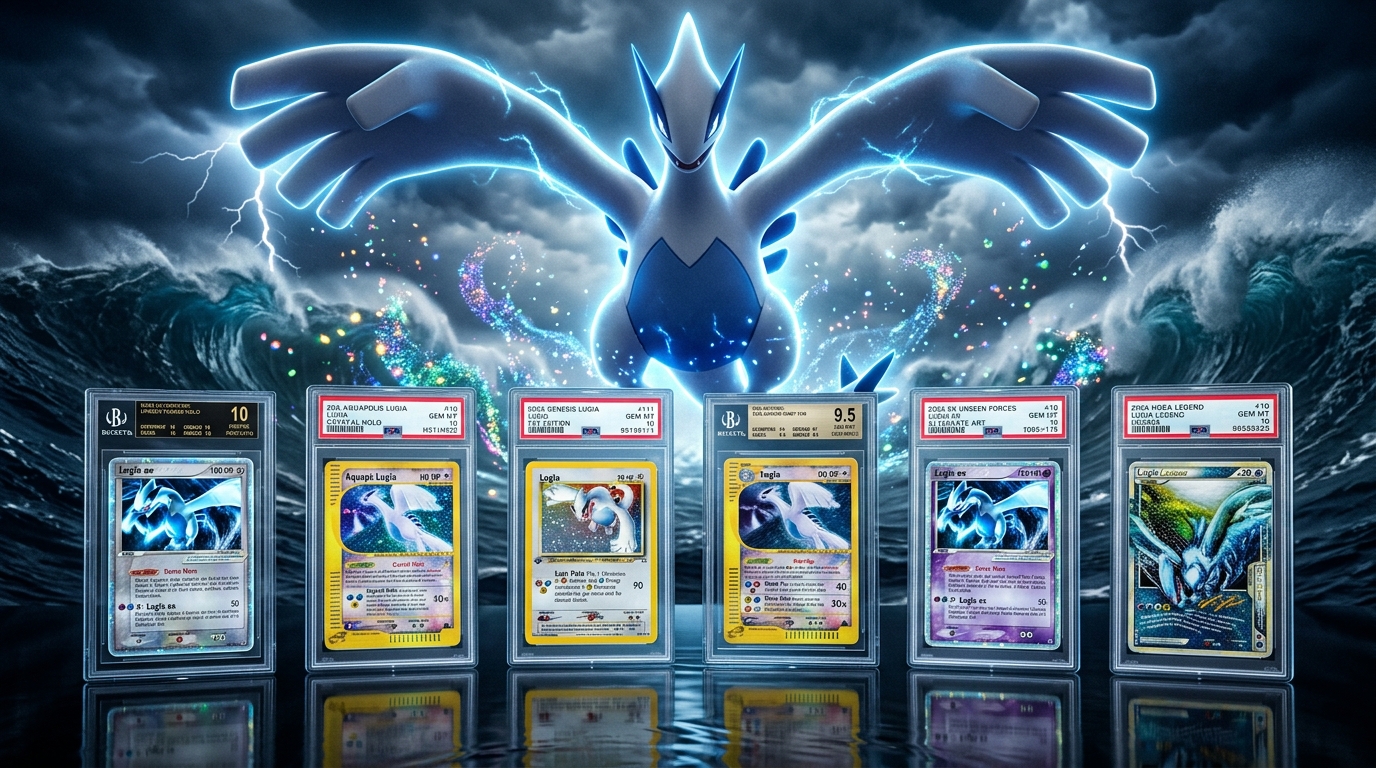
Exploring the most valuable lugia cards reveals some of the most iconic, prestigious, and high-value grails in the entire history of the Pokémon Trading Card Game. Introduced in the second generation as the legendary mascot of Pokémon Silver and the mythical Guardian of the Seas in Pokémon the Movie 2000: The Power of One, Lugia holds an untouchable status among both nostalgic vintage hobbyists and high-end modern investors. Across vintage Wizards of the Coast (WotC) eras, the experimental e-Series, the golden EX era, and modern Alternate Art masterworks, Lugia cards consistently command astronomical prices at premier auction houses such as Goldin, PWCC/Fanatics Collect, and Heritage Auctions.
Whether you are cataloging a vintage binder discovered in an attic, tracking the latest high-grade sales data, or planning your next high-return grading submission, understanding the market valuation hierarchy of Lugia is critical. In this comprehensive guide, we examine the top high-end Lugia cards, analyze historical price trends, break down population reports, and explain how to accurately evaluate condition using modern ai card grading technology.
Key Takeaway: The value of Lugia cards is defined by era-specific scarcity, pristine holographic surfaces free of factory print lines, low PSA 10 population counts, and iconic card art from legendary illustrators like Ken Sugimori, Hajime Kusajima, and Mitsuhiro Arita.
Top 8 Most Valuable Lugia Cards in Pokémon TCG History
When researching the most valuable lugia cards, collectors must distinguish between early 1st Edition vintage holos, low-print-run e-Reader Secret Rares, mid-2000s EX era grails, and modern alternate art ultra-rares. Below is the definitive breakdown of Lugia premier trading cards ranked by historical sales records, collector demand, and peak Gem Mint valuation.
1. 2000 Neo Genesis 1st Edition Lugia Holo #9
Widely considered the single most celebrated card from the entire Neo Era, the 1st Edition Neo Genesis Lugia Holo #9 is the crown jewel of second-generation Pokémon collecting. Illustrated by Ken Sugimori with its dynamic sweeping wing pose against a dark, cosmic holographic foil background, this card is legendary for both its cultural prestige and its extreme grading difficulty.
- Set: Neo Genesis (2000)
- Card Number: 9/111
- PSA 10 Population: Extremely Low (~45 copies out of over 3,000 submissions)
- Peak Market Value: $60,000 – $145,000+ (PSA 10 Gem Mint)
- Raw / PSA 9 Market Value: $400 – $900 (Raw) | $2,500 – $4,500 (PSA 9 Mint)
- Why It Is Valuable: The card suffered from notorious factory print lines, fragile dark foil borders prone to edge silvering, and centering inconsistencies. A true PSA 10 Gem Mint or BGS 9.5+ copy is mathematically scarce and sits alongside the Base Set 1st Edition Charizard as an undisputed titan of most valuable pokemon cards.
2. 2003 Aquapolis Crystal Lugia Secret Rare #149
Released at the tail end of the Wizards of the Coast era, Aquapolis introduced the revolutionary “Crystal Type” mechanic—a specialized non-colorless attribute where Lugia Poké-Body allows it to change its energy type upon attaching basic energy. Illustrated by Kouki Saitou, Crystal Lugia features mesmerizing multi-colored geometric foil accents and an e-Reader dot-code border.
- Set: Aquapolis (2003)
- Card Number: 149/147 (Secret Rare)
- PSA 10 Population: ~140 copies worldwide
- Peak Market Value: $75,000 – $120,000 (PSA 10) | $12,000 – $18,000 (PSA 9)
- Raw Market Value: $800 – $2,200 (depending on condition)
- Why It Is Valuable: Distributed during the low-print “e-Reader drought” when Pokémon card sales dipped following the initial Poke-mania bubble, Aquapolis booster packs had tiny print volumes compared to earlier expansions. High-grade Crystal Lugia copies have skyrocketed in investor demand due to unmatched aesthetic prestige and absolute supply constraints.
3. 2005 EX Unseen Forces Lugia ex Holo #105
The mid-2000s EX era is celebrated by high-end collectors for its ultra-powerful Pokémon-ex mechanics and gorgeous silver-foil borders. Illustrated by Hikaru Koike, the EX Unseen Forces Lugia ex captures Lugia performing its signature Elemental Blast attack (dealing 200 damage by discarding Fire, Water, and Lightning energy).
- Set: EX Unseen Forces (2005)
- Card Number: 105/115
- PSA 10 Population: Under 100 copies
- Peak Market Value: $10,000 – $22,000 (PSA 10) | $1,800 – $3,200 (PSA 9)
- Raw Market Value: $250 – $650
- Why It Is Valuable: EX Unseen Forces was heavily opened by competitive players rather than sealed collectors, meaning most copies were played unsleeved in tournaments. Surviving pristine Gem Mint examples command ferocious bidding wars whenever they appear at major sports and trading card auctions.
4. 2010 Call of Legends Shiny Lugia SL7
The Call of Legends expansion marked the climax of the HeartGold & SoulSilver generation. Among its most prestigious hits was the “Shiny Legend” (SL) subset, featuring full-art holographic depictions of legendary Pokémon in their shiny color palettes. Lugia SL7 showcases a stunning crimson-and-white shiny Lugia soaring over oceanic storms with an intricate shattered-glass foil finish.
- Set: Call of Legends (2011)
- Card Number: SL7
- PSA 10 Population: ~125 copies
- Peak Market Value: $3,500 – $7,500 (PSA 10) | $800 – $1,500 (PSA 9)
- Raw Market Value: $150 – $400
- Why It Is Valuable: The SL subset cards carried brutal pull rates (roughly 1 in every 18 packs across 11 different SL cards), making targeting Lugia SL7 out of sealed boxes nearly impossible. The distinct foil pattern and cross-hatch texture make it a visual centerpiece for shiny Pokémon collectors.
5. 2022 Sword & Shield: Silver Tempest Lugia V Alternate Art #186
While vintage cards dominate all-time record pricing, the modern era produced its own undisputed modern grail: the Silver Tempest Lugia V Alternate Special Art Rare (Alt Art). Illustrated by the acclaimed artist Mitsuhiro Arita (the legendary illustrator behind the 1999 Base Set Charizard), this card depicts Lugia emerging majestically from swirling thunderstorm clouds over crashing ocean waves.
- Set: Sword & Shield: Silver Tempest (2022)
- Card Number: 186/195
- PSA 10 Population: ~4,800 copies (High liquidity)
- Peak Market Value: $300 – $550 (PSA 10) | $150 – $220 (Raw NM)
- Why It Is Valuable: Modern Alternate Arts have revitalized the trading card hobby, bridging the gap between fine artwork and collectible gaming. Because it was illustrated by Mitsuhiro Arita, it holds legendary cross-generational appeal. Check how its price trajectory compares with other top picks in our guide on best sports cards to invest in.
6. 2012 Black & White: Plasma Gale Lugia EX Secret Rare #095 (Japanese) / Plasma Storm #108 (English FA)
The Black & White era introduced Team Plasma cards with distinct blue borders and stylized Plasma logos. The Japanese Plasma Gale 1st Edition Secret Rare Lugia EX and its English counterpart in Plasma Storm #108 showcase a fearsome, full-art textured foil design with glowing purple-blue energy wings.
- Set: Plasma Storm / Plasma Gale (2012–2013)
- Card Number: 108/135 (English) | 095/070 SR (Japanese)
- PSA 10 Market Range: $2,800 – $5,000 (PSA 10) | $500 – $1,100 (PSA 9)
- Raw Market Value: $120 – $350
- Why It Is Valuable: Black & White full-art secret rares feature delicate silver edges and textured foil stamping that easily chip during pack handling. Pristine Gem Mint grades are remarkably scarce relative to total print quantities.
7. 2010 HeartGold & SoulSilver Lugia Legend (Top & Bottom Half)
In 2010, the HeartGold & SoulSilver series introduced “LEGEND” cards—a unique two-card composite mechanic where players had to combine both the Top (#113/123) and Bottom (#114/123) halves onto the bench simultaneously. Illustrated by Shinji Higuchi and Sachiko Eba, the cards unite into a breathtaking panoramic oil-painting mural of Lugia diving through oceanic trenches.
- Set: HeartGold & SoulSilver Base (2010)
- Card Numbers: 113/123 (Top) & 114/123 (Bottom)
- Combined PSA 10 Market Range: $1,800 – $3,400 (Pair in PSA 10)
- Raw Pair Market Value: $120 – $280
- Why It Is Valuable: Assembling a sequential PSA 10 matched pair requires finding two separate cards with identical centering and zero surface scuffs. Matched Gem Mint pairs command significant premiums over individual pieces.
8. 2001 CoroCoro Comics Japanese Shining Lugia Promo
Before shining cards were officially distributed in English booster boxes, Japan released an exclusive holographic promo through the May 2001 issue of CoroCoro Comic. Known as the “CoroCoro Shining Lugia,” this card features an embossed textured holographic foil with a striking metallic sheen across Lugia body.
- Release: CoroCoro Comics Promo (May 2001)
- Card Number: Unnumbered Japanese Promo
- PSA 10 Market Range: $4,500 – $9,000 (PSA 10) | $900 – $1,800 (PSA 9)
- Raw Market Value: $200 – $550
- Why It Is Valuable: CoroCoro promos were distributed as loose sheet inserts glued inside magazine pages, leaving the vast majority with severe indentation marks, bent corners, and surface scratching. Finding an unblemished Gem Mint survivor is exceptionally difficult.
Crucial Value Drivers: What Makes Lugia Cards So Expensive?
Understanding why the most valuable lugia cards trade at such massive premiums requires analyzing physical manufacturing quirks, print run dynamics, and collector psychology. When determining true pokemon card worth, focus on these core valuation pillars:
The Neo Genesis PSA 10 Grading Nightmare (Print Lines & Holo Bleed)
The 2000 Neo Genesis print run is infamous among professional card authenticators as one of the hardest sets to grade in hobby history. Due to factory calibration issues on the Wizards of the Coast production lines:
- Horizontal & Vertical Print Lines: Over 85% of pulled copies left the factory with faint roller lines across the holographic foil box.
- Fragile Dark Foil: The cosmic star foil absorbs microscopic micro-scratches from simple friction against standard deck sleeves.
- Severe Edge Silvering: The dark blue border on early WotC cards chips easily during die-cutting, exposing the raw white paperboard beneath.
Because of these pervasive flaws, a 1st Edition Neo Genesis Lugia in PSA 9 sells for ~$3,500, while a flawless PSA 10 commands $70,000 to $120,000+—a jaw-dropping 20x to 30x condition multiplier!
The E-Reader Era Scarcity & Crystal Mechanics
Between 2002 and 2003, Nintendo introduced the e-Reader peripheral for the Game Boy Advance, printing specialized dot-code borders on expansions like Expedition, Aquapolis, and Skyridge. During this transitional era, Pokémon sales were at a 5-year low before rebounding during the Diamond & Pearl era. Consequently:
- Print runs for Aquapolis were tiny compared to Base Set or Team Rocket.
- The “Crystal” rarity tier was seeded at only 1 in approximately 36 to 72 booster packs.
- Today, e-Series Crystal cards are considered elite portfolio centerpieces for vintage enthusiasts alongside vintage rare pokemon cards.
Modern Alternate Art Surge & Swirl Placement Dynamics
In both vintage WotC cards and modern sets, specific aesthetic traits amplify market value beyond base price guides:
- Holographic Swirls: In cosmos holofoil cards (such as Neo Genesis and Japanese Promos), randomized spiral galaxy patterns (swirls) appear on the foil sheet. A swirl positioned directly near Lugia mouth (“breathing swirl”) or beneath its wings routinely adds a 20% to 50% premium at auction.
- Texture Alignment on Modern Alt Arts: On cards like the Silver Tempest Lugia V Alt Art, misaligned foil stamping or off-center texture etching will instantly disqualify a card from achieving a BGS 10 Black Label or PSA 10.
Grading & Preservation: PSA vs. BGS vs. AI Card Grading for Lugia
Achieving a top-tier grade is the single most effective way to maximize the financial value of any Lugia card. Before submitting valuable raw cards to third-party authentication services, understanding grading standards and company nuances is essential. For an in-depth breakdown of grading companies, explore our comparison of psa vs bgs.
Holofoil Scratch Inspection & Micro-Defect Detection
Because Lugia massive wingspan covers the majority of the holographic area on vintage cards, surface defects are immediately visible under direct LED lighting. Collectors should follow a rigorous inspection checklist:
- Raking Light Surface Scan: Tilt the card at a 45-degree angle under a 5000K daylight lamp to identify faint surface abrasions, binder ring dings, and foil bubbling.
- Corner Whiteness Analysis: Inspect all four corners under 10x or 20x optical magnification. Even a single speck of white paper fiber showing through the blue back border will drop a card from a PSA 10 to a PSA 9.
- Edge Roughness & Silvering: Check the top and bottom borders for factory cutting burrs or micro-flaking.
Centering Standards and Sub-Grade Benchmarks
Different grading companies enforce varying thresholds for Gem Mint status:
- PSA Standards: PSA allows up to 55/45 to 60/40 centering on the front and 75/25 on the back for a PSA 10 Gem Mint grade. This makes PSA more forgiving on centering but notoriously harsh on surface scratching.
- Beckett (BGS) Standards: BGS requires subgrades of 9.5 or higher across Centering, Corners, Edges, and Surface for a standard Gem Mint 9.5, and quad 10s for the legendary BGS 10 Black Label. A BGS 10 Black Label 1st Edition Neo Genesis Lugia would represent a multimillion-dollar grail.
- CGC Cards: CGC has gained significant traction for vintage Pokémon cards due to its crystal-clear plastic casing and rigorous surface scrutiny.
Pre-Grading Inspection Protocol with AI Grading Tools
Sending low-grade cards to professional grading services wastes substantial submission fees and months of turnaround time. Today, advanced collectors use ai card grading platforms to scan digital photographs, calculate sub-millimeter centering ratios, and predict realistic PSA/BGS grade distributions before spending a dollar on postage. Learn more about the complete grading submission workflow in our guide on pokemon card grading.
Market Trends & Investment Outlook for Lugia Cards
The long-term collector demand for Lugia remains among the strongest in the entire collectibles market, rivaling Charizard, Pikachu, Rayquaza, and Gengar.
| Lugia Card Release | Era / Type | Estimated Raw Value | PSA 9 Mint Value | PSA 10 Gem Mint Value | Long-Term Liquidity |
|---|---|---|---|---|---|
| Neo Genesis 1st Ed. #9 | Vintage WotC (2000) | $500 – $900 | $3,000 – $4,500 | $65,000 – $130,000+ | Very High (Iconic Grail) |
| Aquapolis Crystal #149 | e-Reader WotC (2003) | $900 – $2,200 | $12,000 – $18,000 | $75,000 – $120,000 | High (Ultra-Low Pop) |
| EX Unseen Forces #105 | EX Era (2005) | $300 – $650 | $2,000 – $3,200 | $12,000 – $22,000 | High (Scarce Supply) |
| Call of Legends SL7 | HGSS Era (2011) | $180 – $400 | $900 – $1,500 | $4,000 – $7,500 | Moderate (Niche Grail) |
| CoroCoro Shining Promo | Japanese Promo (2001) | $250 – $550 | $1,000 – $1,800 | $4,500 – $9,000 | High (Popular Fan Favorite) |
| Silver Tempest Alt Art #186 | Modern SWSH (2022) | $150 – $220 | $160 – $230 | $320 – $550 | Ultra-High (Mass Market) |
Vintage vs. Modern Lugia Liquidity Comparison
- Vintage Stability: Vintage Lugia grails like Neo Genesis and Aquapolis act as blue-chip stores of value. Their population counts are strictly fixed because sealed booster boxes cost tens of thousands of dollars, ensuring virtually no new Gem Mint copies enter circulation.
- Modern Volatility: Modern cards like Silver Tempest Lugia V Alt Art have large overall print quantities, but maintain exceptional daily sales volume on eBay and TCGplayer. They offer affordable entry points for newer collectors looking to build a high-grade portfolio.
Counterfeit Detection & Authentication
Because vintage Lugia cards command thousands of dollars, counterfeit copies created using modern ink-jet printers and fake holographic foil layers have entered online marketplaces. Always inspect the internal black carbon layer in the card paper core, test foil reflectivity against verified authentic copies, and consult our comprehensive tutorial on how to spot fake sports card and trading cards to protect your capital.
Frequently Asked Questions
What is the most expensive Lugia card ever sold?
The most expensive Lugia card ever sold in public auction history is a BGS 10 Pristine 1st Edition Neo Genesis Lugia Holo #9, which sold for over $144,000 at a Goldin Auctions event. Flawless PSA 10 copies of this iconic card regularly realize between $60,000 and $120,000+ depending on market timing and eye appeal.
Why is the Neo Genesis 1st Edition Lugia so hard to get in a PSA 10?
The Neo Genesis 1st Edition Lugia #9 is notoriously difficult to grade because of severe manufacturing flaws on the 2000 Wizards of the Coast production lines. Most cards rolled off the press with vertical or horizontal roller lines across the dark holographic foil, and the dark blue edges are highly prone to edge silvering and chipping during factory packaging.
Is the Silver Tempest Lugia V Alternate Art a good long-term investment?
Yes, the 2022 Silver Tempest Lugia V Alternate Art #186 is widely regarded as one of the premier modern Pokémon grails. Illustrated by the legendary Mitsuhiro Arita (the original Base Set Charizard artist), its striking dynamic artwork and immense character popularity provide strong long-term liquidity and collector demand.
How do I check if my vintage Lugia card is worth grading?
To evaluate whether a vintage Lugia is worth grading, inspect the holographic surface under direct raking light for micro-scratches, examine all four corners for whitening under 10x magnification, verify that front centering falls within 60/40 or better, and utilize modern ai card grading tools to scan high-resolution photos for pre-submission grading estimates.
What is a holographic swirl on a Lugia card, and does it increase value?
A holographic swirl is a circular spiral pattern formed randomly across the cosmos holofoil sheets used in vintage Pokémon cards. When a swirl appears in an aesthetically pleasing location—such as near Lugia mouth or outstretched wings—collectors will frequently pay a 20% to 50% premium above standard market price guide values.
Pre-Grade & Track Values Instantly with CardMint
CardMint is the ultimate all-in-one scanner for sports card and TCG collectors, saving you time and money.
Simply scan the front of your card. Our AI instantly identifies the card details, checks current pricing metrics, and gives you a centering and wear pre-grade report before you submit to PSA/BGS.
