
15 Most Valuable Pikachu Cards of All Time: Price & Rarity Guide
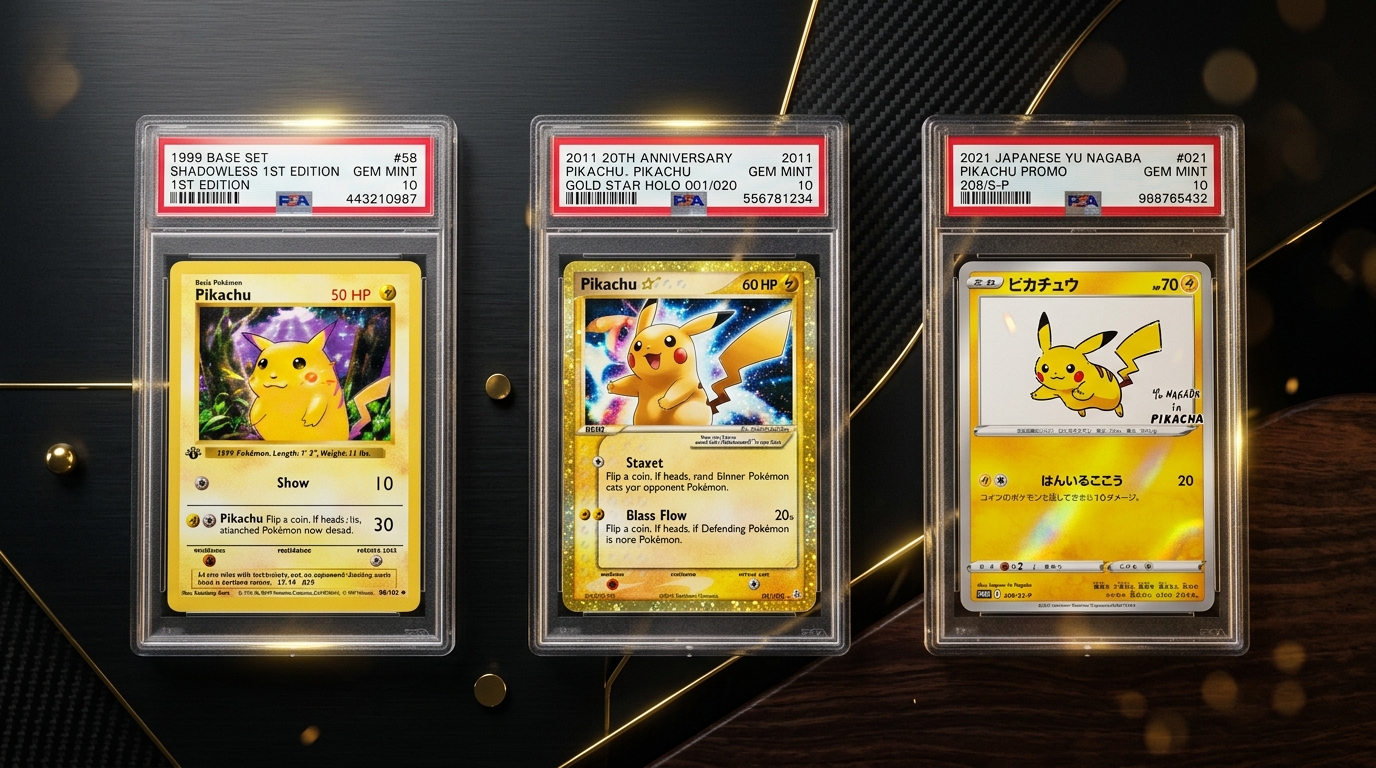
Finding the most valuable Pikachu cards requires looking beyond nostalgia to evaluate record-breaking auction results, extreme rarity, PSA grading census reports, and historical TCG market trends. As the global mascot of the Pokémon franchise, Pikachu has appeared on hundreds of trading cards since the Japanese expansion debuted in 1996. While millions of childhood Base Set cards sit in binder sleeves across the globe, an exclusive group of elusive promotional releases, low-print-run tournament trophies, and pristine error cards command six and seven-figure sums at world-class auction houses like Goldin, Heritage, and PWCC.
Whether you are a seasoned investor diversifying into high-grade TCG assets or an enthusiastic collector auditing a childhood binder, understanding what separates a common $0.50 card from an investment-grade grail is essential. In this ultimate market breakdown, we analyze the top 15 most valuable Pikachu cards, break down the historical sales data behind them, explain critical authentication nuances, and provide actionable valuation strategies.
Key Takeaway: The value of a Pikachu card is dictated by event exclusivity, print run constraints, Japanese vs. English release context, and physical condition. While mass-market set cards require Gem Mint PSA 10 grades to achieve maximum value, vintage trophy promos remain immensely valuable in any grade.
1. What Makes Pikachu Cards So Valuable?
Before diving into individual card sales, it is important to understand the structural mechanics driving prices in the Pokémon TCG market. Not all Pikachu cards are created equal, and price discovery relies heavily on three core principles.
Scarcity, Distribution, and Event Exclusivity
Unlike standard set cards distributed in millions of booster packs worldwide, the world’s highest-valued Pikachu cards were never available in retail stores. Many of the most valuable examples were awarded exclusively to contest winners, tournament champions, or attendees of specialized Japanese promotional events during the late 1990s and 2000s. When a card has a known print run of fewer than 100 copies worldwide, supply remains permanently bottlenecked while collector demand continues to compound globally.
Professional Grading & The PSA 10 Gem Mint Premium
In modern TCG collecting, physical condition is paramount. Third-party grading companies like Professional Sports Authenticator (PSA), Beckett Grading Services (BGS), and Certified Guaranty Company (CGC) assess centering, corners, edges, and surface quality on a 1-to-10 scale. A card in PSA 9 Mint condition might sell for $500, whereas the exact same card in a flawless PSA 10 Gem Mint holder can fetch $5,000 or more. The extreme multiplier on Gem Mint grades reflects the physical fragility of early cardboard stock and holo foil surfaces. To understand how grading affects market value, review our comprehensive pokemon card grading tutorial.
Historical Provenance & Pop Cultural Impact
Pikachu is not merely a trading card character; he is one of the most recognizable pop-culture icons in modern human history. Cross-generational appeal gives Pikachu cards liquidity that obscure Pokémon species simply cannot replicate. Collectors who grew up playing the original Red & Blue Game Boy games now possess significant disposable income, driving aggressive bidding competition for top-tier vintage items.
2. The Top 15 Most Valuable Pikachu Cards
Below is the definitive ranking of the 15 most valuable Pikachu cards ever produced, ordered by peak recorded public sales and current market estimates.
1. 1998 Pokémon Illustrator Pikachu Promo (PSA 10: $5,275,000)
The 1998 CoroCoro Comic Illustration Contest Pikachu—commonly known as the Pikachu Illustrator—holds the Guinness World Record for the most expensive Pokémon card ever sold at private auction ($5,275,000 bought by Logan Paul). Illustrated by Pikachu’s original creator, Atsuko Nishida, only 39 copies were originally distributed to contest winners in Japan, with an estimated 20 to 25 copies known to survive today. Featuring a unique double-star rarity icon and the word “Illustrator” replacing “Trainer” at the top of the card header, it stands as the absolute holy grail of trading card games.
2. 1999 Base Set 1st Edition Red Cheeks Pikachu #58 (PSA 10: $7,500+)
When Wizards of the Coast first printed the English Base Set in 1999, initial press runs erroneously rendered Pikachu’s cheek sparks in red to match his cheeks rather than the intended yellow vector art. Mitsuhiro Arita originally intended for the cheeks to be yellow when charging electricity, prompting a quick correction mid-production. Today, the 1st Edition Red Cheeks Pikachu is a legendary error card. A PSA 10 Gem Mint copy commands upwards of $7,500, while Near-Mint ungraded copies easily surpass several hundred dollars.
3. 2006 Pokémon EX Holon Phantoms Gold Star Pikachu #104 (PSA 10: $12,500 - $25,000)
Introduced during the EX Series era, Gold Star cards featured artwork where the Pokémon’s limbs extended past the artwork frame, accompanied by a shiny gold star next to the character name. Gold Star Pikachu (#104) had an extraordinarily low pull rate of approximately 1 in every 2 booster boxes (1:72 packs). In PSA 10 condition, this card regularly fetches between $12,000 and $25,000 at auction. Its English and Japanese counterparts represent peak mid-2000s TCG investment assets.
4. 1997–1998 Japanese Trophy Pikachu (No. 1, No. 2, No. 3 Trainer) (PSA 9/10: $100,000 - $400,000+)
Awarded to top finishers at the 1997 and 1998 Japanese Official Tournament events, the No. 1, No. 2, and No. 3 Trainer Trophy Pikachu cards depict Pikachu holding a gold, silver, or bronze trophy cup. With fewer than 15 copies of each version ever awarded, these historical artifacts rarely appear at public auction. When a verified copy enters Heritage Auctions or Goldin, bidding routinely breaches six figures.
5. 2016 20th Anniversary 24K Solid Gold Pikachu Promo ($25,000 - $35,000)
To celebrate the 20th anniversary of Pokémon in 2016, The Pokémon Company partnered with renowned Japanese jewelry maker Ginza Tanaka to produce a limited release of 11 grams of pure 24-karat gold Pikachu cards. Replicating the original 1996 Japanese Base Set artwork inside a custom acrylic display case, these non-playable collector pieces originally retailed for roughly $2,000 USD. Today, secondary market demand has driven their value above $25,000.
6. 2018 Mario Pikachu & Luigi Pikachu Full Art Promos (#294/XY-P & #296/XY-P) (PSA 10 Pair: $8,000 - $15,000)
Released exclusively at Pokémon Centers in Japan in October 2016 to commemorate a crossover with Nintendo’s flagship franchise, the Mario Pikachu and Luigi Pikachu special box sets included full-art holographic promo cards. Featuring Pikachu wearing Mario and Luigi overalls and caps, these cards captured the internet’s imagination. In PSA 10 condition, the Mario Pikachu #294/XY-P alone sells for $5,000 to $9,000, while the full sealed box sets command premium prices.
7. 2016 Poncho-Wearing Pikachu Promos (Rayquaza, Charizard, Gyarados) (PSA 10: $3,000 - $8,000)
Japanese Pokémon Center campaigns between 2015 and 2017 featured Pikachu dressed up in costumes (“ponchos”) of fan-favorite legendary and mega-evolved Pokémon. The Mega Charizard Y (#207/XY-P), Mega Charizard X (#208/XY-P), and Shiny Mega Rayquaza (#231/XY-P) poncho promos are among the most sought-after modern full-art promos in existence. High-grade PSA 10 copies have experienced rapid appreciation. Compare these with top Charizard values in our guide on most valuable charizard cards.
8. 2018 Munch: A Retrospective Pikachu Promo #288/SM-P (PSA 10: $2,500 - $4,500)
In late 2018, the Tokyo Metropolitan Art Museum hosted a special exhibition honoring Norwegian painter Edvard Munch. To mark the occasion, The Pokémon Company issued five promo cards inspired by Munch’s iconic painting The Scream. The Pikachu version (#288/SM-P) was distributed as a blind-bag gift to museum visitors. Due to limited distribution and immense artistic crossover appeal, PSA 10 copies now sell consistently for several thousand dollars.
9. 1999 Base Set Shadowless Yellow Cheeks Pikachu #58 (PSA 10: $1,200 - $2,500)
Between the uncorrected 1st Edition print run and the unlimited mass-market release, Wizards of the Coast printed a transitional run known as “Shadowless” (lacking the drop shadow to the right of the art box). Shadowless Base Set Pikachu cards with Yellow Cheeks represent a classic vintage piece of Pokémon history. In Gem Mint condition, they are significantly rarer than standard unlimited copies.
10. 2005 Japanese PokéPark / Gift Box Gold Star Pikachu (PSA 10: $4,000 - $8,000)
While English Gold Star Pikachu cards came from EX Holon Phantoms booster packs, Japanese collectors could acquire a Gold Star Pikachu through the 2005 Gift Box PokéPark set. Featuring distinct foil treatments and set numbering, Japanese copies in pristine PSA 10 grade are prized assets among completionist Gold Star collectors.
11. 2010 Victory Orb / Battle Road Trophy Pikachu (PSA 9/10: $15,000 - $30,000)
Distributed to top-ranking players during the Japanese Battle Road Summer 2005 and 2010 events, Victory Orb and Victory Ring promos feature Pikachu in dynamic action poses surrounded by holographic energy swirls. Low population counts on the PSA census keep values firm well into five-figure territory.
12. 2021 Yu Nagaba x Pokémon Pikachu Promo #208/S-P (PSA 10: $300 - $800)
Acclaimed Japanese minimalist artist Yu Nagaba collaborated with The Pokémon Company in 2021 to produce a unique, long-limbed sketch-style Pikachu promo (#208/S-P). Distributed at Pokémon Centers and public art exhibits in Tokyo, this clean aesthetic piece became an instant modern favorite, proving that modern promos can establish rapid liquidity.
13. 1998 Tamamushi University Magikarp / Pikachu Campaign Promos ($5,000 - $12,000)
Offered through Shogakukan magazines in 1998, school students submitted academic test papers to earn entry into special Japanese campaign contests. While the University Magikarp is famous, the accompanying Pikachu promotional cards distributed during these late-90s academic campaigns remain cornerstone vintage grails.
14. 2015 Black Star Promo Pikachu #XY95 (PSA 10: $600 - $1,200)
Featuring artwork by Mitsuhiro Arita showing Pikachu surrounded by traditional lightning strikes, the XY95 promo was included in English collector tins. Because retail packaging frequently damaged card corners upon factory packing, acquiring a flawless PSA 10 copy is disproportionately difficult, maintaining a high Gem Mint premium.
15. 2020 Precious Collector Box Promo Pikachu #323/S-P (PSA 10: $1,000 - $1,800)
Included exclusively in the high-end Japanese Precious Collector Box release during the Sword & Shield era, promo #323/S-P showcases a stunning textured full-art treatment of Pikachu alongside starters. Premium box presentation and restricted pre-orders created immediate secondary market demand.
3. How to Identify and Evaluate Your Pikachu Cards
Determining your collection’s true worth requires careful physical verification. Follow these practical diagnostic steps before placing your cards on the market.
Checking Set Symbols, Edition Stamps, and Edition Variants
The first step in evaluating any Pikachu card is inspecting the lower right or lower left corner of the artwork or card border:
- 1st Edition Stamp: Look for the black “Edition 1” circle logo on the middle-left side of vintage WOTC cards.
- Shadowless Border: Verify whether the artwork frame lacks a dark drop-shadow on the right border.
- Set Symbols: Identify set logos (such as the star symbol for EX Holon Phantoms or the 20th Anniversary stamp).
To cross-reference current sales prices across major marketplaces, consult our detailed pokemon card price guide.
Red Cheeks vs. Yellow Cheeks Identification Guide
For 1999 Base Set Pikachu #58, carefully inspect the color of the electric pouches on Pikachu’s cheeks:
- Red Cheeks: The cheeks are filled with solid red ink. This applies to 1st Edition and Shadowless error prints.
- Yellow Cheeks: The cheeks match the yellow fur color. This is the standard corrected version.
How to Inspect Condition Before Submitting for Grading
Before spending money on PSA or BGS grading fees, inspect your card under strong LED lighting with a 10x jeweler’s loupe:
- Surface scratches: Check the holo foil surface for micro-scratches or foil peeling.
- Centering: Ensure border margins are balanced top-to-bottom and left-to-right (PSA permits up to 60/40 centering for a 10 grade).
- Corner whitening: Turn the card over and examine the blue rear border for white specks or chipping.
If you suspect a rare card might be a fake print, read our guide on how to spot a fake sports card for universal print test methods.
4. Smart Investment Strategies for Pikachu Card Collectors
Navigating the Pokémon card market requires a balanced approach between vintage stability and modern growth potential.
Vintage vs Modern Pikachu Promos
- Vintage (1996–2003): High barrier to entry, low supply growth, and proven long-term historical stability. Vintage trophy cards act like blue-chip fine art investments.
- Modern Promos (2016–Present): Lower price points, high liquid turnover, but susceptible to short-term market corrections if reprint sets occur. Focus on Japanese exclusive promos with fixed distribution windows (e.g. Yu Nagaba, Mario Pikachu, Munch exhibition).
If you are planning to liquidate or list your cards online, explore our complete walkthrough on how to sell pokemon cards to maximize your net proceeds after seller fees.
Avoiding Counterfeits and Altered Cards
High-value Pikachu cards—especially 1st Edition Red Cheeks and Illustrator replicas—are frequent targets for counterfeiters. Watch out for proxy cards with glossy re-printed backs, incorrect font kerning, or fake 1st Edition stamps pressed onto unlimited cards. Always buy from verified sellers with return guarantees or purchase cards pre-authenticated in sealed PSA, BGS, or CGC holders.
To get an accurate appraisal of your entire collection, utilize our automated tools in the pokemon card valuation overview or test your cards with our instant pokemon card worth calculator.
Frequently Asked Questions
What is the most expensive Pikachu card ever sold?
The most expensive Pikachu card ever sold is the 1998 PSA 10 Pokémon Illustrator Pikachu Promo, which was acquired in a record-breaking private transaction for $5,275,000 by Logan Paul in 2021. It represents the highest price ever paid for any trading card in history.
How much is a 1st Edition 1999 Pikachu card worth?
A 1999 Base Set 1st Edition Pikachu card #58 is typically worth between $50 and $150 in ungraded lightly played condition. However, if it is the rare “Red Cheeks” error variant in a PSA 10 Gem Mint grade, its value routinely exceeds $7,500 at major auction houses.
Why are Japanese Pikachu promo cards worth more than English versions?
Japanese Pikachu promo cards are often worth more because many of them were released exclusively in Japan through limited-time promotional events, art museum crossovers (such as the Munch exhibition), or tournament prizes. They were never printed in English, keeping global supply extremely scarce.
How can I check the exact market price of my Pikachu cards?
You can determine the exact market price of your Pikachu cards by checking recent “Sold” listings on eBay, cross-referencing sales databases like TCGplayer and PriceCharting, or submitting photos into our comprehensive pokemon card valuation system.
Pre-Grade & Track Values Instantly with CardMint
CardMint is the ultimate all-in-one scanner for sports card and TCG collectors, saving you time and money.
Simply scan the front of your card. Our AI instantly identifies the card details, checks current pricing metrics, and gives you a centering and wear pre-grade report before you submit to PSA/BGS.
