
Pokemon Card Grading: Complete Collector's Guide
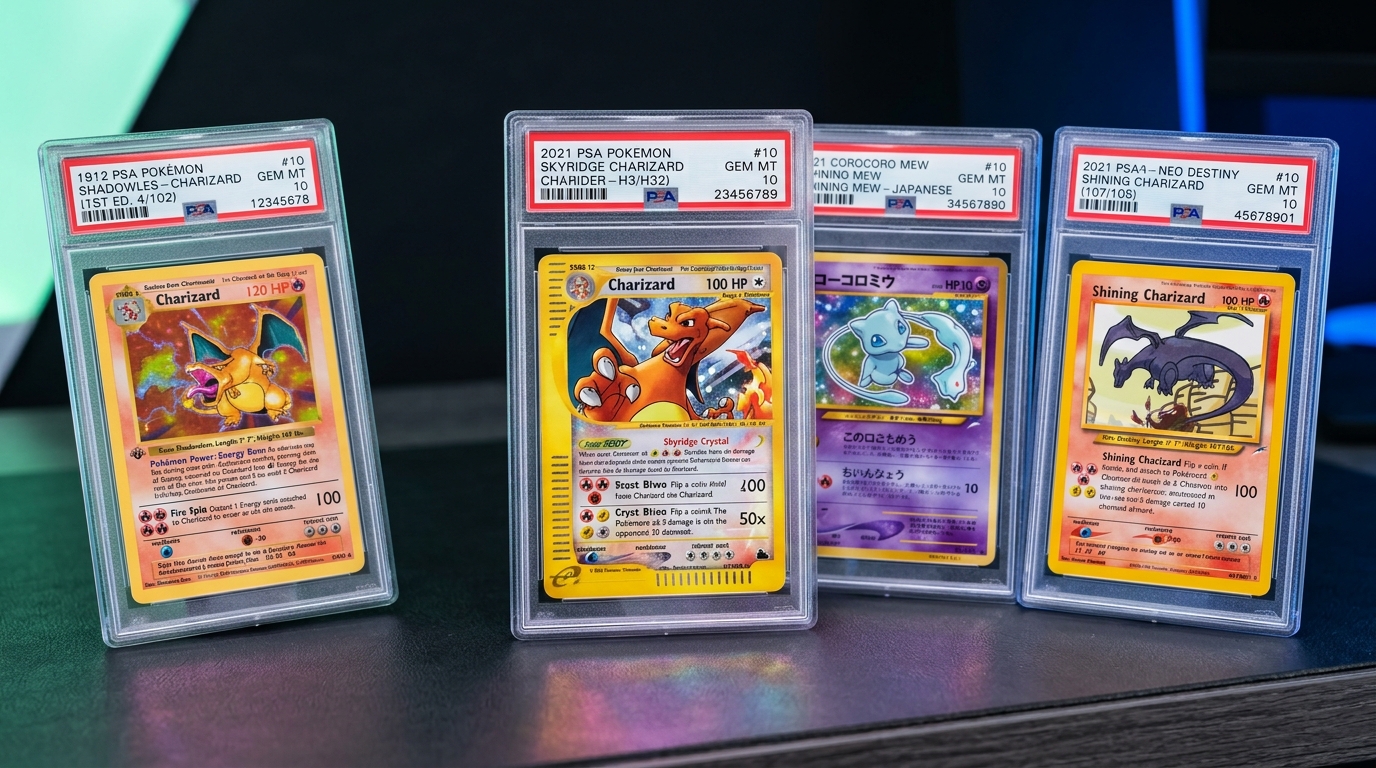
If you want to protect your TCG investment and verify the authenticity of your collection, understanding pokemon card grading is the single most important step you can take. The Pokemon Trading Card Game has transformed from a playground hobby into a multi-million dollar alternative asset market. Today, the difference between a raw card fresh from a pack and a card that has been professionally graded can be thousands of dollars.
In this comprehensive guide, we will break down the mechanics of pokemon card grading, explore the industry’s top grading companies, explain the rigorous 10-point scale, and show you how to leverage AI tools to pre-grade your cards before sending them in.
Why Should You Grade Your Pokemon Cards?
The primary reason to submit your cards for professional grading is to establish their authenticity and physical condition. A third-party grading service acts as an unbiased authority, examining the card under magnification and encapsulation to guarantee it is genuine and has not been altered or doctored.
Once graded, cards are sealed in heavy-duty, tamper-evident plastic slabs. These holders protect the card from physical damage, UV light, and moisture, ensuring it retains its condition. Furthermore, graded cards are far easier to sell. Buyers on platforms like eBay or Myslabs are willing to pay a massive premium for graded cards because the slab eliminates the risk of buying an altered or misrepresented item.
The impact of condition on pokemon card worth cannot be overstated. Consider the following example:
| Card / Player | Raw Value | PSA 9 (Mint) | PSA 10 (Gem Mint) |
|---|---|---|---|
| 1999 Base Set 1st Edition Shadowless Charizard | $1,200 | $5,500 | $220,000 |
| 2003 Skyridge Holographic Charizard H31 | $650 | $1,200 | $14,000 |
| 2021 Evolving Skies Umbreon VMAX Alternate Art | $450 | $600 | $1,100 |
As you can see, the jump from a Mint 9 to a Gem Mint 10 represents an exponential increase in value. Understanding how to grade cards helps you identify which raw cards in your collection are candidates for these top-tier grades. For more details on high-value targets, check out our guide on the most valuable pokemon cards.
The Major Grading Companies for Pokemon Cards
While there are dozens of grading companies in operation today, three major services dominate the Pokemon card market. Each has its own reputation, grading standards, and registry ecosystem.
1. Professional Sports Authenticator (PSA)
Founded in 1991, PSA is the largest and most popular third-party grading service in the world. They have graded over 75 million cards and boast the highest market share. PSA cards generally command the highest resale premiums, especially for Gem Mint 10 grades. Their registry program, where collectors compete to build complete graded sets, drives immense demand for their slabs.
2. Beckett Grading Services (BGS)
BGS is known for its rigid, thick slabs and its famous “subgrades” system. BGS evaluates four specific attributes: Centering, Corners, Edges, and Surface. The overall grade is calculated from these subgrades. A BGS Pristine 10 (with four 10 subgrades, known as a “Black Label”) is considered the holy grail of modern card condition and often outsells a PSA 10 by a wide margin.
3. Sportscard Guaranty Corporation (SGC)
SGC is highly respected, particularly in the vintage card community. Known for their clean black insert mats (often referred to as the “tuxedo slab”), SGC offers fast turnaround times and consistent grading standards. While their modern card premiums lag slightly behind PSA, their vintage grading is second to none in terms of accuracy and collector respect.
4. CGC Cards
CGC is a major player in the TCG and comic book space. Originally specialized in comic books, CGC Trading Cards launched a few years ago and quickly became a popular choice for Pokemon and Magic: The Gathering. CGC is known for its high-quality crystal-clear slabs, advanced scanning technology, and competitive pricing.
The 10-Point Grading Scale: What Do the Grades Mean?
Grading companies use a standard 10-point scale to describe a card’s condition. Here is a breakdown of the key tiers:
- Gem Mint (10): A near-perfect card. It must possess four sharp corners, sharp focus, full original gloss, and be free of staining. Centering must be approximately 55/45 to 60/40 on the front and 75/25 on the back.
- Mint (9): A superb card that exhibits only one minor flaw, such as a microscopic speck or very slight off-centering.
- Near-Mint/Mint (8): A card that looks fresh but may have minor corner wear, a small print spot, or slight edge chipping.
- Near-Mint (7): Minor corner wear is visible, and centering may be off. There could be slight surface scratches or print lines.
- Excellent/Near-Mint (6): Visible corner wear, edge chipping, or minor surface scuffing is present.
- Excellent (5): Minor rounding of corners is obvious. The card may have lost some of its original gloss, and centering is noticeably off.
- Very Good (4): The corners are rounded, and the card may show light creasing or surface wear.
- Good (3): The card has rounded corners, multiple creases, or significant surface wear, but remains intact.
- Fair (2) / Poor (1): Heavy creases, stains, paper loss, or rounded corners. These cards have little eye appeal but may still hold value if they are extremely rare vintage issues.
Knowing how to identify these details is crucial, especially when trying to spot a fake sports card or determining if a vintage card has been trimmed to improve its corners.
The Four Pillars of TCG Condition
To master the art of grading, you must look at cards the way professional graders do. Graders evaluate cards based on four key attributes.
Centering
Centering refers to how well the card’s image is aligned within its borders. If the borders are wider on one side than the other, the card is off-center. Centering is the most objective grading criteria and can be measured precisely. A card must have exceptional centering to achieve a Gem Mint 10 grade. For Pokemon cards, this means checking the yellow borders (on older cards) or silver borders (on newer cards) to make sure they are equal on all sides.
Corners
Corners are the most vulnerable part of a card. Graders inspect corners under magnification to check for soft corners, fraying, or rounding. A perfect corner should be sharp and come to a clean point. In Pokemon cards, look at the back of the card; the blue background makes “whitening” (raw cardboard showing through) extremely obvious. Even a tiny speck of white on a corner will drop the grade to a 9.
Edges
Edges are inspected for chipping, silvering (common on older holographic cards), and roughness from the factory cut. Graders look along the borders of the card to ensure the cut is clean and straight. On vintage Pokemon cards, the sides often exhibit minor chipping from being handled or stored loosely.
Surface
The surface is the most complex attribute to inspect. Graders look for print lines, dimples, scratches, scuffing, wax stains, and creases. They use angled lighting to highlight minor imperfections in the card’s glossy coating. On holographic Pokemon cards, scratches on the shiny artwork are the most common reason for a low surface grade.
Preparing and Submitting Your Cards for Grading
Submitting cards blindly is a recipe for losing money. You must inspect and prepare your cards carefully to ensure you only submit candidates that have a high probability of scoring a 9 or 10.
Step 1: Preliminary Inspection
Begin by placing your card on a clean, soft surface, such as a neoprene playmat. Use a bright desk lamp and a magnifier (a 10x jeweler’s loupe is ideal). Look at the centering, check the corners, run your eyes along the edges, and tilt the card under the light to check the surface for scratches.
Step 2: Clean the Surface
If you spot fingerprints, dust, or light smudges on a glossy foil card, you can gently wipe them off. Use a clean, dry microfiber cloth. Place the card flat on the table and gently wipe from the center of the card outward. Never use moisture or chemical cleaners, as this will damage the card and count as altering.
Step 3: Proper Sleeving and Storage
Once cleaned, immediately place the card into a penny sleeve. Be very careful not to catch the corners of the card on the edge of the sleeve. After sleeving, place the card into a rigid semi-rigid holder. For details on proper handling techniques, consult our guide on how to store baseball cards.
Understanding Pokemon Card Grading Costs and ROI
Before submitting cards, you should evaluate the financial aspect of grading. Grading is an investment that requires capital and patience.
Submitting cards to PSA costs anywhere from $15 per card (in bulk tiers) to several hundred dollars for express grading. You should only grade a card if the value of the graded slab exceeds the raw card value plus the grading fee and shipping costs.
For modern cards, this usually means only grading cards that have a high chance of scoring a Gem Mint 10. A PSA 9 of a modern card often sells for the same price as a raw card, meaning you will lose the grading fee. For vintage cards, however, even a grade of 5 or 6 can be highly profitable because authentication is crucial for older cards. Once you’re ready to sell your graded cards, check out our guide on how to sell pokemon cards.
The Future of Grading: AI Card Grading
As the grading industry scales, human graders are facing massive backlogs and inconsistency. This has led to the rise of technology in card evaluation.
Computer vision and machine learning can analyze cards with a level of precision that the human eye cannot match. Automated systems can measure border widths down to the micron, map surface scratches using multi-angle photography, and detect artificial coloring or trim marks instantly.
With the CardMint mobile app, you can scan your cards and receive a detailed pre-grade report. The app checks centering alignment and looks for surface defects, giving you a clear picture of whether your card is worth sending to PSA or SGC. Incorporating AI card grading workflows into your sorting process allows you to filter out flawed cards and only pay grading fees on true Gem Mint candidates.
This technology is democratizing card grading, allowing everyday collectors to assess their collections without sending them away for months. As the technology matures, it will likely integrate directly with official grading registries, standardizing sports card value and Pokemon card value.
FAQ
How does centering affect Pokemon card grading?
Centering is one of the most important aspects of Pokemon card grading. To get a Gem Mint 10, the card borders must be centered approximately 60/40 on the front and 75/25 on the back. Even if a card is otherwise perfect, severe off-centering will limit the grade to a 9 or even an 8.
Is CGC better than PSA for Pokemon cards?
PSA remains the market leader and generally commands the highest resale premium. However, CGC Cards has gained significant popularity due to its crystal-clear slabs, fast turnaround times, and lower submission fees. BGS remains popular for high-value modern cards because of the potential for a Black Label 10.
What is "whitening" on a Pokemon card?
Whitening refers to the exposure of the white paperboard core along the edges or corners of a card. This happens when the blue ink layer on the card back chips away due to handling or wear. Whitening is the most common reason why a card fails to achieve a Gem Mint 10.
Should I grade my vintage Pokemon cards?
Yes, vintage cards (especially pre-2003 Wizards of the Coast era) are almost always worth grading. Grading establishes authenticity, which protects you and the buyer from counterfeits. Even mid-grade vintage cards (PSA 5 to 7) sell for a premium over raw copies.
How does CardMint help with Pokemon card grading?
CardMint is a mobile scanning app that evaluates your cards’ condition before you submit them to a grading service. By scanning the card, CardMint’s AI analyzes centering, detects surface scratches, and checks for edge wear, giving you a pre-grade report. This helps you select only the best candidates for official grading, saving you money on fees.
Pre-Grade & Track Values Instantly with CardMint
CardMint is the ultimate all-in-one scanner for sports card and TCG collectors, saving you time and money.
Simply scan the front of your card. Our AI instantly identifies the card details, checks current pricing metrics, and gives you a centering and wear pre-grade report before you submit to PSA/BGS.
