
How to Price Sports Cards for Selling
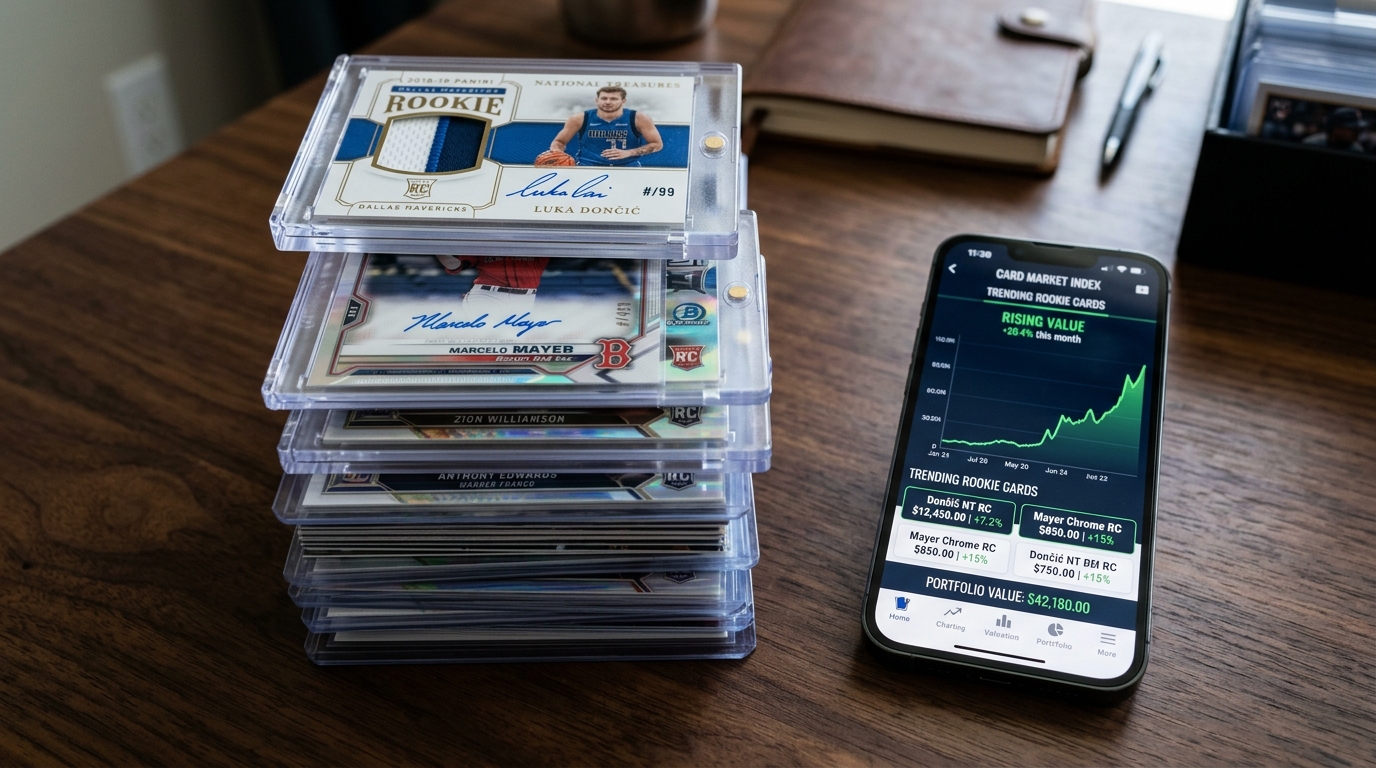
If you want to maximize your returns, learning how to price sports cards for selling is the single most important skill you can develop as a collector or dealer. Trying to find the right selling price for a sports card can be a confusing experience. If you search online marketplaces, you will often find the exact same card listed for wildly different prices—one seller might ask for $25 while another demands $150. Many beginner collectors make the mistake of choosing a price based on these active listings, only to wonder why their cards sit unsold for months.
To price your cards successfully, you must ignore what sellers are asking and look at what buyers are actually paying. This guide outlines a reliable, step-by-step framework to value your sports cards, research historical transactions, account for condition, select the right platform, and price them to sell.
Key Takeaway: Real market value is determined by completed sold transactions, not optimistic active listings. Always check historical sold comps before setting your price.
Why “Asking Prices” are a Mirage in the Card Market
Before diving into the mechanics of valuation, it is essential to understand why listing prices on sites like eBay or Sportlots are highly unreliable. The sports card market is not a retail store with fixed MSRPs; it functions like an active stock exchange driven by real-time supply, demand, and player performance.
Anyone can list any card for any price. A seller might list a common $1 card for $1,000 in the hope that an uninformed buyer makes a mistake, or they might set a high price to serve as a placeholder while they wait for a player’s hype to peak. If you base your pricing on these active listings, you will inevitably overprice your inventory, resulting in dead listings that lose search visibility over time. To avoid this, your pricing strategy must be rooted in hard data: historical transaction records showing the actual market-clearing price.
The 3-Step Card Valuation Method
Avoid overpricing or underpricing by following this systematic, data-driven approach:
Step 1: Decode the Card Details
Before searching for prices, you must identify the exact variation of your card. Look at the back of the card to find the copyright year, manufacturer (Topps, Panini, Upper Deck, Bowman), set name, and card number. On the front, check for special characteristics such as a serial number (e.g., 45/99) or a parallel finish (refractor, color borders, or holofoil).
Even a small difference in parallel type can change a card’s value from $2 to $200. For instance, a standard base rookie card of a star player might sell for $5, while the “Silver Prizm” variation sells for $50, and a “Gold Prizm” numbered to /10 sells for $1,500. If you are unsure of the card’s set or parallel variation, scan the front with the CardMint app to instantly extract its exact attributes.
Step 2: Extract Completed Sales Data (Sold Comps)
Go to eBay and search for your card name, year, and number. Scroll down the left sidebar and toggle the “Sold Items” filter. This shows you the actual prices buyers paid in recent weeks.
- High-Volume Cards: Focus on sold listings from the last 14 to 30 days to capture current market momentum. If a player is on a hot streak, prices from 30 days ago might already be outdated.
- Low-Volume / Rare Cards: If the card only trades a few times a year, expand your search window to 90 days or check niche platforms like COMC or PSA’s Standard Market Report (SMR).
- Using 130Point and Terapeak: When an eBay item sells via a “Best Offer,” eBay displays the original asking price with a strike-through line, hiding the actual accepted offer. Use free tools like 130Point.com or eBay’s built-in Terapeak research tool (available in the Seller Hub) to find the exact dollar amount the buyer paid.
- Outlier Filter: Ignore unusually high or low sales. Base your target price on the average cluster of completed sales. If five copies of a card sold for $20, $22, $19, $21, and one copy sold for $45, the $45 sale is an outlier (often due to a buyer mistake or shill bidding) and should be ignored.
Step 3: Grade the Physical Condition
A card’s physical state dictates its price tier. Even minor edge wear or a small scratch can reduce a card’s raw value by more than half. Grade your raw cards honestly using these standard hobby criteria:
- Near Mint-Mint (NM-MT): Sharp corners, clean edges, good centering, and no visible surface scratches. Focus on the full average sold comp price.
- Excellent-Mint (EX-MT): Minor corner softness or slight surface wear. Expect to price at 70-80% of NM-MT value.
- Very Good (VG): Rounded corners, minor creasing, or edge chipping. Price at 30-50% of NM-MT value.
- Poor / Fair (PR-FR): Heavy creasing, water damage, ink marks, or severe edge wear. Price at 10-20% of NM-MT value.
If you have a high-value rookie card, consider getting it graded by PSA, BGS, or CGC. Graded cards in pristine condition (such as a PSA 10) frequently sell for several times the value of their raw counterparts. Use CardMint’s AI card grading tool to pre-check your card’s condition before paying for professional grading.
Detailed Pricing Rules by Card Era and Category
Different eras and card variations follow distinct market dynamics:
Modern Rookie Cards (Post-2000)
Modern rookie card values fluctuate rapidly based on real-time performance, injury news, and media hype. When dealing with modern rookie cards, you must check very recent 7-to-14-day sold comps during the active season. If you are new to rookie cards, read our guide on what RC means on a sports card for a primer on why they carry a premium.
For modern cards, the grade is everything. The supply of modern cards is often high, meaning raw cards that are not in pristine condition carry a significant discount. A raw modern rookie might sell for $15, while a PSA 10 sells for $150, but a PSA 9 might only fetch $20.
Vintage Cards (Pre-1980)
Vintage pricing is highly sensitive to physical condition, but unlike modern cards, collectors are much more forgiving of wear. A vintage card from the 1950s does not need to be a PSA 10 to hold immense value; even a PSA 1 or PSA 2 (Poor to Good) copy of a legendary player like Mickey Mantle or Hank Aaron can sell for hundreds or thousands of dollars.
When pricing vintage cards:
- Focus heavily on centering and eye appeal. A well-centered vintage card with soft corners will often outsell an off-center card with sharper corners.
- Use specialized vintage databases and auction houses (like Heritage Auctions, REA, or Mile High Card Co) to find comps for high-end vintage items.
- Refer to Beckett price guides for historical context, but always defer to recent real-world transactions.
Numbered Parallels and Inserts
Modern cards feature a dizzying array of parallel variations, often differentiated by color borders or foil patterns. Serial-numbered cards represent a guaranteed scarcity. When pricing numbered cards, apply these multiplier guidelines if direct comps are unavailable:
- Low-print runs (e.g., /10 or 1-of-1): These rarely have direct, recent comps. You must find comps for similar players in the same set, or find comps for the same player in a different but comparable set.
- Graduated Multipliers: A parallel numbered to /25 typically sells for 3x to 5x the price of a parallel numbered to /99 of the same player. Use this ratio to estimate prices if you only have comps for one tier.
Autographed and Relic Cards
Autographed cards are highly prized, but the style of autograph matters:
- On-Card Autographs: The player signed their name directly onto the card. These command a 20% to 50% price premium over sticker autographs.
- Sticker Autographs: The player signed a sheet of clear stickers, which the manufacturer later applied to the card. These are less desirable.
- Relic / Patch Cards: Cards containing a piece of player-worn jersey or equipment. Check if the patch is “player-worn” or “game-used” (game-used is significantly more valuable). Multi-colored patches (with stitching, logos, or laundry tags) sell for much more than single-colored plain jersey swatches.
- Authentication: Before purchasing or selling expensive autographed cards, learn how to spot a fake sports card to avoid counterfeit signatures and fake patch swaps.
How to Price a “One-of-One” (1/1) Card
Pricing a card that has a print run of exactly one is one of the toughest challenges in the hobby. Because there are no identical copies, you cannot simply look up recent sold comps. Instead, you must use a technique called “bracket pricing”:
- Identify the Floor: Find the sold price of the player’s next rarest card in the same set (e.g., the /5 red parallel or the /10 gold parallel). Your 1/1 must be priced higher than this floor.
- Identify the Ceiling: Look up the sold price of a 1/1 card of a comparable player in the same set. If you are selling a 1/1 rookie card of a promising young quarterback, look at what the 1/1 rookie cards of other quarterbacks drafted in the same tier recently sold for.
- Evaluate Player Tiering: Map out where your player fits compared to their peers.
- Set a High “Buy It Now” with “Best Offer”: When listing a 1/1, it is almost always best to list it at a high, optimistic fixed price (closer to your estimated ceiling) while enabling the “Best Offer” option. This allows the market to submit offers, giving you a gauge of what serious buyers are willing to pay without locking you into a low auction price.
Auction vs. Buy It Now: Choosing the Right Format
Your pricing structure depends heavily on the listing format you choose:
| Format | Best For | Pros | Cons |
|---|---|---|---|
| 7-Day Auction | Hot rookies, star players in the playoffs, ultra-rare 1/1 cards, or brand-new releases with high demand. | Quick sale (guaranteed in 7 days), high emotional bidding potential, discovers true market value. | Risk of selling far below expectations if bid timing is poor or traffic is low, vulnerable to unpaid buyers. |
| Buy It Now (Fixed Price) | Vintage cards, common cards, mid-tier players, inserts, and cards with low active demand. | Full control over the final sale price, allows you to wait for the right buyer, attracts buyers who want instant gratification. | Card can sit unsold for weeks or months, requires active price monitoring and adjusting. |
The “Best Offer” Hybrid Strategy
For most sports cards, the optimal listing strategy is Buy It Now with “Best Offer” enabled. Price the card 15% to 25% higher than the average sold comp. This gives you room to negotiate, permits buyers to feel like they are getting a bargain, and lets you accept reasonable offers while declining lowball bids.
The Hidden Impact of Shipping and Platform Fees
When you learn how to price sports cards for selling, you must account for fees and shipping costs. If you price a card at $10 but forget that platform fees and shipping will eat up $5, you will end up with a razor-thin profit margin.
1. Platform Fees
- eBay: Typically charges around 13.25% + $0.30 of the total transaction amount (including shipping and sales tax).
- COMC (Check Out My Cards): Charges processing fees to list, and cash-out fees (usually 10%) when you withdraw funds.
- Facebook Groups / Instagram: Often 0% fees if paid via PayPal Friends & Family (though using PayPal Goods & Services at 2.9% + $0.30 is highly recommended for buyer/seller protection).
2. Shipping Methods
- eBay Standard Envelope (ESE): For raw cards under $20 and weighing under 3 ounces, you can ship via eBay’s tracked envelope service for the price of a postage stamp (~$0.68 - $1.15). This is a game-changer for pricing cheap cards competitively.
- First Class Package (Bubble Mailer): For cards over $20, you must ship in a bubble mailer with cardboard protection. This costs between $4.00 and $5.00. You must decide whether to build this cost into your card’s price (e.g., “$25 with Free Shipping”) or charge it separately (e.g., “$20 + $5 shipping”). Listings with “Free Shipping” generally rank higher in search results and convert better.
Advanced Pricing Tactics: Timing the Market
Because sports cards function like liquid commodities, timing your sales around real-world events can boost your selling price by 20% to 100%:
- The Playoff Hype Cycle: The best time to sell a star player’s card is right before or during a deep playoff run. The volume of buyers spikes, leading to emotional, premium-priced purchases. Conversely, the worst time to sell is immediately after their team is eliminated, as interest drops off a cliff.
- Off-Season Deals: If you are buying inventory to flip, target the off-season when player news is quiet. If you are selling, try to hold your listings until pre-season training camp begins and hype builds up again.
- Hall of Fame Induction: Legacy players see a short-term pricing spike when they are announced as Hall of Fame inductees or when they pass away. If you have vintage inventory of a border-line candidate, wait for the official announcements to list.
- The “New Product” Window: If you rip boxes of newly released sets, sell your hits within the first 48 to 72 hours of the product release. Prices for new cards are almost always at their peak during release week due to lack of supply, after which they steadily decline as more boxes are opened and supply floods the market.
Frequently Asked Questions
What is the most accurate way to value a sports card?
The most reliable method is to check eBay’s completed and sold listings from the last 30 days. This displays the actual market clearing prices paid by real buyers. For a quick estimate, scan the card with CardMint’s AI scanner to see current low-high valuation ranges based on aggregate marketplace sales. For a broader overview of card values across sports, see our sports cards value and price guide.
Why is there a difference between raw and graded card pricing?
Graded cards have been authenticated, graded, and physically slabbed by third-party experts (like PSA, BGS, or SGC), which guarantees their condition. A perfect PSA 10 or BGS 9.5 card represents the highest possible quality and commands a massive price premium over raw, unverified copies of the same card because it removes all risk of hidden surface scratches or centering issues for the buyer.
How do I price card lots or bulk collections?
Sort out cards worth more than $5 to $10 to sell individually. For common cards or base prints worth under $2, group them together by team, player, or set year and list them as bulk lots. Pricing bulk lots at 10-20% of individual card values is a great way to move large volumes of cards quickly while saving on individual shipping costs.
Should I use auctions or Buy It Now for my listings?
Use auctions for highly sought-after, liquid cards—like a rookie card of a player who just won the MVP or a newly released product. Use Buy It Now with Best Offer enabled for 90% of your inventory, as it gives you control over the price and allows you to negotiate with interested collectors over time.
How does player performance or injury affect card pricing?
Sports cards behave like volatile stocks. If a player gets injured, their card values can drop by 20% to 50% overnight. Conversely, if a player is traded to a contending team, wins a championship, or has a breakout playoff game, their cards will spike. Successful sellers monitor sports news and adjust their pricing dynamically to capitalize on these shifts.
Pre-Grade & Track Values Instantly with CardMint
CardMint is the ultimate all-in-one scanner for sports card and TCG collectors, saving you time and money.
Simply scan the front of your card. Our AI instantly identifies the card details, checks current pricing metrics, and gives you a centering and wear pre-grade report before you submit to PSA/BGS.
