
Most Valuable Mickey Mantle Cards: The Definitive Price & Rarity Guide (2026)
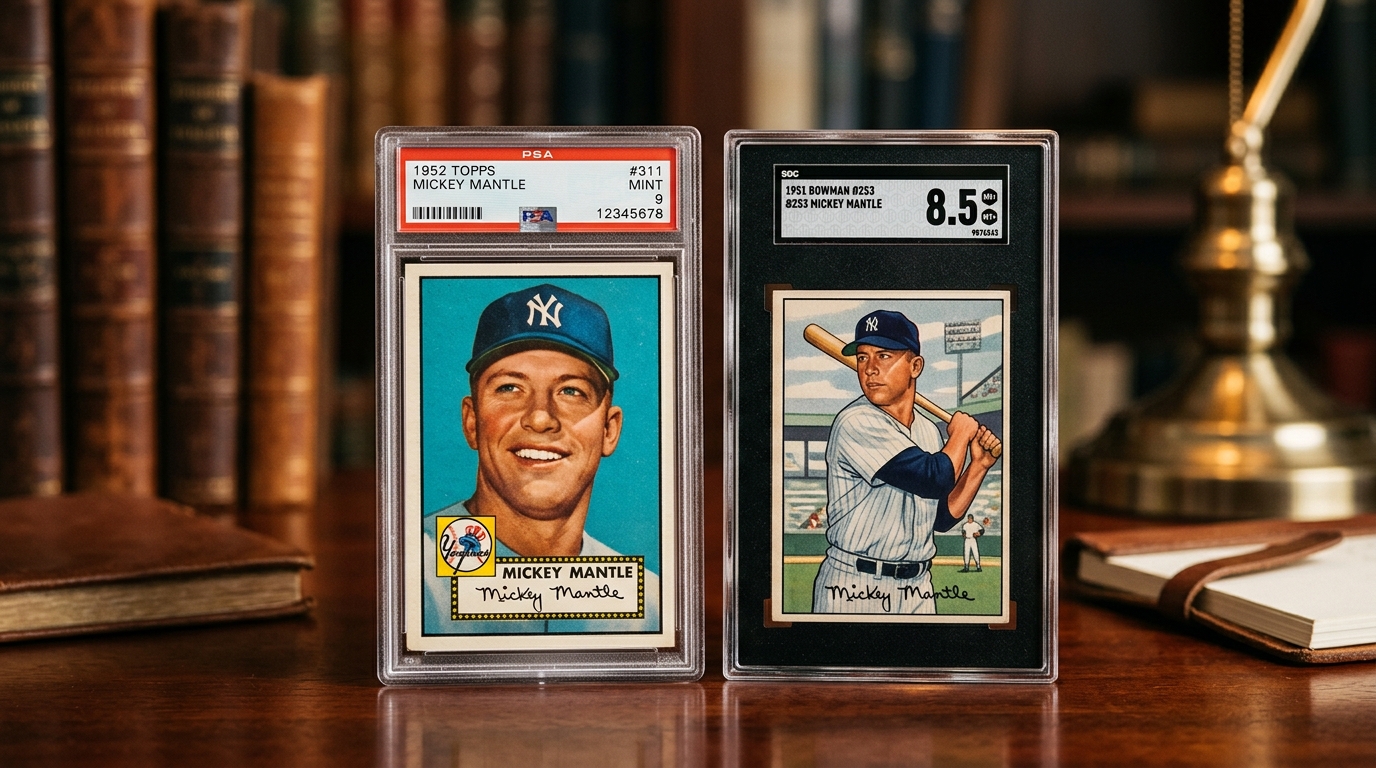
Tracking the most valuable mickey mantle cards is the ultimate benchmark for vintage sports card collectors and serious alternative asset investors. Known affectionately across generations as “The Commerce Comet,” Mickey Mantle captured the imagination of post-war America with tape-measure home runs, seven World Series rings, and three American League Most Valuable Player awards while patrolling center field for the New York Yankees. Yet his cultural imprint extends far beyond the diamond: Mantle represents the foundational bedrock of modern sports memorabilia trading.
When sports collectibles transitioned from shoebox nostalgia into a sophisticated institutional asset class, Mantle cards served as the primary catalyst. His cards routinely set all-time auction records, outperforming blue-chip stock equities, real estate indices, and traditional fine art. When evaluating the most expensive baseball card sales in global auction history, Mantle consistently occupies the pinnacle of the market, led by the legendary 1952 Topps #311 which surpassed $12.6 million.
Whether you have inherited a vintage family collection, are hunting raw finds at regional card shows, or are looking to allocate capital into certified investment-grade cardboard, understanding the hierarchy of Mantle issues is paramount. In this definitive 2026 guide, CardMint breaks down the historical context, population scarcity, condition sensitivities, and verified market valuations for the most sought-after Mickey Mantle cards ever printed.
Key Investment Takeaway: While the 1952 Topps #311 commands the highest gross dollar volume in the entire sports hobby, the 1951 Bowman #253 is Mickey Mantle’s true recognized rookie card. For mid-tier and high-end vintage collectors, card centering, corner sharpness, and original print paper registration create exponential valuation chasms between neighboring numerical grades.
Complete Ranking of the Most Valuable Mickey Mantle Cards
The following ranking details the premier Mickey Mantle cards across his playing career (1951–1969), evaluated by historical auction milestones, population reports, and current market demand.
+-------------------------------------------------------------------------------+
|                MICKEY MANTLE BLUE-CHIP CARD VALUE MATRIX (2026)               |
+-------------------------------------------------------------------------------+
| Card Issue & Number           | Designation      | PSA 8 / NM-MT   | All-Time Record Sale |
+-------------------------------------------------------------------------------+
| 1. 1952 Topps #311            | High-Number Icon | $1,850,000+     | $12,600,000 (SGC 9.5)|
| 2. 1951 Bowman #253           | True Rookie Card | $480,000+       | $3,192,000 (PSA 9)   |
| 3. 1953 Topps #82             | Painted Artwork  | $115,000+       | $396,000 (PSA 9)     |
| 4. 1956 Topps #135            | Triple Crown MVP | $65,000+        | $360,000 (PSA 9)     |
| 5. 1954 Bowman #65            | Solo License Era | $42,000+        | $216,000 (PSA 9)     |
| 6. 1955 Bowman #202           | Color TV Set     | $32,000+        | $144,000 (PSA 9)     |
| 7. 1957 Topps #95             | Real Photo Duel  | $28,000+        | $156,000 (PSA 9)     |
| 8. 1969 Topps #500 (White)    | Career Farewell  | $18,500+        | $84,000 (PSA 10)     |
+-------------------------------------------------------------------------------+
1. 1952 Topps Mickey Mantle #311: The Crown Jewel of Post-War Collecting
Although technically not his rookie card, the 1952 Topps #311 Mickey Mantle is universally celebrated as the most recognizable and prestigious sports card on planet Earth. Designed by Topps executive Sy Berger in his Brooklyn apartment, the 1952 Topps baseball release revolutionized the industry by introducing larger card dimensions (2-5/8“ by 3-3/4“), full-color painted portraits, team logos, detailed player biographies, and simulated player facsimile autographs.
+-------------------------------------------------------------------------------+
|                        1952 TOPPS #311 SPECIFICATIONS                         |
+-------------------------------------------------------------------------------+
| Release Series        | High-Number Series (Cards #311 - #407)                |
| Card Dimensions       | 2-5/8" x 3-3/4" (Standard 1952-1956 Vintage)          |
| Key Identifying Marks | Cyan blue background, Yankees bat-and-hat emblem      |
| Front Variations      | Type 1 (Star border left) vs Type 2 (Chevron right)   |
| Record Auction Comp   | $12,600,000 (Heritage Auctions, August 2022, SGC 9.5) |
| Total PSA Population  | ~1,900 across all grades (Only 3 PSA 10s exist)       |
+-------------------------------------------------------------------------------+
The Atlantic Ocean Barge Dump and High-Number Scarcity
The astronomical valuation of the 1952 Topps #311 is directly rooted in an infamous distribution disaster. Card #311 was placed in the final sixth series (“high numbers,” cards #311 through #407). By the time these high-number wax packs arrived in retail candy shops in late autumn 1952, school children had moved their sporting attention and allowance pennies from baseball to football.
Hundreds of cases of unsold high-number inventory sat abandoned in a Topps warehouse in Brooklyn for nearly eight years. In 1960, desperately needing storage space, Sy Berger loaded thousands of pristine, uncirculated high-number 1952 Topps packs and wax boxes onto a garbage barge and dumped them into the Atlantic Ocean off the coast of New Jersey. This disposal destroyed tens of thousands of potential Gem Mint Mantle cards, instantly creating the modern supply bottleneck that fuels multi-million-dollar valuations.
Condition Obstacles & Grading Variables
Achieving a high numerical grade on the 1952 Topps Mantle is extraordinarily difficult. Because the cards were packaged alongside sticks of bubble gum, many raw copies suffer from corrosive wax stains on the reverse card back or grease penetration across the front portrait. Furthermore, the high-speed industrial cutting blades of the era produced severe 80/20 or 90/10 centering flaws. When evaluating centering, collectors must consult professional baseball card grading standards, as even a minor diamond cut or tilt will knock a specimen down to a qualifier grade.
2. 1951 Bowman Mickey Mantle #253: The True Rookie Card
While the 1952 Topps captures mainstream auction headlines, purists and advanced sports historians revere the 1951 Bowman #253 as Mickey Mantle’s legitimate rookie card. Released during Mantle’s debut season when the 19-year-old phenom wore uniform #6 before switching to his iconic #7, this card represents the true genesis of his professional cardboard legacy.
+-------------------------------------------------------------------------------+
|                        1951 BOWMAN #253 SPECIFICATIONS                        |
+-------------------------------------------------------------------------------+
| Format Orientation    | Horizontal (Landscape)                                |
| Card Dimensions       | 2-1/16" x 3-1/8" (Smaller Vintage Bowman Format)      |
| Card Number           | #253 (High Series, Cards #253 - #324)                 |
| Record Auction Comp   | $3,192,000 (Heritage Auctions, PSA 9 Mint)            |
| Key Condition Flaws   | Centering shift, vertical print lines, edge chipping  |
+-------------------------------------------------------------------------------+
The Horizontal Format & High-Series Challenge
Bowman designed its 1951 set with miniature artistic paintings reproduced on narrow card stock. Unlike the majority of the checklist, Mantle’s card was designed in a horizontal landscape layout, depicting the young slugger holding a bat over his right shoulder against a picturesque outfield grandstand backdrop.
Just like the 1952 Topps release, the 1951 Bowman Mantle was situated in the scarce high-series block (#253-#324). Production quantities for high series cards were substantially lower than low series sheets, ensuring that far fewer examples survived the decade. In high grades (PSA 8 or higher), the 1951 Bowman is actually considerably rarer in total population count than the 1952 Topps. Only one PSA 10 Gem Mint copy exists on the PSA Population Report, and it has not crossed an auction block in decades.
Preserving Card Stock Integrity
The 1951 Bowman card stock was softer and more fibrous than the layered cardboard later introduced by Topps. As a consequence, corners chip and fray with the slightest handling. Learn how to store baseball cards in rigid archival magnetic holders and semi-rigid sleeves to prevent cardboard degradation if you are fortunate enough to own a raw vintage copy.
3. 1953 Topps Mickey Mantle #82: The Oil-Painted Masterpiece
Following their triumph in 1952, Topps raised the aesthetic bar with the 1953 Topps baseball set. Card #82 features a breathtaking, full-bleed oil painting of Mantle glancing upward toward Yankee Stadium’s iconic facade. Renowned artist Gerry Dvorak painted the portraits directly onto canvas boards, giving the 1953 release an artistic elegance unmatched by modern photography.
+-------------------------------------------------------------------------------+
|                        1953 TOPPS #82 MARKET DYNAMICS                         |
+-------------------------------------------------------------------------------+
| Visual Format         | Vertical hand-painted portrait                        |
| Border Styling        | Solid black lower nameplate banner                    |
| PSA 7 Near-Mint Comp  | $35,000 - $48,000                                     |
| PSA 8 NM-MT Comp      | $110,000 - $145,000                                   |
| All-Time Record Sale  | $396,000 (Heritage Auctions, PSA 9 Mint)              |
+-------------------------------------------------------------------------------+
The Black Border Nightmare
From a grading perspective, the 1953 Topps Mantle is notorious for condition fragility. The bottom fifth of the card face features a solid black nameplate panel displaying Mantle’s facsimile signature and team emblem. Because this panel is printed with deep black ink over white cardboard, even microscopic paper friction or handling creates glaring white edge flakes and corner dings.
PSA reports confirm that finding a 1953 Topps Mantle with a pristine black bottom border is one of the toughest challenges in vintage collecting. A copy that grades PSA 8 commands six figures, while mid-grade PSA 4 to PSA 6 copies remain the sweet spot for blue-chip portfolio builders looking for strong long-term appreciation.
4. 1956 Topps Mickey Mantle #135: The Historic Triple Crown Season
In 1956, Mickey Mantle produced one of the most dominant statistical campaigns in Major League Baseball history. Winning the elusive Triple Crown, Mantle led both leagues with a .353 batting average, 52 home runs, and 130 RBIs, culminating in a unanimous AL MVP award and a World Series championship over the Brooklyn Dodgers.
His card for that legendary year, 1956 Topps #135, is a masterpiece of horizontal visual composition. The left half displays a smiling close-up portrait of Mantle in his navy Yankees cap, while the right half captures an action rendering of Mantle leaping over a stadium outfield wall to rob an opposing batter of a home run.
+-------------------------------------------------------------------------------+
|                       1956 TOPPS #135 BACK VARIATIONS                         |
+-------------------------------------------------------------------------------+
| White Back Variant    | Printed on cream/white cardstock; higher contrast     |
| Gray Back Variant     | Printed on traditional darker recycled cardboard stock|
| Population Breakdown  | Gray backs are slightly scarcer; white backs look cleaner|
| PSA 8 Benchmark       | $60,000 - $75,000                                     |
| PSA 9 Benchmark       | $300,000 - $360,000                                   |
+-------------------------------------------------------------------------------+
The 1956 Topps issue was also the final year Topps utilized the large-card format before transitioning to the modern standard 2-1/2“ by 3-1/2“ dimensions in 1957. Collectors actively debate whether to target the White Back or Gray Back variation. While Gray Backs carry a slightly lower overall population, White Back copies typically command equal or superior prices due to superior visual eye appeal and crisper cartoon ink registration.
5. Other Essential Mickey Mantle Cards for Collectors
Beyond the top four titans, several other Mantle releases from the Golden Era of collecting command substantial five-figure and six-figure valuations.
+-------------------------------------------------------------------------------+
|                  ADDITIONAL HIGH-VALUE MICKEY MANTLE RELEASES                 |
+-------------------------------------------------------------------------------+
| Year & Set            | Card Number | Distinct Feature                        |
+-------------------------------------------------------------------------------+
| 1954 Bowman           | #65         | Exclusive contract year; sharp portrait |
| 1955 Bowman           | #202        | Iconic walnut-woodgrain Color TV frame  |
| 1957 Topps            | #95         | First real color photography card       |
| 1969 Topps (White)    | #500        | Last regular-issue card; rare lettering |
+-------------------------------------------------------------------------------+
1954 Bowman #65
Due to an aggressive legal war over player licensing between Topps and Bowman in 1954, Mantle signed an exclusive endorsement contract with Bowman. Consequently, Mickey Mantle does not appear in the 1954 or 1955 Topps base sets! This exclusive status makes the 1954 Bowman #65 his sole mainstream cardboard appearance that season. Featuring a stunning painted close-up, high-grade copies of card #65 are fiercely contested whenever they appear at major auction houses.
1955 Bowman #202: The Color TV Set
Bowman’s 1955 release is celebrated as one of the most inventive vintage designs ever printed. Known as the “Color TV” set, each card is enclosed inside a mock horizontal television console complete with polished walnut woodgrain borders and an antenna knob design. The #202 Mantle is an undeniable fan favorite, capturing the mid-1950s transition of Major League Baseball into living rooms across the nation.
1957 Topps #95: The Photography Revolution
The 1957 Topps set marked a watershed technological moment for sports cards. Topps transitioned away from painted artist interpretations, introducing real color action photography and adopting the standardized modern card dimension of 2-1/2“ by 3-1/2“. Card #95 showcases Mantle following through on his swing, with his bat cocked behind his shoulders. Because 1957 cards feature borderless photographs on the reverse and minimalist white frames on the front, surface print defects (known as “snow”) are prevalent, elevating pristine PSA 9 copies into $150,000+ assets.
1969 Topps #500: The White Letters Variation
Mantle retired during spring training in March 1969, making the 1969 Topps #500 his final regular-issue career card. While the standard card features “MICKEY MANTLE” printed in yellow block letters at the top, an early print run variation features his name printed in solid White Letters. This uncorrected scarcity is vastly rarer than the standard yellow version, with PSA 9 examples approaching six-figure sales.
Vintage Condition Sensitivity & The Grading Multiplier
In vintage sports cards, the numerical grade assigned by third-party authenticators does not simply correlate linearly with value—it acts as an exponential multiplier. Understanding how grading tiers impact market pricing is essential before buying or selling high-ticket vintage memorabilia.
+-------------------------------------------------------------------------------+
|               1952 TOPPS MICKEY MANTLE GRADE-TO-VALUE EXPONENT                |
+-------------------------------------------------------------------------------+
| Grade Tier            | Typical Numerical Grade | Realized Auction Comp Range |
+-------------------------------------------------------------------------------+
| Authentic / Poor      | PSA 1 (Poor)            | $25,000 - $35,000           |
| Good to Very Good     | PSA 2 - 3 (GD - VG)     | $45,000 - $75,000           |
| Excellent             | PSA 5 (EX)              | $110,000 - $140,000         |
| Near Mint             | PSA 7 (NM)              | $320,000 - $450,000         |
| Near Mint-Mint        | PSA 8 (NM-MT)           | $1,750,000 - $2,100,000     |
| Mint                  | PSA 9 (Mint)            | $4,500,000 - $5,500,000     |
| Gem Mint              | SGC 9.5 / PSA 10        | $12,600,000+ (Record)       |
+-------------------------------------------------------------------------------+
Notice the colossal leap between a PSA 7 ($350k) and a PSA 8 ($1.8M+). That 5x price difference reflects the sheer scarcity of high-grade survivors. For comprehensive analysis comparing third-party grading tiers, read our detailed comparison of PSA vs BGS to understand slab liquidity and auction house preferences.
To calculate accurate valuations for vintage cards across diverse grading conditions, always cross-reference recent completed auction sales with our guide on sports card value.
Counterfeit Alert: How to Spot Fake Mickey Mantle Cards
Because Mickey Mantle cards command life-changing sums of money, they are the most frequently forged and counterfeited collectibles in the world. Unscrupulous sellers routinely artificially age modern reprints by soaking them in tea, baking them in ovens, or rubbing coffee grounds along card edges to mimic seven decades of natural patina.
+-------------------------------------------------------------------------------+
|                    VINTAGE AUTHENTICITY INSPECTION MATRIX                     |
+-------------------------------------------------------------------------------+
| Inspection Method     | Authentic Vintage Feature    | Modern Fake / Counterfeit|
+-------------------------------------------------------------------------------+
| 60x Magnifier / Loupe | Solid black ink lines; crisp | CMYK dot matrix rosettes |
| Blacklight (UV Test)  | Dull cardboard, no glow      | Intense bright blue glow |
| Caliper Thickness     | 0.018 - 0.020 inch thickness | Thin glossy paper stock  |
| Natural Paper Scent   | Dry, musty vintage cellulose | Chemical, ink, or burnt  |
+-------------------------------------------------------------------------------+
1. The Halftone Rosette Pattern Test
Under a 30x to 60x jeweler’s loupe, authentic 1952 Topps cards reveal solid black lines for the player’s name, border outlines, and facsimile signatures. Counterfeit cards produced with modern digital ink-jet or laser printers break down into microscopic multicolored dots (halftone rosettes) across every element, including text and borders. If you see tiny color specks inside the solid black lines, the card is counterfeit.
2. UV Blacklight Fluorescence
Before the late 1960s, card manufacturers did not use synthetic chemical optical brighteners in paper pulp. Authentic vintage cardboard absorbs ultraviolet light and appears dark or muddy under a 395nm blacklight. In contrast, modern paper containing chemical bleach glows an intense bright fluorescent blue or neon white. For deeper hands-on testing protocols, study our master guide on how to spot fake sports card anomalies.
How to Monetize Your Vintage Mickey Mantle Cards
If you own an authentic Mickey Mantle card and wish to liquidate your asset, choosing the right distribution channel is critical to maximizing your net return.
+-------------------------------------------------------------------------------+
|                   VINTAGE CARD LIQUIDATION CHANNEL COMPARISON                 |
+-------------------------------------------------------------------------------+
| Sales Channel         | Best Suited For             | Fee Structure           |
+-------------------------------------------------------------------------------+
| Major Auction Houses  | Graded PSA 7+ ($50k+ cards) | 10% - 20% Buyer Premium |
| Fixed-Price Vaults    | Graded PSA 3 - 6 ($5k-$40k) | 5% - 8% Seller Fee      |
| In-Person Card Shows  | Raw / Estate Lots           | Cash / Immediate Trade  |
+-------------------------------------------------------------------------------+
For high-end Mantle cards valued over $25,000, premier auction houses such as Heritage Auctions, Goldin Auctions, and REA (Robert Edward Auctions) offer dedicated vintage client bases and global marketing campaigns that generate maximum bidding competition. When preparing your collectibles for sale, follow our professional guide on how to sell sports cards to minimize platform consignment commissions, structure shipping insurance, and protect against wire fraud.
Understanding vintage designation labels is also vital when cataloging collections; make sure you understand what RC means on vintage trade checklists so you do not confuse regular-issue tribute cards with true rookie pieces.
Frequently Asked Questions
What is the single most expensive Mickey Mantle card ever sold?
The single most expensive Mickey Mantle card in history is a 1952 Topps Mickey Mantle #311 graded SGC 9.5 (Mint+), which sold for $12.6 million at Heritage Auctions on August 28, 2022. This landmark transaction made it the highest-priced sports card and sports memorabilia item ever sold at public auction, surpassing the previous $7.25 million record held by the T206 Honus Wagner.
Is the 1952 Topps Mickey Mantle considered his official rookie card?
No, the 1952 Topps #311 is not Mickey Mantle’s official rookie card. His true, officially recognized rookie card is the 1951 Bowman #253, issued during his debut rookie season in 1951. The 1952 Topps card is Mantle’s first regular-issue card with Topps Chewing Gum, but it was released during his second full season in the Major Leagues.
How many 1952 Topps Mickey Mantle cards exist in PSA 10 Gem Mint condition?
There are only three known copies of the 1952 Topps Mickey Mantle #311 graded PSA 10 Gem Mint on the official PSA Population Report. None of these three copies have appeared at a public auction in over two decades. If one were to reach the open market today, industry experts estimate it would command between $25 million and $30 million.
How can I tell if my vintage Mickey Mantle card is real or a reprint?
You can verify authenticity by conducting three physical tests: inspecting black text and borders under a 60x loupe for solid ink lines (counterfeits show digital rosette dot patterns), shining an ultraviolet blacklight on the card to ensure it does not glow neon blue, and measuring paper thickness with a micrometer (authentic cards measure between 0.018 and 0.020 inches). For definitive certification, submit the card to PSA or SGC for professional third-party grading.
What is the difference between a 1956 Topps White Back and Gray Back Mantle?
The difference lies in the color of the recycled cardboard stock used on the reverse. White Back copies were printed on brighter, cream-colored cardstock, giving the cartoons and statistics higher visual contrast. Gray Back copies were printed on traditional darker grayish paper stock. While Gray Backs are technically slightly scarcer in overall population count, both versions command comparable market values when preserved in identical high-grade condition.
Pre-Grade & Track Values Instantly with CardMint
CardMint is the ultimate all-in-one scanner for sports card and TCG collectors, saving you time and money.
Simply scan the front of your card. Our AI instantly identifies the card details, checks current pricing metrics, and gives you a centering and wear pre-grade report before you submit to PSA/BGS.
