
Most Valuable Rookie Cards: Ultimate Collector & Price Guide
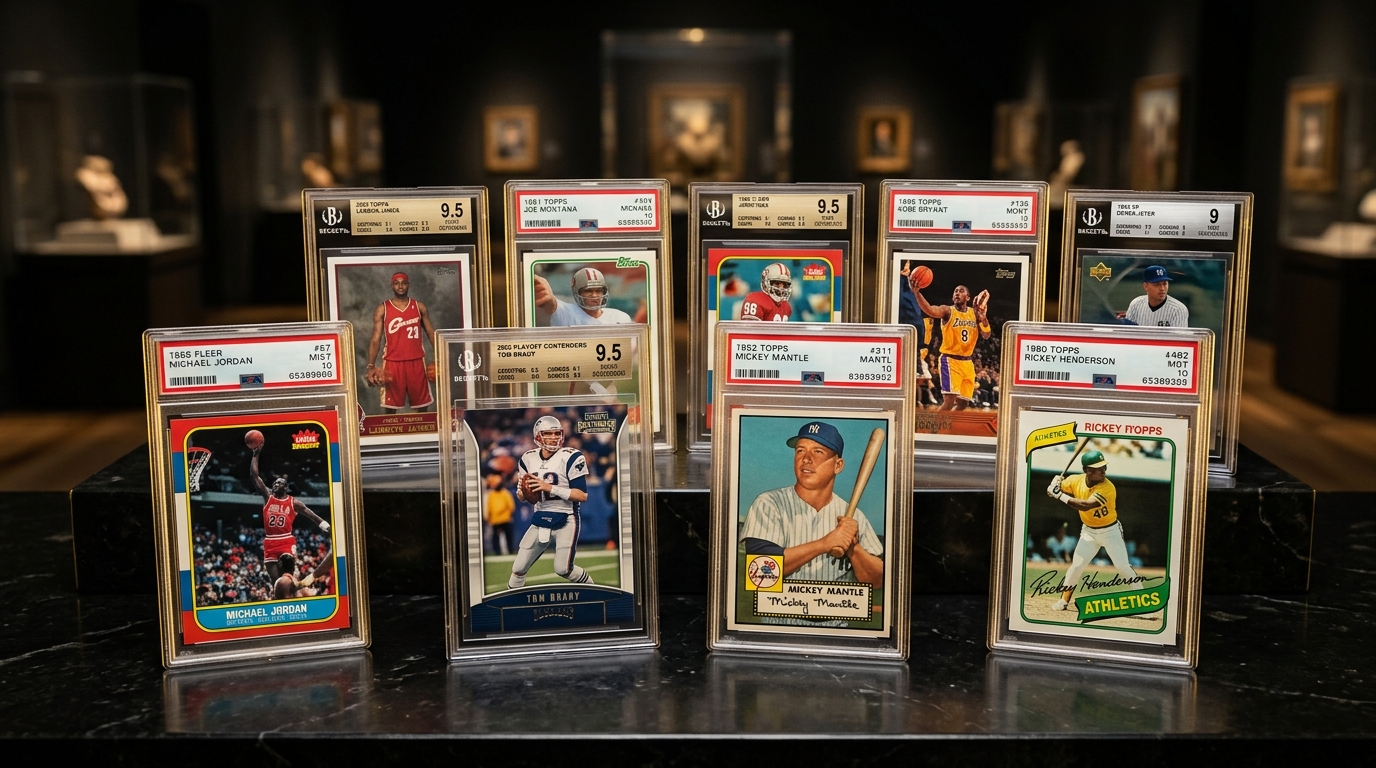
Investing in the most valuable rookie cards has become one of the most lucrative pursuits in the modern sports collectibles market. Across baseball, basketball, football, and hockey, a player’s official first-year trading card represents the pinnacle of liquidity, historical prestige, and financial appreciation. Whether you are holding a 1952 Topps Mickey Mantle in a bank vault or chasing ultra-modern Panini National Treasures Rookie Patch Autographs (RPAs) of current superstars, rookie cards serve as the gold standard for sports card collectors worldwide.
The market for trading cards has evolved from an informal schoolyard hobby into a quantitative, multi-billion-dollar alternative asset class. Modern investors rely on population reports, auction sales archives, and real-time market tools like CardMint to identify high-potential cards before market breakouts occur. In this definitive guide, we analyze the top most valuable rookie cards in sports history, break down the core mechanics that drive multi-million-dollar valuations, and provide actionable strategies to evaluate, grade, and protect your rookie card investments.
What Makes a Rookie Card the Holy Grail of Sports Collectibles
In sports card collecting, a player will have thousands of different cards printed throughout their career. However, none carry the market prestige or price appreciation potential of their official rookie card. Understanding the underlying mechanics of rookie card valuation is essential before committing significant capital to the market.
The Magic of the RC Logo and True Rookie Distinction
A true rookie card (often designated with an official “RC” logo on modern cards) is defined as a player’s first base-set card featured in a fully licensed, nationally distributed mainstream product. To learn more about how card manufacturers define these releases, read our deep dive on what RC means.
While prospect cards, pre-rookie inserts, and regional issues exist, the market consistently places its highest financial premium on true base rookie cards and their associated parallel variations. The single season representing a player’s rookie debut creates a strictly fixed supply that can never be expanded or reprinted.
Pop Counts, Gem Mint Multipliers, and Scarcity
The valuation of any sports card is driven by supply and demand, but for rookie cards, condition rarity amplifies price exponentially. Third-party grading companies such as PSA (Professional Sports Authenticator) and BGS (Beckett Grading Services) publish public population reports (“pop counts”) detailing how many copies of a specific card exist in each grade.
For vintage cards printed prior to 1980, finding an example in “Gem Mint” (PSA 10) condition is exceedingly rare due to poor print centering, rough paper stock, and decades of handling. A vintage rookie card graded PSA 8 might sell for $5,000, while a PSA 10 copy of the exact same card can command over $100,000—a 20x Gem Mint multiplier. To understand how third-party grading impacts liquidity and ROI, explore our complete guide on how to grade sports cards.
Player Legacy and Cultural Impact
While print population creates scarcity, player performance drives demand. A rookie card’s value tracks the long-term career trajectory, championships, MVP awards, and Hall of Fame status of the athlete. Icons like Michael Jordan, Tom Brady, Mickey Mantle, and LeBron James transcend their respective sports, transforming their rookie cards into universal cultural artifacts comparable to fine art or rare coins.
Top Most Valuable Rookie Cards in Baseball History
Baseball cards boast the longest and richest heritage in sports collecting. From early tobacco card releases of the 1900s to modern Chrome autographs, baseball rookie cards consistently set world record auction prices. For an expanded analysis of diamond legends, check out our report on the most valuable baseball cards.
1952 Topps Mickey Mantle #311
While not technically Mantle’s first card (his 1951 Bowman card preceded it), the 1952 Topps #311 is universally recognized as the undisputed king of modern sports cards. As Card #311 in Topps’ landmark 1952 set, it was part of the notoriously scarce high-number series. Legend has it that hundreds of unsold cases of 1952 Topps high-numbers were dumped into the Atlantic Ocean in 1960 by Topps executive Sy Berger, destroying countless Mantle rookies.
In August 2022, a 1952 Topps Mickey Mantle graded SGC 9.5 (Mint+) sold at Heritage Auctions for a staggering $12.6 million, making it the most expensive sports card ever sold at public auction.
1909-11 T206 Honus Wagner
Distributed inside American Tobacco Company cigarette packs between 1909 and 1911, the T206 Honus Wagner is the ultimate grail of vintage card collecting. Wagner, a legendary shortstop for the Pittsburgh Pirates and one of the original five Hall of Fame inductees, pulled his card from production early. Whether due to a conflict over compensation or a desire not to promote tobacco use to children, fewer than 60 copies are known to exist today.
A PSA 2 (Good) example of the T206 Wagner fetched $7.25 million in a private transaction in 2022, proving that extreme historical scarcity can overcome lower physical condition grades.
1989 Upper Deck Ken Griffey Jr. #1
Representing the modern era of baseball card collecting, the 1989 Upper Deck Ken Griffey Jr. #1 changed the industry forever. Featuring a smiling 19-year-old phenom in a Seattle Mariners cap, Upper Deck placed Griffey as Card #1 in their inaugural high-end set printed on premium gloss card stock with a tamper-proof hologram.
Although printed in high quantities during the junk wax era, pristine PSA 10 Gem Mint copies remain highly sought after by collectors who grew up in the 1990s, routinely selling for $1,500 to $2,500 depending on market cycles.
2011 Topps Update Mike Trout #US175
Mike Trout’s 2011 Topps Update #US175 is the benchmark rookie card of 21st-century baseball. Released in Topps’ end-of-year update series, the base card and its colorful parallel refractors (Cognac, Hope Diamond, and 1/1 Platinum) represent modern collecting at its finest. A 1/1 Superfractor autographed parallel of Trout’s 2009 Bowman Chrome rookie card sold for $3.93 million in 2020.
Top Most Valuable Rookie Cards in Basketball
Basketball cards have experienced explosive global demand, propelled by international fanbases, NBA stardom, and iconic Panini card designs. To discover more hardwood investments, review our guide to the most valuable basketball cards.
1986 Fleer Michael Jordan #57
The 1986 Fleer Michael Jordan #57 is the premier icon of basketball card collecting. Fleer introduced its premier basketball set during Jordan’s third NBA season after a card manufacturing hiatus in the early 1980s, making Card #57 Jordan’s official consensus NBA rookie card.
Because the 1986 Fleer set featured bright red, white, and blue borders that easily chip, finding a copy with flawless edges and centering is exceptionally difficult. At the peak of the market, PSA 10 Gem Mint copies of the Jordan rookie surpassed $700,000 at auction, cementing its position as a mandatory portfolio cornerstone for serious basketball investors.
2003-04 Upper Deck Exquisite Collection LeBron James RC #78
When LeBron James entered the NBA straight out of St. Vincent-St. Mary High School in 2003, Upper Deck debuted its ultra-luxury “Exquisite Collection” product priced at $500 per pack. Card #78 featured an on-card autograph paired with an authentic game-worn patch, limited to just 99 serial-numbered copies.
In April 2021, a 2003 Exquisite LeBron James RPA numbered /99 graded BGS 9.2 with a 10 autograph sold for $5.2 million, demonstrating the immense value placed on low-numbered modern rookie patch autographs.
1996 Topps Chrome Kobe Bryant #138
The 1996 Topps Chrome basketball set introduced metallic refractor technology to the hardwood. Kobe Bryant’s rookie card #138 depicts the 18-year-old Lakers phenom driving to the basket. While the standard base card is widely accessible, the Refractor parallel version—limited to roughly 500 copies—commands massive premiums, with BGS 10 pristine examples selling for well over $250,000.
Top Most Valuable Rookie Cards in Football
Gridiron rookie cards feature some of the most dramatic value appreciation in sports collectibles. Led by legendary quarterbacks and iconic vintage sets, football card collecting continues to surge. For a full deep dive on NFL legends, explore our article on valuable football cards.
2000 Playoff Contenders Championship Ticket Tom Brady #144
Drafted 199th overall in the 2000 NFL Draft by the New England Patriots, Tom Brady went on to win seven Super Bowl titles and establish himself as the greatest football player of all time. His ultimate rookie card is the 2000 Playoff Contenders Championship Ticket autographed card, limited to just 100 hand-numbered copies.
In June 2021, a BGS 9.5 (Gem Mint) copy of Brady’s Championship Ticket rookie card sold for $3.1 million, setting the record for the most expensive football card ever auctioned.
1958 Topps Jim Brown #62
The 1958 Topps Jim Brown #62 is the cornerstone of vintage football card collecting. Featuring the legendary Cleveland Browns fullback during his dominant rookie campaign, the card is notoriously difficult to find centered with clean yellow backgrounds. PSA 9 Mint copies command over $300,000, while no PSA 10 copy has ever been graded.
2017 Panini National Treasures Patrick Mahomes RPA #161
Patrick Mahomes revolutionized modern NFL offense, leading the Kansas City Chiefs to multiple Super Bowl championships. His flagship rookie card is the 2017 Panini National Treasures Rookie Patch Autograph #161, serial-numbered to /99. Platinum 1/1 versions of Mahomes’ National Treasures RPA have crossed the $4 million mark in private sales.
Comparative Analysis of Top Rookie Cards
To compare market metrics across the most valuable rookie cards in sports history, review the summary data below:
| Player / Card | Sport | Era | Key Feature / Scarcity | Top Recorded Auction Sale |
|---|---|---|---|---|
| 1952 Topps Mickey Mantle #311 | Baseball | Vintage | High-number series, extreme organic scarcity | $12.60 Million |
| 1909-11 T206 Honus Wagner | Baseball | Pre-War | Tobacco card, ~60 copies known | $7.25 Million |
| 2003 UD Exquisite LeBron James #78 | Basketball | Modern | RPA /99, game-worn patch | $5.20 Million |
| 2017 Panini NT Patrick Mahomes #161 | Football | Ultra-Modern | RPA /99, 1/1 Platinum parallel | $4.30 Million |
| 2009 Bowman Chrome Mike Trout #BDPP89 | Baseball | Modern | 1/1 Superfractor Autograph | $3.93 Million |
| 2000 Playoff Contenders Tom Brady #144 | Football | Modern | Championship Ticket Autograph /100 | $3.10 Million |
| 1986 Fleer Michael Jordan #57 | Basketball | Vintage/Modern | Chipping-prone borders, iconic RC | $738,000 |
How to Identify, Grade, and Value Your Rookie Cards
Whether you are evaluating a inherited collection or buying raw cards online, following a systematic evaluation protocol ensures you protect your financial investment and avoid common market pitfalls.
       +-------------------------------------------------------+
       |   Step 1: Verify RC Authenticity & License Standard   |
       +-------------------------------------------------------+
                                   |
                                   v
       +-------------------------------------------------------+
       |   Step 2: Inspect Centering, Corners, Edges & Surface |
       +-------------------------------------------------------+
                                   |
                                   v
       +-------------------------------------------------------+
       |   Step 3: Cross-Reference Real-Time CardMint Valuation |
       +-------------------------------------------------------+
                                   |
                                   v
       +-------------------------------------------------------+
       |   Step 4: Submit to PSA/BGS for Encapsulation         |
       +-------------------------------------------------------+
Step 1: Confirming Authentic RC Attributes
Before investing, verify that the card is an official licensed base rookie card rather than a reprint, tribute card, or unauthorized regional oddball. Look for official league licensing (MLB, NBA, NFL) and check set checklists on CardMint. In high-value vintage cards, authentication is vital to prevent buying counterfits; learn how to safeguard your portfolio by reading our guide on how to spot fake sports cards.
Step 2: Evaluating Physical Condition Before Submission
Third-party grading fees can cost anywhere from $20 to $500 per card depending on turnaround speed and declared value. Before submitting cards to PSA or BGS, inspect four key physical condition criteria under a lighted magnifying glass:
- Centering: Measure left-to-right and top-to-bottom border symmetry. PSA 10 standards require 55/45 to 60/40 centering on the front.
- Corners: Examine all four corners for sharpness, fraying, or rounding.
- Edges: Check for chipping, silvering, or factory rough cuts along cardboard borders.
- Surface: Look for print spots, scratches, creasing, or surface wax residue.
Step 3: Leveraging AI Price Tracking Tools
Card values fluctuate based on player injuries, playoff momentum, and macroeconomic conditions. Before making an offer on a high-value rookie card, consult our real-time sports card value database and research our comprehensive guide on the best sports cards to invest in to analyze recent confirmed eBay sales, PWCC auction history, and historical price trajectories.
Frequently Asked Questions
What makes a rookie card more valuable than later base cards?
A rookie card is printed only during an athlete’s first official professional season, creating a strictly capped, non-reprintable supply. Collectors and investors view the rookie card as the definitive historical entry point of a player’s career. As a player achieves championships, individual awards, and Hall of Fame immortality, demand concentrates heavily on their official rookie card rather than later veteran releases.
How can I check if a card in my collection is a true rookie card?
To verify if a card is a true rookie card, check for the official “RC” logo printed on modern cards (introduced standard across sports in 2006). For vintage cards printed before 2006, cross-reference official set checklists to confirm that the card is from the player’s first nationally distributed, licensed base set. Cards from insert sets, subset highlights, or minor league issues are generally classified as prospects or inserts rather than true rookie cards.
Which third-party grading service adds the most value to rookie cards?
Professional Sports Authenticator (PSA) currently holds the highest market share and secondary market price liquidity for sports rookie cards. A PSA 10 Gem Mint grade typically commands the highest resale prices for modern and vintage base cards. However, Beckett Grading Services (BGS) and SGC (Sportscard Guaranty Corporation) are highly respected, with BGS 9.5/10 Pristine grades carrying significant premiums on modern autographed rookie patch cards (RPAs).
Are modern ultra-luxurious rookie cards (RPAs) safer investments than vintage cards?
Vintage rookie cards (such as 1952 Topps Mickey Mantle or 1986 Fleer Michael Jordan) offer proven historical stability, low pop counts, and established organic scarcity, making them low-volatility long-term assets. Modern Rookie Patch Autographs (RPAs) offer high upside potential tied to active player performance but carry higher volatility if a young player suffers career injuries or underperforms expectation. Diversifying across both vintage grails and elite modern RPAs provides a balanced investment approach.
How do I safely store and preserve high-value rookie cards?
To preserve physical condition and prevent surface degradation, place raw rookie cards into archival-grade penny sleeves followed immediately by rigid top-loaders or semi-rigid Card Saver I sleeves. For high-value cards, submission to PSA or BGS for permanent sonically sealed acrylic slab encapsulation offers the ultimate protection against UV light, humidity, corner wear, and physical handling damage. Always store encapsulated cards in a climate-controlled environment away from direct sunlight.
Ready to evaluate your sports card collection? Search real-time market prices, track pop counts, and monitor trending rookie cards today on CardMint!
Pre-Grade & Track Values Instantly with CardMint
CardMint is the ultimate all-in-one scanner for sports card and TCG collectors, saving you time and money.
Simply scan the front of your card. Our AI instantly identifies the card details, checks current pricing metrics, and gives you a centering and wear pre-grade report before you submit to PSA/BGS.
