
Most Valuable Baseball Cards: Ultimate Value & Price Guide
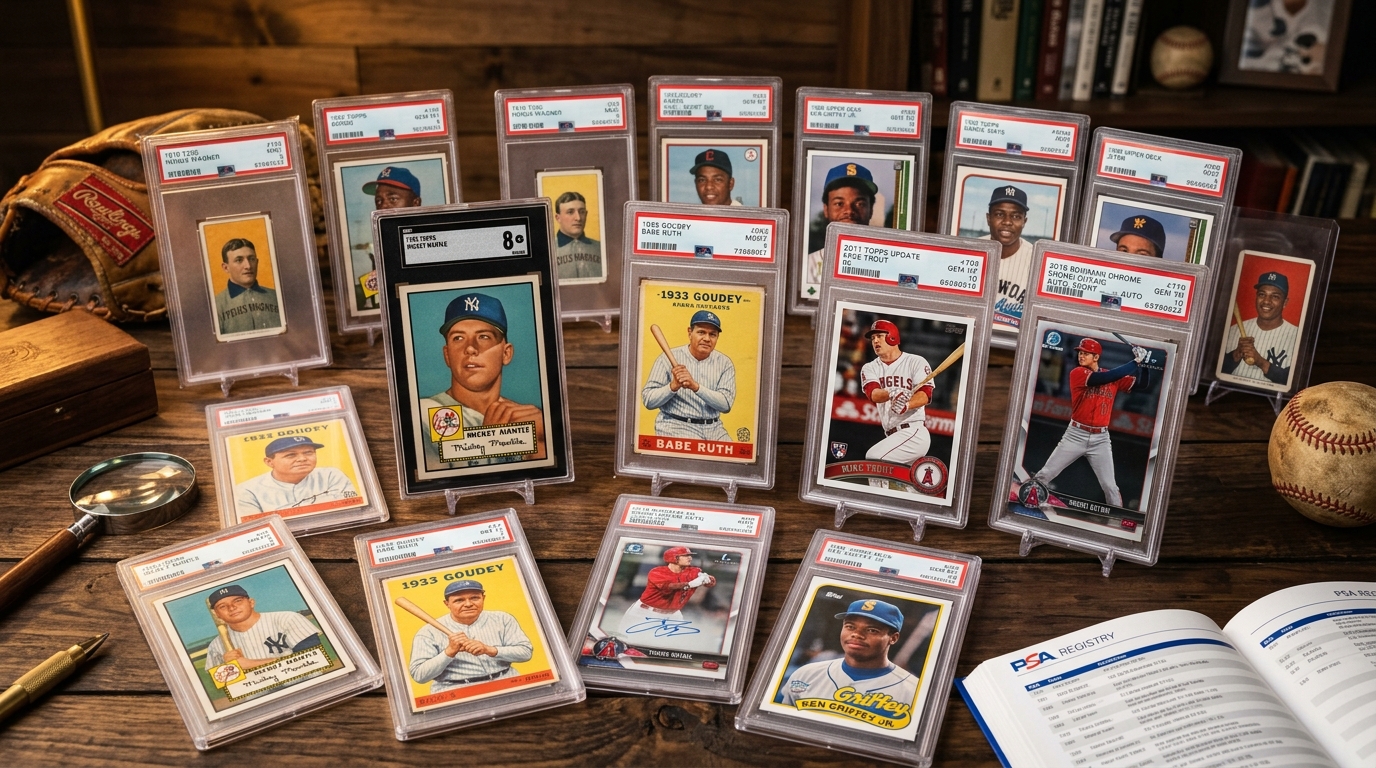
Identifying the most valuable baseball cards requires examining historical auction records, physical card condition, player hall-of-fame legacy, and real-time market demand across both vintage classics and modern parallels. Whether you inherited a binder of pre-war treasures, stumbled upon a stack of 1950s Topps commons in an attic, or actively invest in high-end Bowman Chrome prospect autographs, understanding what drives multi-million dollar sales is the key to maximizing your hobby portfolio.
The sports card investment landscape has transformed dramatically over the last decade. High-grade vintage cards of legendary icons like Mickey Mantle, Honus Wagner, and Babe Ruth now compete directly with fine art, rare coins, and real estate as blue-chip alternative assets. At the same time, ultra-modern rookie refractors and 1/1 Superfractors of modern titans like Mike Trout and Shohei Ohtani command seven-figure bids at premier auction houses like Heritage, Goldin, and REA.
Key Takeaway: The market for the most valuable baseball cards is anchored by three critical pillars: verifiable physical scarcity, professional grading slab authentication (PSA/SGC/BGS), and historical player significance. A single grade bump from a PSA 8 to a PSA 9 can turn a $50,000 card into a $500,000 windfall.
1. Top 5 Most Valuable Vintage Baseball Cards of All Time
Vintage baseball cards — specifically pre-war releases (pre-1942) and golden era Topps sets (1952–1969) — hold the vast majority of all-time price records in sports memorabilia history. Here are the five legendary cards that define the pinnacle of card collecting.
T206 Honus Wagner (1909–1911)
Widely known as “The Holy Grail of Baseball Cards,” the 1909–1911 T206 Honus Wagner remains an unquestioned titan in the hobby. Issued by the American Tobacco Company inside cigarette packs, Wagner objected to his likeness being used to promote tobacco products to children, demanding production be halted. Only an estimated 50 to 200 copies ever reached the public.
In August 2022, an SGC 2 “Grade 2” copy of the T206 Wagner sold for a staggering $7.25 million in a private transaction, breaking the previous auction record of $6.6 million held by a PSA 3 copy. Even low-grade or trimmed authentic copies fetch upwards of $1.5 million whenever they hit the market.
1952 Topps Mickey Mantle #311
While not Mickey Mantle’s official rookie card (his true rookie is the 1951 Bowman #253), the 1952 Topps #311 is the single most iconic baseball card ever produced. Positioned as card #311 in Topps’ high-number series, thousands of unsold cases were dumped into the Atlantic Ocean in 1960 by Topps executive Sy Berger, creating massive artificial scarcity for high-grade copies.
In August 2022, a 1952 Topps Mickey Mantle graded SGC 9.5 Mint+ sold at Heritage Auctions for $12.6 million, making it the most expensive sports card ever sold at public auction. Centering, vivid blue background hues, and pristine corners make high-grade examples of card #311 the undisputed king of post-war sports collectibles.
1914 Baltimore News Babe Ruth Rookie
Before George Herman “Babe” Ruth joined the Boston Red Sox or New York Yankees, he pitched for his hometown minor league team, the Baltimore Orioles. Printed on thin paper stock as an insert for the local Baltimore News newspaper, this card features a young 19-year-old Ruth in a blue or red jacket.
Fewer than 10 copies of the 1914 Baltimore News Babe Ruth are known to exist. In December 2023, an SGC 3 copy sold for $7.2 million, solidifying its place alongside the T206 Wagner as one of the rarest pre-war collectibles in existence.
1933 Goudey Babe Ruth #53 / #149 / #181 / #144
The 1933 Goudey Gum set is revered as one of the most beautiful card sets ever printed. Goudey included four distinct Babe Ruth cards in the 240-card checklist. Card #53 (the yellow background variant) and Card #181 (the red background variant) are considered the most desirable.
A PSA 9 Mint copy of the 1933 Goudey Babe Ruth #53 commanded $4.21 million at auction. The combination of vibrant pastel artwork, Babe Ruth’s cultural status, and Goudey’s historic set design makes high-grade Goudey Ruths staple holdings for high-net-worth sports investors.
1916 Sporting News Babe Ruth #151 (M101-4/5)
Featuring Babe Ruth during his rookie pitching campaign with the Boston Red Sox, the 1916 M101-4/5 Sporting News card is his true major league rookie card. Unlike his Baltimore News minor league issue, this card saw national distribution as a promotional item.
High-grade copies are extremely elusive due to the fragile paper stock and grey borders. A PSA 7 NM example crossed the auction block for $2.46 million, and collectors actively track any new discoveries that surface in vintage family estates.
2. Top Modern & Ultra-Modern Most Valuable Baseball Cards
While vintage cards rely on century-old scarcity, modern baseball cards (1980–present) derive their extreme value from serial numbering, chrome refractor technology, and certified on-card autographs.
2011 Topps Update Mike Trout #US175 (Superfractor 1/1)
Mike Trout ushered in the ultra-modern boom. His 2011 Topps Update #US175 rookie card is considered the modern equivalent of the 1952 Topps Mickey Mantle. While base PSA 10 copies sell for around $1,000–$1,200, his rare parallels command astronomical prices.
In August 2020, the 2011 Topps Update Mike Trout 1/1 Superfractor autographed card sold for $3.93 million at Goldin Auctions. This sale proved that modern prospect and rookie cards could rival pre-war vintage grails when paired with absolute 1/1 scarcity and pristine grading.
2018 Bowman Chrome Shohei Ohtani Autograph #BCAP-SO (Superfractor 1/1)
As a historic two-way phenom, 50/50 club founder, and multi-time MVP, Shohei Ohtani has rewritten baseball history books. His premier rookie autograph card — the 2018 Bowman Chrome Rookie Autographs 1/1 Superfractor — is the holy grail of modern international sports cards.
Ohtani’s rare Bowman Chrome autograph parallels routinely break sales records. Bidders worldwide compete aggressively for his BGS 9.5 and PSA 10 gem mint rookies whenever they appear at major sports auctions.
Bowman Chrome 1/1 Prospecting Superfractors
Prospecting — buying cards of unproven minor league players before they reach the major leagues — is a major driver of modern card market liquidity. The 1st Bowman Chrome Autograph Superfractor 1/1 is widely accepted as the definitive card for any prospect.
Cards of top draft picks like Jackson Holliday, Elly De La Cruz, and Paul Skenes have fetched between $100,000 and $500,000 while the players were still in Single-A or Double-A ball. If you are new to tracking rookie designations, review our comprehensive breakdown on what does RC mean to avoid confusing rookie inserts with true base rookie cards.
3. Critical Factors Determining Baseball Card Value
Understanding how to price your collection requires mastering the core variables that grading companies and professional dealers evaluate.
       [ PLAYER SIGNIFICANCE ]  <--->  [ SCARCITY / PRINT RUN ]
                  \                         /
                   \                       /
                    v                     v
                [ PHYSICAL CARD CONDITION (PSA/SGC) ]
                                 |
                                 v
                     [ FINAL MARKET VALUATION ]
Professional Card Grading (PSA, SGC, BGS)
Raw (ungraded) baseball cards sell at a massive discount compared to professionally authenticated slabs. Third-party grading services evaluate cards on a 1-to-10 scale based on four criteria:
- Centering: Front and back border alignment (50/50 is ideal).
- Corners: Sharpness under magnification (no dinged or soft corners).
- Edges: Clean cuts with no chipping along the card borders.
- Surface: Freedom from scratches, print lines, creases, or wax stains.
A 1989 Upper Deck Ken Griffey Jr. RC in raw condition might sell for $40. The same card graded PSA 10 Gem Mint commands over $1,500. To learn how third-party authenticators evaluate cards, read our complete guide on baseball card grading for step-by-step scoring rules.
Serial Numbering, Parallels, and Print Runs
Modern manufacturers like Topps and Panini print base cards in large quantities, but limit parallel versions using foil stamps:
- Refractor / Silver: Non-numbered short print (SP) shiny parallels.
- Numbered Parallels: Blue (/150), Green (/99), Gold (/50), Orange (/25), Red (/5), and Black (/1).
- Superfractors: 1/1 gold swirl refractor pattern — the ultimate modern chase card.
Lower print numbers mean higher market premiums. A player’s Gold Refractor /50 will typically sell for 5x to 10x more than their Blue Refractor /150.
On-Card Autographs vs. Sticker Signatures
Collectors place a high premium on on-card autographs — where the athlete physically holds the card and signs directly on the surface. Sticker autographs, where the player signs a sheet of clear plastic stickers that factory workers later apply to cards, trade at a 30% to 50% discount compared to hard-signed cards.
Before purchasing high-end autographs online, ensure you know how to detect altered signatures or altered borders. See our guide on how to spot a fake sports card to protect yourself against counterfeit signatures and recolored edges.
4. How to Determine the Value of Your Own Baseball Cards
If you have inherited an old collection or want to audit your current cards, follow this systematic four-step process.
Step 1: Identify Set & Year  --->  Step 2: Assess Raw Condition
                                            |
Step 4: Consult CardMint      <---  Step 3: Search eBay Sold Listings
Step 1: Identify Card Year, Manufacturer, and Set
Check the back bottom margin of the card for copyright dates, set names, and card numbers. For example:
- 1975 Topps #228 George Brett RC
- 1993 SP Foil #279 Derek Jeter RC
- 2011 Topps Update #US175 Mike Trout
Step 2: Search Recent eBay Sold Listings and Auction Records
Never rely on active asking prices (buy-it-now listings), as sellers can list cards for any arbitrary price. Always filter search results by “Sold Items” or “Completed Items” on eBay, or consult historical auction databases like 130point and Heritage Auctions.
Step 3: Check for Short Prints (SP) and Variations
Look closely at card numbers on vintage and modern releases. Manufacturers frequently produce photo variation cards, error cards, or short prints (SP) that carry 10x higher values than standard base cards.
Step 4: Utilize CardMint Real-Time Valuation Tools
Instead of manually sifting through hundreds of auction pages, CardMint aggregates real-time sold data, PSA population reports, and market trend indicators to give you instant portfolio pricing. Check out our comprehensive guide on sports cards value to learn how to track price fluctuations like a professional market analyst.
If you are looking to build a long-term collection with upside, review our analysis of the best sports cards to invest in for expert asset allocation strategies across vintage and ultra-modern cards.
5. Storage, Preservation, and Investment Strategy
Protecting the physical integrity of your cards is mandatory. Environmental damage like moisture, humidity, UV light, and improper sleeves can destroy card value instantly.
| Storage Method | Best Used For | Protection Level | Recommended Accessories |
|---|---|---|---|
| Penny Sleeve + Top Loader | Raw cards valued under $100 | Good | Ultra PRO 3“x4” Clear Toploaders |
| One-Touch Magnetic Holder | High-value raw cards ($100–$1,000) | Excellent | 35pt Recessed UV One-Touch |
| PSA / SGC Graded Slabs | Blue-chip investment cards ($100+) | Maximum | Slab Sleeves + Pelican Hard Case |
| Archival Binders | Set building & lower-value commons | Moderate | Acid-free 9-pocket side-loading pages |
Proper storage prevents corner dinging and surface scratches. For full details on humidity control, temperature settings, and archival binder selection, read our guide on how to store baseball cards.
Frequently Asked Questions
What is the single most valuable baseball card ever sold?
The single most valuable baseball card ever sold at public auction is the 1952 Topps Mickey Mantle #311 graded SGC 9.5 Mint+, which sold for $12.6 million in August 2022 at Heritage Auctions. In private transactions, the 1909–1911 T206 Honus Wagner graded SGC 2 holds the record at $7.25 million.
How do I know if my old baseball cards are worth money?
Your old baseball cards are likely worth money if they feature Hall of Fame players (such as Mickey Mantle, Willie Mays, Babe Ruth, or Hank Aaron), were produced prior to 1970, are in pristine condition with sharp corners, or feature low-numbered parallels and authentic autographs. Cards produced between 1986 and 1994 (the Junk Wax Era) were mass-produced in the millions and generally have lower market value unless graded PSA 10.
Are 1980s and 1990s baseball cards worth anything today?
Most baseball cards printed between 1986 and 1994 were overprinted by manufacturers like Topps, Donruss, Fleer, and Score. However, key rookie cards from that era — such as the 1989 Upper Deck Ken Griffey Jr. #1, 1993 SP Derek Jeter Foil #279, and 1985 Topps Mark McGwire #401 — can be worth hundreds or thousands of dollars if graded PSA 10 Gem Mint.
Is it worth grading raw baseball cards before selling?
Yes, grading raw baseball cards is worth it if the card is in Mint or Near-Mint condition and has a high market ceiling. A successful grade from PSA or SGC authenticates the card, protects it from physical damage, and can multiply its market value by 5x to 50x compared to its raw counterpart.
Pre-Grade & Track Values Instantly with CardMint
CardMint is the ultimate all-in-one scanner for sports card and TCG collectors, saving you time and money.
Simply scan the front of your card. Our AI instantly identifies the card details, checks current pricing metrics, and gives you a centering and wear pre-grade report before you submit to PSA/BGS.
