
Sports Cards Value & Price Guide
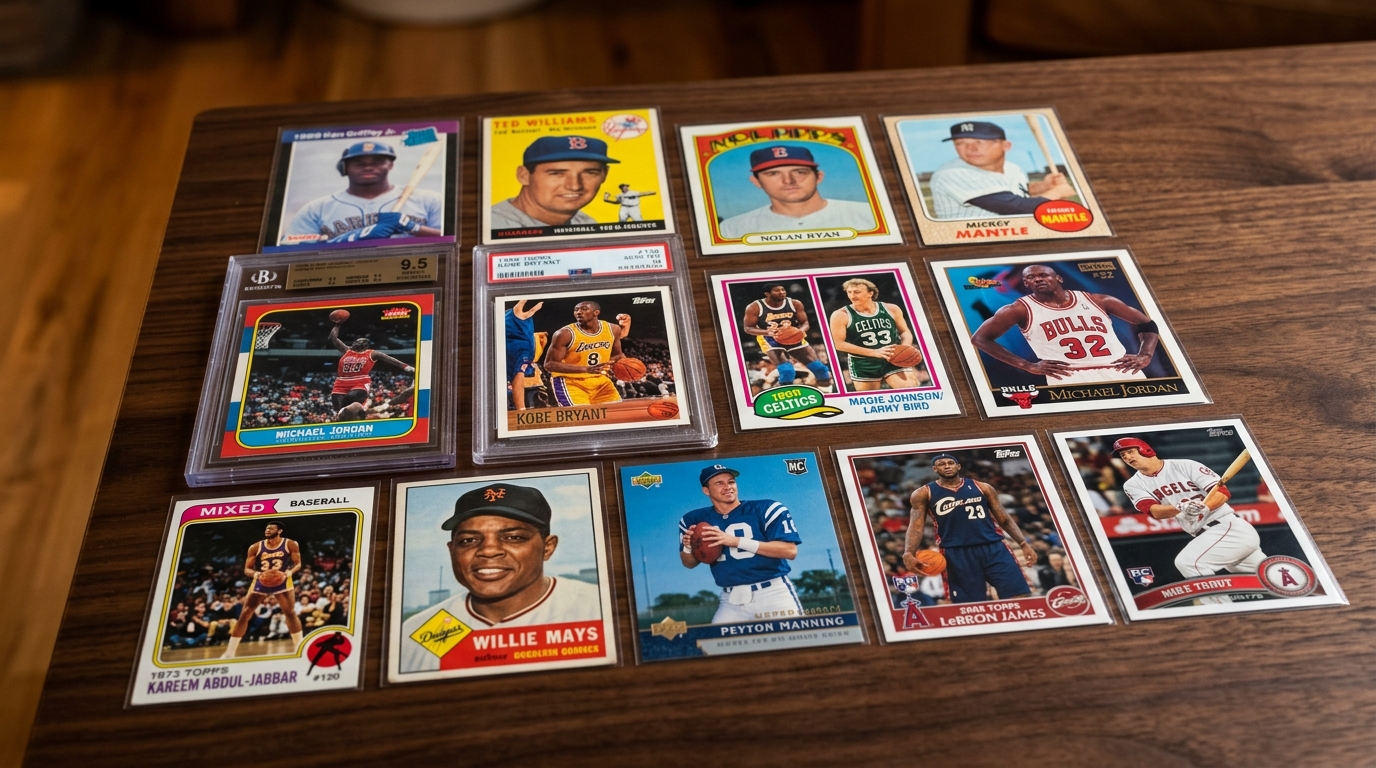
Determining your sports cards value relies on analyzing recent eBay sold listings, cross-referencing industry-standard price guides, and accounting for variables like card condition, serial numbering, and player performance. Whether you hold a single shoebox of childhood relics from the junk wax era or an active portfolio of high-end ultra-modern cards, understanding what drives the market separates a casual hobbyist from an investor who avoids leaving money on the table.
The sports card industry has evolved from a nostalgic hobby into a multi-billion-dollar alternative asset class. With modern grading companies, fractionally owned card platforms, and major investment funds entering the space, prices are more data-driven than ever. In this comprehensive guide, we will examine the five core pillars of sports card valuation, analyze sport-specific market structures, compare vintage and modern card dynamics, and show you exactly how to price your collection with modern toolkits.
Key Takeaway: Sports card value is anchored by a player’s real-life performance, Rookie Card (RC) status, serial numbering, autograph authenticity, and physical card condition. A mistake in evaluating even one of these details can cost you hundreds or thousands of dollars.
1. Key Drivers of Sports Card Value
A sports card’s market price is shaped by several overlapping factors. Understanding each one gives you a significant edge when buying, selling, or organizing your collection.
Rookie Cards (RC) & Prospecting
A player’s first officially licensed card — marked with the RC designation on modern releases — almost always commands the highest long-term premium. For example, a PSA 10 2018 Panini Prizm Luka Dončić RC has sold for over $4,500, while his base non-rookie parallels rarely break $50. Vintage rookie cards carry even larger spreads: a 1952 Topps Mickey Mantle in PSA 8 condition has crossed the $5 million mark at auction.
In modern card collecting, particularly in baseball, the market separates “Prospect Cards” from “Rookie Cards.” A player’s very first card is often their “Bowman 1st,” released while they are still in the minor leagues. The “Bowman 1st Chrome Autograph” is considered the premier prospecting card. Once the player is called up to the major leagues, Topps (the parent company) releases their true “Rookie Card” featuring the official “RC” logo. Knowing the difference between a prospect card and an official rookie card is essential.
If you are unsure whether your card qualifies as a true rookie, read our guide on what does RC mean to learn the exact criteria card companies use.
Serial Numbering & Manufactured Scarcity
Modern hobby and retail boxes often include cards stamped with a print-run fraction — for instance, 25/99 or 1/1. Lower total print runs create scarcity, which directly lifts value. A base Prizm parallel numbered to 299 might sell for $20, while the same card numbered to 10 can fetch $300 or more. A true one-of-one (1/1) version of a star player routinely sells for thousands.
Card companies use different colored borders or foil treatments (parallels) to denote these print runs. For example:
- Refractors / Silvers: Standard shiny parallels (non-numbered but short-printed).
- Serial-Numbered Parallels: Gold (/10), Red (/5), Blue (/199), Green (/99), and Black (/1).
- Case Hits: Rare, non-numbered inserts that fall roughly once per case (e.g., Panini’s Kaboom!, Downtown, Color Blast, or Genesis parallels). These cards command massive premiums due to their visual appeal and low insertion rates.
Autographs & Relics
On-card autographs — where the player physically signed the card surface — carry a significant premium over sticker autographs, sometimes two to five times the price. Game-worn jersey patches (“relics”) embedded into the card add another layer of desirability. A 2023 Panini National Treasures patch auto of Victor Wembanyama numbered to 99, for example, has sold for north of $15,000.
However, collectors must distinguish between the types of relic cards found in today’s products:
- Game-Worn/Game-Used: The player wore the jersey during an official league game. These carry the highest value.
- Player-Worn/Event-Worn: The player put the jersey on briefly (often during a rookie photoshoot or press conference) just to have it cut up. These are less desirable.
- Non-Associated: The relic is a piece of fabric that has no association with any specific player, game, or event. These are common in lower-end modern products and hold the least value.
Always verify autograph authenticity before paying a premium. Our guide on how to spot a fake sports card covers the red flags to watch for in both autographs and patch relics.
Player Performance & The Hype Cycle
Unlike most collectibles, sports cards are tied to a living, breathing asset — the athlete. A breakout season, MVP award, or championship run can double or triple a player’s card values virtually overnight. Conversely, injuries or poor performance can slash prices just as quickly. Monitoring player news is essential for timing your buys and sells.
The sports card market operates on a distinct seasonal “hype cycle”:
- Pre-Season / Training Camp: Values spike as fans and collectors speculatively buy cards of players projected to have breakout years.
- In-Season: Prices react dynamically to weekly performances. A prime-time game-winning touchdown or a 50-point basketball game causes immediate, short-term demand spikes.
- Off-Season: As public attention shifts to other sports, card prices for the inactive sport generally drift downward, representing a prime buying window.
2. Value by Sport
While the same pricing fundamentals apply across sports, each hobby segment has its own dominant brands, price ceilings, and collector behaviors.
Baseball Cards
Baseball remains the heritage backbone of the hobby. Topps holds the exclusive MLB license for flagship sets, making Topps Series 1/Series 2 and Topps Chrome the most widely collected modern baseball products. Bowman (also produced by Topps) is the go-to for prospect cards — Bowman 1st Chrome autos of top draft picks can sell for hundreds to thousands before a player even reaches the majors. Vintage pre-war and post-war cards (T206 Honus Wagner, 1952 Topps Mantle) sit at the absolute top of the market. Collectors highly value centering and paper preservation on older vintage cards, as pre-1970 cards were printed on fragile cardboard stock.
Basketball Cards
Basketball has arguably the hottest modern market. Panini Prizm is the most liquid basketball product, with Silver Prizm parallels serving as the de facto benchmark card for any player. Donruss Optic provides a more affordable alternative with a similar chromium finish. Top-tier products like National Treasures and Flawless cater to high-end collectors. Rookie cards of generational talents like LeBron James (2003 Topps Chrome RC, PSA 10 — over $1 million) and Luka Dončić set the ceiling. The basketball market is also heavily influenced by global appeal, with players like Giannis Antetokounmpo and Nikola Jokić seeing strong international demand.
Football Cards
Football mirrors basketball’s product hierarchy but with its own player dynamics. Panini Prizm, Select, and Mosaic dominate the mid-tier, while National Treasures and Flawless anchor the high end. Quarterback rookie cards — Patrick Mahomes, Joe Burrow, C.J. Stroud — carry the heaviest premiums. Skill-position players like wide receivers and running backs generally trail QB values unless they reach truly elite status. Defensive players, regardless of how dominant, rarely command significant value in the hobby.
Hockey Cards
Hockey has a dedicated, highly loyal collector base, with Upper Deck holding the exclusive NHL license. The absolute gold standard for hockey rookie cards is the Upper Deck Young Guns series, found in Series 1, Series 2, and Extended Series. A player’s Young Guns card is their most liquid base rookie card. Higher-end collectors target Upper Deck Future Watch Autographs (numbered to 999) from the SP Authentic line, or the ultra-premium The Cup Rookie Patch Autographs (RPA) numbered to 99. The hockey market is dominated by Canadian and northern United States collectors, but international superstars (like Alex Ovechkin or Connor Bedard) drive global sales.
Soccer & Formula 1 Cards
Soccer (Association Football) and Formula 1 have seen explosive growth in the sports card hobby over the past five years.
- Soccer: Major licenses are split between Panini and Topps. Key products include Panini Prizm (especially World Cup and Premier League editions), Topps Chrome (UEFA Champions League), and Panini Donruss (featuring the famous Kaboom! case hits). Rookie cards (often marked as “RC” or “TC” for True Rookie) of legends like Lionel Messi and Cristiano Ronaldo, or rising stars like Erling Haaland, command premium prices.
- Formula 1: Topps Chrome F1 is the undisputed king of the racing card market. Cards of multi-time champions like Lewis Hamilton and Max Verstappen, as well as rookie cards of younger drivers, have set major auction records, appealing to a global, high-net-worth audience.
3. Modern vs. Vintage Value Systems
The sports card market is split into two distinct eras, each with its own valuation framework: Vintage and Modern.
The Junk Wax Era (1986–1995)
During the late 1980s and early 1990s, companies like Topps, Donruss, Fleer, and Upper Deck printed cards in massive quantities to meet skyrocketing demand. This period is known as the “Junk Wax Era.” Because millions of copies of each card were produced, 99% of cards from this era have little to no monetary value today. Even cards of Hall of Famers like Ken Griffey Jr., Cal Ripken Jr., or Nolan Ryan from these years are typically worth only a few dollars. The only exceptions are cards graded in perfect PSA 10 condition, where the condition rarity itself creates value.
The Ultra-Modern Era (2018–Present)
Modern cards rely on artificial scarcity. While manufacturers still print base cards in large numbers, they limit the print runs of color parallels, autographs, and insert cards. Modern collecting is highly speculative, with values shifting rapidly based on weekly sports news. This era is characterized by high liquidity, premium designs, and a strong reliance on professional grading.
Vintage Blue Chips (Pre-1980)
Vintage cards are the “blue chips” of the hobby. Unlike modern cards, their value is not speculative; it is based on decades of historical significance and true scarcity. Because collectors in the mid-20th century frequently threw cards away, kept them in rubber bands, or flipped them against walls, finding pre-1980 cards in near-mint or mint condition is extremely rare. Vintage price appreciation is slower but far more stable than modern cards, making them popular for long-term wealth preservation.
4. How Condition & Grading Affects Sports Card Value
Card condition is one of the most impactful — and most overlooked — value drivers. Professional grading services use standardized 1-to-10 scales to evaluate cards. A single grade difference can represent thousands of dollars in value.
The “Big Three” Grading Companies
To maximize a card’s value, collectors submit their raw cards to professional third-party grading services. The market recognizes three major companies:
- PSA (Professional Sports Authenticator): The undisputed market leader in volume and resale value. PSA 10 (Gem Mint) cards command the highest price premium in the industry. PSA is the standard for both modern cards and vintage baseball.
- BGS (Beckett Grading Services): Known for its distinct thick holders and “subgrades” (measuring Centering, Corners, Edges, and Surface separately). BGS is popular for thick card stocks like patch cards. A BGS 10 “Black Label” (perfect 10s on all subgrades) is the rarest grade in the hobby and can sell for a massive premium over a PSA 10.
- SGC (Sportscard Guaranty Corporation): Famous for its black “tuxedo” insert frame, SGC is highly respected, particularly for vintage sports cards. It offers fast turnaround times and competitive pricing, making it a favorite for collectors who want quick verification.
The Math of Grading (ROI Analysis)
Before sending a card to be graded, you must determine if the potential value increase outweighs the cost of grading (which typically ranges from $15 to $50+ per card plus shipping and insurance).
Consider this real-world pricing matrix showing the percentage of near-mint/mint value across grades:
| Grade | Label | Approx. % of NM-MT Value | Modern Premium Multiplier (Raw vs. Graded) |
|---|---|---|---|
| PSA 10 | Gem Mint | 100% (benchmark) | 3x to 5x+ raw value |
| PSA 9 | Mint | 40–60% | 1.1x to 1.5x raw value |
| PSA 8 | NM-MT | 15–30% | Equal to raw value |
| PSA 7 | Near Mint | 8–15% | Lower than raw value |
| PSA 6 | EX-MT | 4–8% | Lower than raw value |
| PSA 5 | Excellent | 2–5% | Lower than raw value |
| PSA 4 & below | VG or lower | 1–3% | Lower than raw value |
Example: Imagine you own a modern rookie card that sells raw (ungraded) for $50.
- If you pay $20 to grade it and it receives a PSA 10, the graded value might jump to $250 (Net Profit: $180).
- If it receives a PSA 9, the value might be $65 (Net Loss: -$5 after grading fees).
- If it receives a PSA 8 or lower, the card might only sell for $35, meaning you lost money by grading it.
This makes pre-grading inspection critical. If you want to estimate a grade before submitting, try our AI card grading tool for an instant preliminary assessment.
How to Inspect a Card’s Condition at Home
To avoid wasting money on grading fees, inspect your cards at home using a microfiber cloth, a bright desk lamp, and a magnifier (jeweler’s loupe). Look for the following issues:
- Centering: The border width on the left/right and top/bottom. For a perfect 10, centering should be 50/50 or 60/40 at worst.
- Corners: Inspect the corners for “softness” (fraying of the cardboard) or white spots where the color has chipped off.
- Edges: Check the edges for chipping, indentations, or “silvering” (common on chrome cards where the foil backing peels).
- Surface: Hold the card under a light at an angle. Look for print lines, dimples, scratches, fingerprints, or wax stains.
5. How to Research Current Market Prices
Sports card prices change weekly — sometimes daily — so using the right tools is critical. Never rely on the listing price of active eBay items, as sellers can ask whatever they want. Only focus on actual transacted sales.
- eBay Sold Listings — Go to eBay, search for your card (e.g., “2018 Panini Prizm Luka Doncic 280”), and check the “Sold Items” and “Completed Items” filters in the sidebar. This is the single best free resource for real-time market value.
- 130 Point — A free search engine that compiles sold listings from eBay, PWCC, Goldin, and other auction houses. It is particularly useful because it reveals the exact accepted offer price for eBay listings sold via “Best Offer” (which eBay hides as a crossed-out number).
- COMC (Check Out My Cards) — A consignment marketplace with built-in price tracking. Useful for finding comps on mid-range cards that may not have heavy eBay volume.
- PSA SMR (Sports Market Report) — PSA’s official price guide for graded cards. Best used as a baseline reference, though it can lag behind fast-moving market shifts.
- CardMint — Upload a photo of your card to our platform to get an instant AI-powered valuation that pulls from multiple data sources. If you are ready to sell, read our step-by-step guide on how to price your cards for selling.
6. Storing & Protecting Your Cards to Maintain Value
Once you establish your sports cards value, preserving it requires proper storage. Physical damage can drop a card’s grade from a 10 to a 6 instantly, destroying 90% of its value.
Standard Protection Supplies
- Penny Sleeves: The first line of defense. Always slide a card into a soft plastic penny sleeve before placing it in any rigid holder to prevent surface scratching.
- Top Loaders: Rigid plastic cases that protect cards from bending or corner damage. Use them for mid-range cards.
- Semi-Rigid Sleeves (Cardboard Gold): The preferred holder for grading submissions. They keep the card secure without sliding during shipping.
- Magnetic One-Touch Cases: Premium hard plastic cases that lock with a magnet. Perfect for high-value raw cards. Always use a penny sleeve on top of the surface before closing to prevent scratching.
- Storage Boxes: Use cardboard or plastic storage boxes specifically sized for top loaders to keep them out of light and dust.
Environmental Controls
Keep your collection in a climate-controlled room. High humidity can cause cards to bow or warp (especially chrome cards) and can cause autographs to bleed. Avoid storing cards in hot attics, damp basements, or in direct sunlight, as UV rays will fade the ink and discolor the cardboard.
7. Tax and Legal Considerations for Sellers
If you sell sports cards, you must treat the transaction with the same care as any other financial investment.
- Collectible Tax Rate: The IRS classifies sports cards as “collectibles.” Under federal law, capital gains on collectibles are taxed at a maximum rate of 28% for long-term holdings (held for more than one year).
- Tax Form 1099-K: Online marketplaces like eBay, PayPal, and Venmo are required to report your gross sales to the IRS using Form 1099-K if you exceed federal or state reporting thresholds.
- Hobbyist vs. Business: If you buy and sell cards with the primary intent of making a profit, the IRS may classify your activity as a business. This allows you to deduct expenses (like card purchases, grading fees, shipping, and travel) on Schedule C, whereas hobbyists cannot deduct hobby losses. Consult a certified public accountant (CPA) to ensure compliance.
Frequently Asked Questions
How do I find the value of old sports cards?
Start by identifying the card’s year, brand, set name, card number (found on the back), and player. Then search eBay sold listings or 130 Point for that exact card. For vintage cards (pre-1980), condition plays an outsized role — even a one-grade difference can mean thousands of dollars. PSA’s SMR guide and auction house archives (Heritage Auctions, PWCC) are the best references for high-value vintage.
Are sports cards a good investment?
Sports cards can appreciate significantly, but they are not a guaranteed investment. Rookie cards of generational players in top condition have historically held or increased in value. However, the market is volatile and heavily influenced by player performance, hobby trends, and economic conditions. Treat cards as an alternative collectible asset, not a retirement plan, and never invest money you cannot afford to lose.
What sports cards are worth money right now?
Rookie cards of current superstars — Luka Dončić, Victor Wembanyama, Shohei Ohtani, Patrick Mahomes, C.J. Stroud, Connor Bedard — carry the strongest demand. Low-numbered parallels, autographed versions, and PSA 10 copies of these players’ flagship rookie cards consistently bring premium prices. Classic vintage cards of Hall of Fame legends like Babe Ruth, Mickey Mantle, Michael Jordan, and Wayne Gretzky also maintain high value.
Should I get my cards graded before selling?
Grading makes the most financial sense for cards that are already high-value (roughly $50+ raw) and appear to be in near-mint or better condition. The grading fee, shipping, and turnaround time need to be justified by the expected price increase. For lower-value cards, selling raw or in lots is usually more cost-effective. Use our AI card grading tool to get a quick condition estimate before deciding.
What is the difference between a parallel and an insert?
An insert is a card that belongs to a separate subset with its own design, distinct from the base set (e.g., a Downtown card). A parallel is a version of a base card that has been modified with a different color border, foil stamping, or serial numbering (e.g., a Gold Prizm parallel of a base rookie card), but shares the same photo and card number as the base version.
Pre-Grade & Track Values Instantly with CardMint
CardMint is the ultimate all-in-one scanner for sports card and TCG collectors, saving you time and money.
Simply scan the front of your card. Our AI instantly identifies the card details, checks current pricing metrics, and gives you a centering and wear pre-grade report before you submit to PSA/BGS.
