
Most Valuable Derek Jeter Cards: The Definitive Rookie Price Guide & 90s Grails (2026)
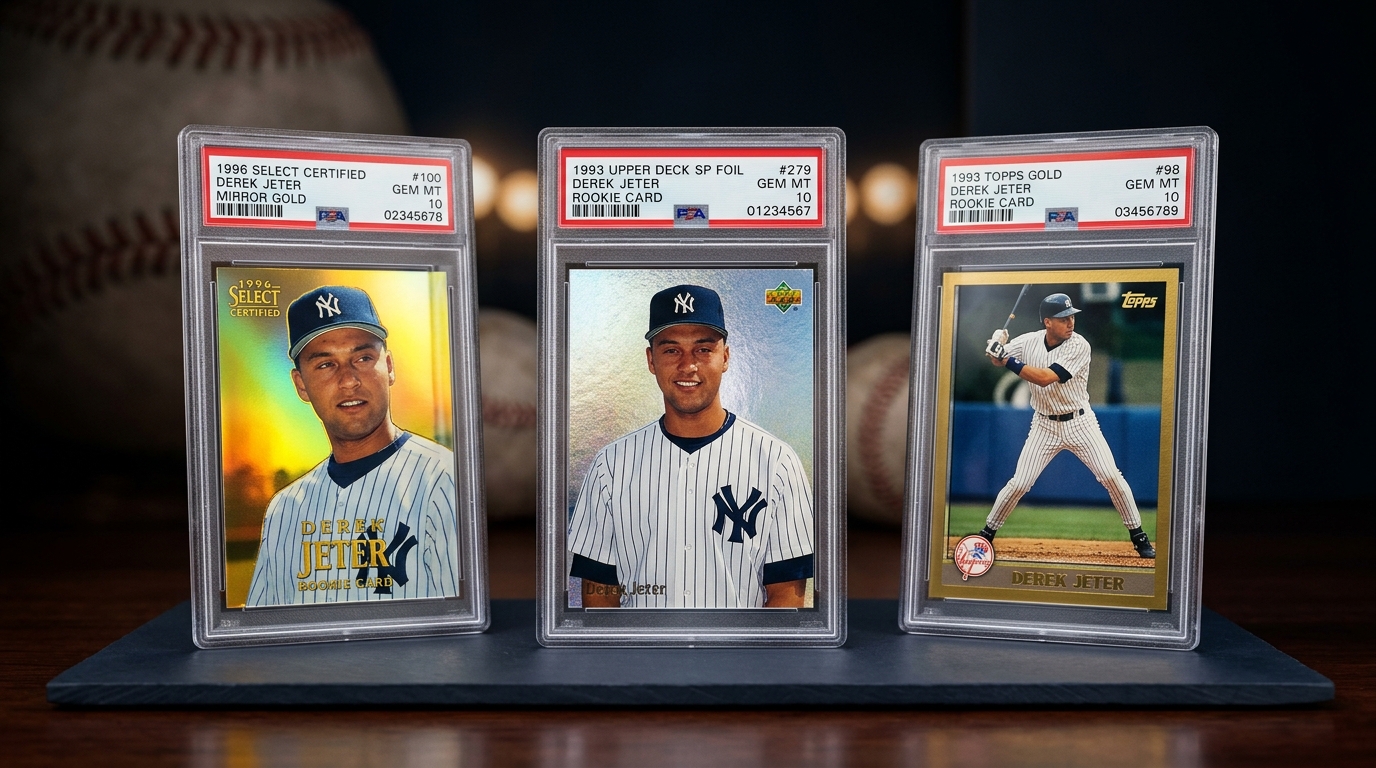
Examining the secondary auction market for the most valuable derek jeter cards reveals the undisputed pinnacle of modern baseball card collecting and alternative asset investing. As the iconic captain of the New York Yankees, a five-time World Series champion, 14-time All-Star, and unanimous first-ballot National Baseball Hall of Famer, Derek Jeter stands as the defining baseball icon of the 1990s and 2000s. Across his 20-year career in the Bronx, Jeter amassed 3,465 hits (sixth all-time in MLB history), captured five Gold Glove Awards, earned the 2000 World Series MVP, and authored countless indelible October moments—from “The Flip” in Oakland to the iconic walk-off home run as “Mr. November.”
In the sports card hobby, that legendary athletic legacy translates into blue-chip commercial liquidity that rivals post-war titans like most valuable Mickey Mantle cards and modern phenoms like most valuable Aaron Judge cards. Anchoring the entire modern sports collectibles era is Derek Jeter’s condition-sensitive holy grail: the 1993 Upper Deck SP Foil #279. Out of more than 20,000 copies submitted to professional grading services, fewer than two dozen have ever earned the fabled PSA 10 Gem Mint grade, resulting in verified public auction sales reaching up to $600,000.
Beyond his signature 1993 rookie card checklist, the Jeter market is ignited by ultra-rare 1990s parallel inserts, licensed pre-rookie minors issues, pioneering certified on-card autographs, and modern 1-of-1 MLB Logoman patch relics. Whether you are sorting through a binder of 1993 base cards, evaluating auction lots on Goldin or Heritage Auctions, or using modern computer-vision scanners to verify raw condition, understanding the pricing hierarchy of Jeter cards is essential. In this exhaustive 2026 market analysis, we explore the top auction sales, examine population report realities, break down every major 1993 rookie release, and provide actionable grading advice for collectors worldwide.
Key Investment Takeaway: The market for Derek Jeter cards is defined by extreme condition sensitivity and serial-numbered scarcity. While base 1993 rookie cards from Topps, Bowman, and Upper Deck remain widely accessible in raw condition for under $50, high-grade PSA 10 specimens command massive 10x to 100x premiums. For premier institutional portfolios, the 1993 SP Foil #279 (PSA 10), 1996 Select Certified Mirror Gold (#/30), and early Topps Finest/Chrome Refractors represent the ultimate modern baseball blue chips.
The Legacy of Derek Jeter and the Rise of Modern Baseball Card Grails
To comprehend why the most valuable baseball cards of the modern era center around Derek Jeter, one must understand both the athletic magnitude of his career and the tectonic shift that occurred in sports card manufacturing between 1992 and 1997.
+-------------------------------------------------------------------------------+
|                       DEREK JETER CAREER & HOBBY MILESTONES                   |
+-------------------------------------------------------------------------------+
| June 1992: Drafted 6th overall by New York Yankees from Kalamazoo Central HS  |
| Dec 1992: First licensed minor league cards debut (Little Sun, Front Row)     |
| 1993: Official MLB rookie card class released (SP Foil, Topps, Bowman, Score) |
| May 1995: Major League Debut at Kingdome in Seattle                           |
| 1996: AL Rookie of the Year & World Series Champion (Select Certified, Chrome)|
| 1998-2000: Historic Yankees Three-Peat World Series Dynasty | 2000 WS MVP     |
| July 2011: 3,000th Career Hit (Home Run off David Price at Yankee Stadium)    |
| Sept 2014: Iconic walk-off single in final career game at Yankee Stadium      |
| Jan 2020: Elected to Baseball Hall of Fame with 99.7% of votes (396 of 397)   |
| 2021-2026: 1993 SP Foil #279 PSA 10 commands $300,000 - $600,000 at auction  |
+-------------------------------------------------------------------------------+
From Kalamazoo Central to Yankees Pinstripes: The Draft Era
Derek Jeter entered professional baseball with astronomical expectations. Starring as a shortstop at Kalamazoo Central High School in Michigan, Jeter batted an eye-popping .508 with 12 home runs and 23 stolen bases as a senior, winning USA Today High School Player of the Year honors. While five teams passed over him in the 1992 MLB Draft due to concerns over his college commitment to the University of Michigan, Yankees scout Dick Groch famously declared: “The only place Derek Jeter is going is Cooperstown.” New York selected Jeter with the sixth overall pick, cementing the franchise’s trajectory for the next two decades.
This amateur-to-pro transition sparked Jeter’s earliest licensed card appearances. Issues like the 1992 Little Sun High School Prospects and 1992 Front Row Draft Picks captured Jeter before he ever donned a Major League uniform, establishing a devoted pre-rookie collector niche that remains fiercely contested today.
Five World Series Rings, 3,465 Hits, and Unrivaled Hobby Liquidity
While many modern prospects suffer sharp card value crashes after initial hype cycles fade, Jeter built a 20-year resume of unprecedented consistency in the world’s biggest sports market. Playing in 158 career postseason games, Jeter accumulated 200 postseason hits, 20 home runs, and a .308 batting average in October, earning the moniker “Captain Clutch.”
When sports card collectors evaluate fundamental sports card value, three pillars dictate market longevity: player pedigree, market size, and card condition scarcity. Jeter checks every box:
- Unassailable Legacy: 14x All-Star, 5x World Series Champion, 3,465 hits, Hall of Fame class of 2020.
- Global Media Capital: Two decades in New York Yankees pinstripes with universal respect across all fan bases.
- Manufacture Transition Point: Jeter’s career began in the “Junk Wax” era (1993) but transitioned into the dawn of premium parallels, refractors, and super-short prints (1996-1997).
Anatomy of the Holy Grail: Why the 1993 SP Foil #279 Dominates the Market
Among all post-1980 baseball cards, no single issue possesses the cultural cachet, market power, and pricing dominance of the 1993 Upper Deck SP Foil #279 Derek Jeter.
+-----------------------------------------------------------------------------+
|               1993 UPPER DECK SP FOIL #279: HOBBY PROFILE                   |
+-----------------------------------------------------------------------------+
| Set Release:        1993 Upper Deck SP Baseball (Card #279)                 |
| Subset:             Premier Prospects (Cards #270-#290)                     |
| Surface Stock:      Full-bleed silver holofoil finish                       |
| Edges & Corners:    Die-cut perimeter prone to chipping to white            |
| Total PSA Graded:   22,500+ submissions                                     |
| PSA 10 Gem Mint:    Only 22 copies recorded                                 |
| Gem Rate:           0.097% (Less than 1 in 1,000 cards!)                   |
| Record Auction:     $600,000 (Goldin Auctions, April 2022)                  |
| 2025-2026 Baseline: $340,000 - $375,000 (PSA 10) | $3,500 - $4,500 (PSA 9)  |
+-----------------------------------------------------------------------------+
The Extreme Condition Sensitivity of Silver Die-Cut Foil
In 1993, Upper Deck introduced the “SP” brand as the hobby’s first ultra-premium product. Packaged in sleek silver foil wrappers with an elevated pack price ($3.99 per pack compared to $1.00 for standard Upper Deck), the set featured 20 “Premier Prospects” printed on high-gloss card stock covered in 100% full-bleed silver metallic foil.
Unlike white-bordered cards from the same era, the silver foil layer on the 1993 SP was applied across the entire front surface, extending directly to the card’s die-cut edges and corners. When packs were sealed, transported, or handled, the fragile foil layer flaked off effortlessly, revealing bright white card stock underneath. Even fresh out of a sealed pack in 1993, a vast majority of Jeter #279 cards exhibited:
- Corner “Snowflakes”: Microscopic chipping of foil at all four tips.
- Surface Scratches: Fine hairline scratches caused by contact with adjacent cards inside foil packs.
- Centering Skew: Heavy top-to-bottom or left-to-right shifts that disqualified cards from 50/50 gem mint tolerance.
- Foil Roller Marks: Vertical production lines pressed into the metallic sheet during factory stamping.
The Sub-0.1% Gem Rate: Inside the PSA 10 Population Report
As professional third-party grading transformed the sports card industry in the late 1990s and 2000s, the brutal reality of the 1993 SP Foil became apparent. While common modern cards routinely achieve PSA 10 gem rates of 60% to 75%, the 1993 SP Jeter boasts the lowest gem rate of any iconic modern card in hobby history:
+-----------------------------------------------------------------------------+
|             PSA POPULATION BREAKDOWN: 1993 SP FOIL DEREK JETER #279         |
+-----------------------------------------------------------------------------+
| Grade Tier       | Population Count | Percentage | Typical Market Value     |
+-----------------------------------------------------------------------------+
| PSA 10 Gem Mint  | 22               | 0.097%     | $340,000 - $600,000      |
| PSA 9 Mint       | 640              | ~2.8%      | $3,500 - $4,500          |
| PSA 8 Near-Mint  | 3,850            | ~17.1%     | $450 - $600              |
| PSA 7 NM         | 6,100            | ~27.1%     | $200 - $280              |
| PSA 6 EX-MT      | 4,200            | ~18.6%     | $120 - $160              |
| PSA 1 to 5       | 7,700+           | ~34.2%     | $40 - $100               |
+-----------------------------------------------------------------------------+
With only 22 copies certified Gem Mint 10 in over three decades of grading, market supply is virtually locked up. Most PSA 10 copies reside in private museum-caliber collections or institutional sports funds. Whenever a PSA 10 surfaces at a major auction house like Goldin, Heritage, or Memory Lane, it generates intense international bidding wars. For an in-depth breakdown of third-party standards, check out our guide on PSA vs BGS.
Top 10 Most Valuable Derek Jeter Cards Ever Sold
The following verified public auction sales and private transactions represent the ten most valuable Derek Jeter cards in collecting history. These grails showcase the evolution of modern card pricing from 1992 amateur drafts to ultra-rare 90s parallels and modern museum patch autographs.
+---------------------------------------------------------------------------------------+
|               TOP 10 MOST VALUABLE DEREK JETER CARDS RANKED BY VALUE                  |
+---------------------------------------------------------------------------------------+
| Rank | Year / Card Description                             | Grade     | Peak Price   |
+---------------------------------------------------------------------------------------+
| 1    | 1993 Upper Deck SP Foil #279 Rookie Card            | PSA 10    | $600,000     |
| 2    | 1996 Select Certified Mirror Gold #100 (#/30)       | PSA 10    | $268,400     |
| 3    | 1992 Little Sun High School Prospects Auto          | Encaps./10| $60,000      |
| 4    | 2024 Topps Dynasty Gold MLB Logoman Patch Auto 1/1  | BGS 9.5/10| $42,000      |
| 5    | 1996 Select Certified Mirror Blue #100 (~/45)       | PSA 10    | $37,200      |
| 6    | 1995 Topps Finest Refractor with Coating #279       | PSA 10    | $33,600      |
| 7    | 1996 Topps Chrome Refractor #80                     | PSA 10    | $28,500      |
| 8    | 1992 Front Row Draft Picks Gold #55                 | PSA 10    | $16,500      |
| 9    | 1993 Stadium Club Murphy #117 Factory Rookie        | PSA 10    | $12,000      |
| 10   | 1996 Leaf Signatures Gold Autograph (On-Card)       | BGS 9.5   | $9,500       |
+---------------------------------------------------------------------------------------+
1. 1993 Upper Deck SP Foil #279 (PSA 10) — Peak Value: $600,000
The undisputed king of modern baseball cards. In April 2022, Goldin Auctions facilitated the record-shattering sale of a pristine PSA 10 copy for $600,000, eclipsing prior benchmark sales of $375,000 and $324,000. In Summer 2025, another verified PSA 10 crossed the block at Memory Lane Inc. for $340,736, confirming that even in normalized market environments, the card commands blue-chip mid-six-figure valuations.
What makes Card #279 so mesmerizing is the radiant holographic sheen surrounding Jeter as he poses in his classic white New York Yankees road-stripe uniform. To achieve a PSA 10, the card must show no silver flaking along the edges, zero corner whitening under 10x magnification, exact 50/50 centering, and an unblemished reflective foil surface. It is the modern counterpart to the 1952 Topps Mickey Mantle.
+-----------------------------------------------------------------------------+
|                      CARD DETAILS: 1993 SP FOIL #279                        |
+-----------------------------------------------------------------------------+
| Set:            1993 Upper Deck SP                                          |
| Card Number:    #279                                                        |
| Population 10:  22 copies (out of 22,500+ graded)                           |
| Raw Price:      $80 - $250 (Typically grades PSA 6 or 7)                    |
| PSA 9 Price:    $3,500 - $4,500                                             |
| PSA 10 Record:  $600,000 (Goldin Auctions)                                  |
+-----------------------------------------------------------------------------+
2. 1996 Select Certified Mirror Gold #100 (PSA 10) — Peak Value: $268,400
While the 1993 SP is Jeter’s most famous card, the 1996 Select Certified Mirror Gold #100 is his rarest and most coveted 1990s parallel grail. Released by Pinnacle Brands in 1996, the “Mirror Gold” parallel was limited to a strict print run of only 30 copies globally, seeded at an impossible pack ratio of 1:300 packs across high-end hobby boxes.
The card features a dazzling 24-karat mirror gold refractor finish protected by a removable translucent film coating (“PEEL & REMOVE”). Finding an authentic copy that survived with the peel intact, zero greening, and razor-sharp corners is an extraordinary hobby miracle. In 2021, Heritage Auctions hammered down a PSA 10 copy for a breathtaking $268,400. Because many copies were handled with bare hands or scratched during peel removal, the PSA 10 population remains in the low single digits.
3. 1992 Little Sun High School Prospects Signed (PSA 10) — Peak Value: $60,000
Before Derek Jeter was a household name in the Bronx, Little Sun produced a regional draft set featuring top high school prospects from across the United States. Card #2 captures a 17-year-old Jeter wearing his Kalamazoo Central maroon jersey and holding a bat over his shoulder.
While unsigned base copies sell for $50 to $150, Little Sun contracted Jeter to sign a tiny allotment of copies (estimated at 250 signed cards) in blue ballpoint ink. Authenticated and graded copies carrying a PSA/DNA Gem Mint 10 certification for both the card and the signature have realized over $60,000 in private brokerage transactions. It remains the holy grail of pre-rookie Jeter memorabilia.
4. 2024 Topps Dynasty Gold MLB Logoman Patch Autograph 1/1 — Peak Value: $42,000
While vintage and 90s cards dominate the upper echelon of Jeter collectibles, modern ultra-luxury manufacturing occasionally produces a grail that breaks into the record books. The 2024 Topps Dynasty Gold MLB Logoman Patch Autograph (#AMLP-DJ) is a certified 1-of-1 masterpiece.
Enclosed in a thick magnetic acrylic uncirculated case, the card houses an authentic game-worn Major League Baseball embroidered silhouetted batter “Logoman” patch harvested directly from one of Jeter’s game-used Yankees jerseys. Paired with an on-card autograph signed in bold blue ink with a pristine “10” grade, this modern showpiece realized $42,000 upon initial release, appealing to high-end contemporary sports investors who target Logoman grails alongside valuable sports card value.
5. 1996 Select Certified Mirror Blue #100 (PSA 10) — Peak Value: $37,200
Serving as the intermediate sister parallel to the Mirror Gold, the 1996 Select Certified Mirror Blue #100 features a deep sapphire chromium sheen that mimics an oceanic refractor. While unnumbered, hobby consensus and factory production data place the print run at roughly 45 total copies with a pack insertion rate of 1:200 packs.
Mirror Blue parallels from 1996 are notoriously brittle; the blue colored dye applied to the chromium surface is susceptible to edge chipping and surface hazing over time. A flawless PSA 10 specimen crossed the auction block for $37,200 at PWCC/Fanatics Collect, making it one of the most expensive non-gold 90s parallels in baseball card history.
6. 1995 Topps Finest Refractor with Peel #279 (PSA 10) — Peak Value: $33,600
In 1993, Topps changed the sports card world forever by inventing “Refractor” technology in its inaugural Topps Finest set. In 1995, Topps released Card #279 featuring Derek Jeter in its regular baseball series, complete with a 1:12 pack Refractor parallel.
The 1995 Finest Refractor features a prismatic rainbow reflective finish and came from the factory with a protective cloudy cellophane peel reading “Topps Finest Protector.” Collectors who preserved their copies with the peel fully intact—and whose cards avoided the infamous “greening” oxidation flaw common to early chromium cards—hold a monster asset. A PSA 10 copy with peel intact reached a record price of $33,600.
7. 1996 Topps Chrome Refractor #80 (PSA 10) — Peak Value: $28,500
The year 1996 was historic for Derek Jeter: he started Opening Day at shortstop, hit a home run, won AL Rookie of the Year, and carried the Yankees to their first World Series title in 18 years. It was also the inaugural year of Topps Chrome Baseball, which took the flagship paper Topps design and rendered it in premium chromium acetate.
Card #80 was short-printed in its Refractor parallel format, seeded 1 in 12 packs of 1996 Topps Chrome. Because of tight centering tolerances and surface roller lines on 1996 Chrome stock, Gem Mint 10 copies are extraordinarily elusive. Historical auction records show PSA 10 copies routinely fetching between $25,000 and $28,500 at major sports memorabilia auctions.
8. 1992 Front Row Draft Picks Gold #55 (PSA 10) — Peak Value: $16,500
Issued shortly after the June 1992 MLB Draft, the Front Row Draft Picks collection features Jeter in a relaxed batting pose wearing his minor league uniform. While the base blue-bordered cards are common, Front Row produced limited parallel versions, including a stunning Gold Foil parallel (#55).
The bright gold perimeter is unforgiving on chipping, making high-grade copies scarce. In PSA 10 condition, this 1992 draft pick rarity has sold for upwards of $16,500, solidifying its position as one of the most valuable minor-league issues ever produced for an active or retired baseball player.
9. 1993 Stadium Club Murphy #117 Factory Rookie (PSA 10) — Peak Value: $12,000
In 1993, Topps released a special boxed set commemorating the Stadium Club partnership with Jack Murphy Stadium in San Diego (host of the 1992 All-Star Game). Packaged in a compact stadium-shaped display box, the 200-card set had a limited print run of 128,000 factory sets.
Card #117 features Jeter fielding a ground ball on a borderless, high-gloss UV-coated card stock. Because the cards were tightly bricked together inside the factory stadium packaging, pulling a copy without surface paper loss or damaged corners was a daunting challenge. While raw copies can be found for $50 to $100, certified PSA 10 copies have commandingly hammered down at auction between $10,000 and $12,000.
10. 1996 Leaf Signatures Gold Autograph (BGS 9.5 / PSA 10) — Peak Value: $9,500
Before autograph cards became a mandatory inclusion in every hobby box, the 1996 Leaf Signatures set was a monumental breakthrough. Leaf contracted Major League players to hand-sign cards on-card in clean blue or black ink. The set featured three tiered foil variations: Bronze, Silver, and the ultra-rare Gold parallel.
Limited to approximately 200 copies per player, Jeter’s Gold Autograph from his 1996 Rookie of the Year campaign represents one of his very first licensed on-card MLB autographs. A BGS 9.5 Gem Mint copy with a 10 autograph grade set a sales record at $9,500, with private sales approaching $12,000.
The 1993 Rookie Card Class: Comprehensive Base & Parallel Comparison
For everyday collectors who may not possess a six-figure budget for an SP Foil PSA 10, Derek Jeter’s official 1993 rookie card checklist offers an exciting range of entry points across varying budgets and visual aesthetics. Understanding what an official rookie card means is critical when navigating these sets.
+-------------------------------------------------------------------------------------+
|                  DEREK JETER 1993 ROOKIE CARD CHECKLIST OVERVIEW                    |
+-------------------------------------------------------------------------------------+
| Card Set & Number        | Surface Style      | Raw NM Value | PSA 9 Value | PSA 10 |
+-------------------------------------------------------------------------------------+
| 1993 Upper Deck SP #279  | Full Holofoil      | $100 - $250  | $4,000      | $350K+ |
| 1993 Topps #98           | White Border Paper | $15 - $25    | $60 - $85   | $650   |
| 1993 Topps Gold #98      | Gold Foil Accent   | $50 - $90    | $350 - $450 | $4,500 |
| 1993 Bowman #511         | Full Color Glossy  | $20 - $35    | $90 - $125  | $1,400 |
| 1993 Pinnacle #457       | Matte Black Border | $10 - $20    | $50 - $75   | $1,600 |
| 1993 Score #489          | Dark Navy Border   | $8 - $15     | $40 - $60   | $950   |
| 1993 Upper Deck #449     | Standard UV Gloss  | $10 - $20    | $45 - $65   | $400   |
| 1993 Stadium Club #117   | High Gloss Full    | $40 - $75    | $300 - $450 | $11,000|
+-------------------------------------------------------------------------------------+
1993 Topps #98 & Topps Gold: The Mainstream Essentials
The flagship 1993 Topps #98 represents the most recognizable and widely distributed Jeter rookie card. Featuring Jeter in his classic Yankees home pinstripes with a “Draft Pick” ribbon banner across the bottom right, this card was printed in massive quantities during the twilight of the junk wax boom.
However, Topps also introduced the 1993 Topps Gold #98 parallel, inserted at a rate of 1 per retail pack and in complete factory set bonus packs. The Gold parallel replaces the standard team name and draft ribbon with radiant embossed gold foil. Because gold stamping was prone to flaking and the white paper stock frequently suffered from off-center printing, a PSA 10 Topps Gold commands upwards of $4,500, compared to roughly $650 for a base PSA 10.
1993 Bowman #511: The Clean Prospect Pioneer
Before Bowman became the modern home of the “1st Bowman Chrome” autograph, the 1993 Bowman release was a pure collector favorite. Card #511 showcases an action shot of Jeter in his navy road jersey against a lush green baseball outfield.
With a UV-varnish protective finish and premium white borders, 1993 Bowman cards aged far better than SP Foil cards. However, strict 50/50 centering is difficult to locate on Card #511, elevating PSA 10 values to $1,400, making it a fantastic alternative blue chip for mid-tier portfolios.
1993 Pinnacle #457 & Score #489: Tough Dark Borders
Both Pinnacle #457 and Score #489 feature full dark borders—jet black on Pinnacle and deep midnight navy on Score. Much like 1971 Topps vintage cards, black and dark-bordered cards immediately show white chipping upon the slightest friction. While raw copies can be scooped up at flea markets and local card shops for $10, finding pristine PSA 10 copies requires patience, with Pinnacle #457 fetching $1,600 and Score #489 commanding $950.
1993 Upper Deck #449 Star Rookie: The Accessible Classic
For entry-level collectors, the standard 1993 Upper Deck #449 “Star Rookie” is the quintessential beginner card. Featuring Upper Deck’s signature hologram on the reverse, crisp photography, and clean white borders, Card #449 is an affordable slice of baseball history. A raw near-mint copy can be acquired for $15, while a PSA 10 slab trades hands for a modest $400, offering high liquidity for budget-conscious fans.
Strategic Investing in Derek Jeter Collectibles: Navigating the 90s Market
Investing in 1990s baseball cards requires a vastly different strategic playbook than modern chromium sports card trading. In today’s market, mastering card condition, professional grading thresholds, and preservation techniques separates profitable collectors from frustrated buyers.
+-----------------------------------------------------------------------------+
|               STRATEGIC CHECKLIST FOR DEREK JETER CARD COLLECTORS           |
+-----------------------------------------------------------------------------+
| 1. Prioritize Certified Graded Slabs (PSA, BGS, SGC) over raw copies        |
| 2. Inspect 1993 SP Foil copies under 10x magnification for edge chipping    |
| 3. Check for surface greening on mid-90s Topps Finest Refractors            |
| 4. Measure border dimensions to identify trimmed or altered cards           |
| 5. Store high-grade raw cards in acid-free penny sleeves & semi-rigid holders|
| 6. Monitor auction comps across Goldin, Heritage, and eBay with CardMint     |
+-----------------------------------------------------------------------------+
Foil Chipping, Surface Peeling, and Centering Flaws
When inspecting raw Derek Jeter rookie cards, always utilize a 10x LED jewelers loupe. On the 1993 SP Foil #279, pay special attention to:
- The Die-Cut Upper Perimeter: The top edge of Card #279 was stamped with heavy mechanical dies, frequently leaving jagged micro-fringe along the silver foil.
- Refractor Peels: On 1995-1998 Topps Finest cards, cards with the factory peel intact traditionally command a 15% to 25% premium over unpeeled copies. However, ensure the adhesive has not bubbled or yellowed over three decades of storage.
- Surface Greening: Copper and silver metallic inks used in early chromium sets frequently react to moisture, turning green or bronze. Slabs that display zero color degradation command top-tier bids.
Certified Authentication: PSA vs. BGS vs. SGC in Modern Vintage
When it comes to Jeter’s 1993 SP Foil, PSA (Professional Sports Authenticator) holds near-monopoly pricing power at the Gem Mint level. A PSA 10 SP Jeter sells for $340,000+, whereas a BGS 9.5 (Beckett Grading Services) copy generally trades between $25,000 and $40,000—a nearly 10x price differential driven strictly by PSA’s historical registry competition.
However, for vintage aesthetics and dark-bordered cards like the 1993 Pinnacle or 1993 Score, SGC (Sportscard Guaranty Corporation) has gained massive collector market share due to its sleek black tuxedo slabs. Learn how each company scores cards in our complete baseball card grading manual.
Beware of Alterations, Trimming, and Reglossed Borders
Because the financial spread between a PSA 8 ($500) and a PSA 10 ($350,000+) on the 1993 SP Jeter is among the highest in human history, bad actors frequently attempt to alter raw cards. Common fraudulent tactics include:
- Edge Trimming: Using paper shears to slice a fraction of a millimeter off chipped borders to create artificially sharp edges. Always compare card dimensions against a digital caliper (standard size is exactly 2.5 x 3.5 inches).
- Foil Touch-Ups: Applying silver metallic paint pens or graphite to conceal white corner chipping. Under ultraviolet (UV) blacklight inspection, touched-up areas glow with a different fluorescence than factory foil.
- Wax Buffing & Reglossing: Applying automotive buffing compounds to buff out surface scratches on 1993 SP holofoils.
To protect yourself against counterfeit and modified cards, always review our guide on how to spot fake sports cards before completing high-dollar purchases.
How to Scan, Grade, and Track Derek Jeter Cards with CardMint
Evaluating vintage and modern sports cards in today’s fast-moving market requires instant access to verified sales data and precision condition analysis. The CardMint mobile application equips collectors with cutting-edge computer vision technology to identify, evaluate, and track their Jeter collections.
+-----------------------------------------------------------------------------+
|                 CARDMINT AI SCANNING & VALUATION WORKFLOW                   |
+-----------------------------------------------------------------------------+
| 1. High-Resolution Camera Capture   --> Point camera at any raw or slabbed card|
| 2. Instant AI Card Identification   --> Detects set, year, variation & parallel|
| 3. Sub-Pixel Centering Analysis     --> Calculates 50/50 borders for PSA odds  |
| 4. Surface Defect Pre-Check         --> Highlights micro-creases and chipping  |
| 5. Multi-Marketplace Comp Engine    --> Aggregates verified sales from eBay/PWCC|
| 6. Cloud Portfolio Value Sync       --> Tracks collection equity in real time  |
+-----------------------------------------------------------------------------+
With CardMint installed on your iOS or Android device:
- Instant Parallel Differentiation: Automatically determine whether your 1993 Topps Jeter is a standard base card or the valuable Topps Gold parallel in seconds.
- Pre-Submission Grade Estimator: Measure the exact centering ratio of your raw 1993 SP Foil before submitting to PSA or BGS, saving hundreds of dollars in submission fees on sub-grade cards.
- Real-Time Auction Alerts: Receive instant push notifications whenever a rare Jeter insert (like a 1996 Select Certified Mirror or Topps Chrome Refractor) is listed or sold at major auction venues.
- Safe Storage & Estate Organization: Keep a digital vault of high-resolution front-and-back scans paired with insurance replacement values. Learn proper preservation habits in our guide on how to store baseball cards.
Ready to take your collection to the next level? Download the CardMint app today and scan your raw cards with AI-powered precision!
Frequently Asked Questions
What is Derek Jeter’s official and most valuable rookie card?
Derek Jeter’s official and most valuable rookie card is the 1993 Upper Deck SP Foil #279. Released in Upper Deck’s premium SP baseball set, the card features a condition-sensitive full silver foil surface and die-cut edges. In PSA 10 Gem Mint condition, only 22 copies exist globally, resulting in verified auction sales between $340,000 and $600,000.
Why is the 1993 SP Foil #279 Derek Jeter so hard to get in PSA 10?
The 1993 SP Foil #279 Derek Jeter is virtually impossible to obtain in PSA 10 because of its full-bleed metallic foil finish that extends directly to the borders without a white protective edge. During packaging, shipping, and handling, the fragile silver foil easily chipped away to expose bright white card stock beneath. Out of more than 22,500 copies graded by PSA, less than 0.1% have earned a Gem Mint 10 grade.
How much is an ungraded or raw 1993 SP Derek Jeter rookie card worth?
An ungraded, raw 1993 SP Foil Derek Jeter rookie card typically sells between $80 and $250, depending on visible edge chipping, surface scratches, and centering. Because most raw copies suffer from microscopic wear that limits their graded potential to PSA 6, 7, or 8, raw copies trade at a massive discount compared to certified high-grade slabs.
Are 1993 Topps Derek Jeter rookie cards worth money?
Yes, 1993 Topps Derek Jeter cards are valuable, particularly in high grades. A standard 1993 Topps #98 base card in a PSA 10 Gem Mint holder is worth roughly $650, while raw copies sell for $15 to $25. The rare 1993 Topps Gold #98 parallel is significantly more valuable, commanding between $3,500 and $4,500 in PSA 10 condition due to its sensitive gold foil stamping.
What makes 1996 Select Certified Mirror Gold Jeter cards so expensive?
The 1996 Select Certified Mirror Gold #100 Derek Jeter is one of the most expensive 1990s baseball cards because it was limited to a strict print run of only 30 copies worldwide. Printed during Jeter’s 1996 AL Rookie of the Year season with a fragile 24-karat mirror gold refractor coating, a pristine PSA 10 copy sold at Heritage Auctions for $268,400.
How can I spot a counterfeit or trimmed Derek Jeter rookie card?
To spot a counterfeit or trimmed Derek Jeter rookie card, check the card’s dimensions with a precision digital caliper (it must measure exactly 2.5 by 3.5 inches), examine the silver foil under a 10x jewelers loupe for unnatural paint touch-ups, and inspect the card under UV blacklight to detect modern adhesive or recolored edges. Furthermore, authentic 1993 SP cards feature crisp, raised typography on the reverse that cannot be easily replicated by modern inkjets.
How does CardMint help evaluate Derek Jeter baseball cards?
CardMint uses proprietary artificial intelligence and computer-vision algorithms to scan your raw or slabbed Derek Jeter cards via your smartphone camera. The app instantly identifies the exact card set, year, and parallel, analyzes edge and centering quality to estimate grading probabilities, and cross-references recent verified completed sales from eBay and major auction houses to provide an accurate real-time valuation.
Pre-Grade & Track Values Instantly with CardMint
CardMint is the ultimate all-in-one scanner for sports card and TCG collectors, saving you time and money.
Simply scan the front of your card. Our AI instantly identifies the card details, checks current pricing metrics, and gives you a centering and wear pre-grade report before you submit to PSA/BGS.
