
Most Valuable Ken Griffey Jr Cards: Rookie Price Guide & 90s Inserts (2026)
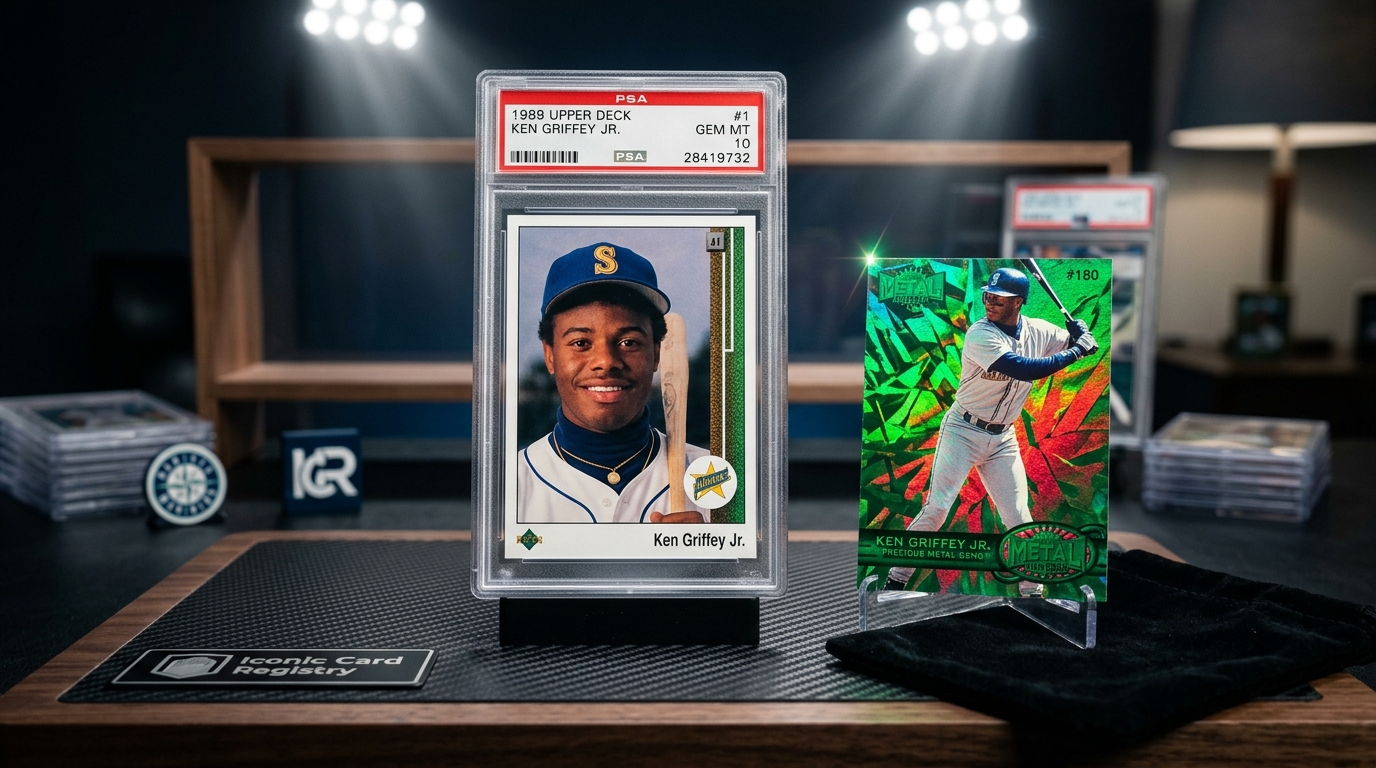
Tracking the most valuable Ken Griffey Jr cards remains the pinnacle pursuit for vintage and modern baseball card collectors around the globe. Known universally as “The Kid,” Ken Griffey Jr. brought an unmatched combination of effortless athleticism, backwards-cap swagger, and the sweetest left-handed swing in baseball history to the diamond. His transcendent cultural impact did more than revitalize the Seattle Mariners; it single-handedly transformed sports card collecting from a modest childhood hobby into a multi-billion dollar alternative asset class.
When Upper Deck debuted in 1989, selecting a teenage Griffey as Card #1 was an unprecedented gamble that forever disrupted the sports card industry. Over three decades later, Griffey collectibles occupy an extraordinary position in the secondary market. From widely printed junk wax rookie cards that achieve massive four-figure premiums in pristine PSA 10 condition to impossibly scarce 1990s serial-numbered inserts commanding six-figure sums at Goldin and Heritage Auctions, the Griffey market is dynamic, highly liquid, and endlessly fascinating.
Whether you pulled a stack of 1989 rookies from a binder in your childhood bedroom, inherited an uncut sheet, or are strategically allocating capital into blue-chip baseball cards, understanding the exact hierarchy of Griffey cards is essential. In this definitive guide, we evaluate historical auction records, outline the rookie card hierarchy, explore ultra-rare 90s insert grails, analyze condition flaws that determine PSA 10 versus PSA 9 values, and explain how modern AI tools like CardMint streamline authentication and real-time market valuation.
Key Investment Takeaway: While millions of Ken Griffey Jr rookie cards were printed during the junk wax era, condition rarity dictates real-world value. A standard raw 1989 Upper Deck #1 trades between $30 and $50, whereas a certified Gem Mint PSA 10 specimen consistently commands $1,500 to $2,500 due to factory centering defects and fragile foil holograms. In the high-end sector, Griffey’s late-1990s serial-numbered inserts—such as the 1997 Metal Universe Precious Metal Gems (PMG) Green and 1998 E-X2001 Essential Credentials—represent some of the most expensive modern baseball cards ever sold.
The Cultural Phenomenon of The Kid and the 1989 Hobby Revolution
To grasp why Ken Griffey Jr commands such enduring market share compared to his contemporaries, one must understand the timing of his arrival. In the late 1980s, the baseball card market was saturated with flimsy cardboard produced by Topps, Fleer, and Donruss. Print runs expanded unchecked, and quality control was minimal.
Enter the Upper Deck Company in 1989. Upper Deck introduced tamper-proof foil packaging, high-grade white paper stock, crisp dual-sided color photography, and a counter-measure hologram on the reverse of every card to prevent counterfeiters. To launch their flagship product, Upper Deck needed an electrifying face for Card #1. They chose 19-year-old Ken Griffey Jr before he had played a single Major League inning.
+-------------------------------------------------------------------------------+
|                       KEN GRIFFEY JR. HOBBY MILESTONES                        |
+-------------------------------------------------------------------------------+
| April 1989: MLB Debut With Mariners       | Hits double in first career at-bat|
| 1989 Upper Deck #1 Debuts                 | Redefines premium card standards  |
| 1990 All-Star Game With Ken Griffey Sr.    | Father-son historic back-to-back HR|
| 1997 AL MVP & 56 Home Runs               | Prime era drives 90s insert frenzy |
| 1997 Metal Universe PMG Release           | Birth of ultra-rare serial inserts |
| 2016 Hall of Fame Induction (99.3%)       | Near-unanimous Cooperstown honor  |
| 2020-2026: Modern Vintage Hegemony        | Blue-chip liquidity across slabs  |
+-------------------------------------------------------------------------------+
Griffey validated Upper Deck’s bet immediately, doubling in his first Major League at-bat against Oakland’s Dave Stewart and smashing 16 home runs as a rookie. In the decades that followed, Griffey accumulated 630 career home runs, 10 consecutive Gold Glove Awards, 13 All-Star selections, and the 1997 AL MVP Award. When assessing fundamental sports card value, historical dominance combined with clean character makes Griffey the gold standard for long-term hobby resilience.
Top 10 Most Valuable Ken Griffey Jr. Cards Ever Sold
While rookie cards dominate daily discussion, Griffey’s ultra-rare 1990s parallel and insert cards represent his highest recorded auction sales. Below are the verified top public sales for Ken Griffey Jr cards across major auction houses including Goldin, Heritage, and PWCC.
+-----------------------------------------------------------------------------+
|              TOP 10 KEN GRIFFEY JR. CARDS SOLD AT AUCTION                   |
+-----------------------------------------------------------------------------+
| 1. 1997 Metal Universe PMG Green /10 (PSA 8)          --> $528,000 (Goldin) |
| 2. 1998 E-X2001 Essential Credentials Future /60 (PSA)--> $180,000 (Heritage)|
| 3. 1997 Metal Universe PMG Red /90 (BGS 9)            --> $132,000 (Goldin) |
| 4. 1999 SkyBox Premium Star Rubies /50 (PSA 9)        --> $108,000 (Goldin) |
| 5. 1998 SkyBox Golden Touch #1 Die-Cut (PSA 10)       --> $84,000 (Heritage)|
| 6. 1994 Upper Deck Ken Griffey Jr./Mickey Mantle Auto  --> $68,400 (Goldin)  |
| 7. 1989 Bowman Tiffany #220 (PSA 10)                  --> $26,400 (Heritage)|
| 8. 1989 Topps Traded Tiffany #41T (PSA 10)            --> $12,500 (Goldin)  |
| 9. 1998 Ultra Stars Gold #1 (PSA 10)                  --> $11,400 (eBay)    |
| 10. 1989 Upper Deck #1 Star Rookie (PSA 10)           --> $4,800 (Auction)  |
+-----------------------------------------------------------------------------+
These transaction prices illustrate a pivotal dynamic: 1990s inserts with strict serial scarcity and fragile foil edges routinely outpace even the rarest factory set rookie parallels. Collectors looking to build a high-conviction portfolio frequently cross-reference our list of the best sports cards to invest in to understand how scarcity outranks raw print age.
1989 Ken Griffey Jr. Rookie Card Hierarchy
Ken Griffey Jr.’s rookie year featured licensed cards from five primary card manufacturers: Upper Deck, Topps, Bowman, Fleer, and Donruss. Each brand produced regular base cards as well as limited-edition factory sets or premium gloss variations. Here is how the premier rookie cards rank in today’s market.
+-----------------------------------------------------------------------------+
|               KEN GRIFFEY JR. 1989 ROOKIE CARDS COMPARISON                  |
+-----------------------------------------------------------------------------+
| Card Set & Variation       | Raw Price   | PSA 9 Mint  | PSA 10 Gem Mint   |
+----------------------------+-------------+-------------+-------------------+
| 1989 Bowman Tiffany #220   | $1,200-$1,800| $3,500-$5,000| $22,000-$28,000 |
| 1989 Topps Traded Tiffany  | $600-$900   | $1,800-$2,500| $10,000-$13,000   |
| 1989 Fleer Glossy #548     | $75-$150    | $350-$500   | $2,800-$3,500     |
| 1989 Upper Deck #1         | $35-$60     | $175-$250   | $1,600-$2,200     |
| 1989 Score Young Superstars| $15-$30     | $80-$120    | $850-$1,200       |
| 1989 Donruss Rookies #3    | $10-$20     | $50-$80     | $550-$750         |
| 1989 Topps Traded #41T     | $10-$20     | $40-$60     | $350-$500         |
| 1989 Fleer #548 Base       | $8-$15      | $30-$50     | $300-$450         |
| 1989 Score Traded #100T    | $5-$12      | $25-$40     | $250-$350         |
+----------------------------+-------------+-------------+-------------------+
1. 1989 Bowman Tiffany #220
By far the most expensive regular-issue rookie card of Ken Griffey Jr., the Bowman Tiffany set was limited to approximately 6,000 factory sets sold exclusively through hobby dealers. Measuring an oversized 2.5 by 3.75 inches, Bowman Tiffany cards feature a radiant glossy front and immaculate white cardstock on the reverse compared to the coarse cardboard of the base set. Because of its large dimensions and delicate colored borders, finding a copy centered well enough to earn a PSA 10 is notoriously difficult. A Gem Mint 10 copy commands over $22,000 at public auction.
2. 1989 Topps Traded Tiffany #41T
Printed in an estimated print run of 15,000 sets, Topps Traded Tiffany was the high-end counterpart to the standard yellow-back Topps Traded boxed set. Tiffany versions are immediately identifiable by their bright white cardstock back and glass-like high-gloss coating on the front. In PSA 10, the card consistently commands between $10,000 and $13,000. Understanding these specialized parallels is critical; if you are new to hobby designations, review our breakdown on what does RC mean to learn how boxed sets and update series interact with rookie status.
3. 1989 Upper Deck #1 Star Rookie
The single most iconic baseball card printed since the 1952 Topps Mickey Mantle. Upper Deck’s inaugural card captured the youthful charisma of The Kid in a Seattle Mariners home jersey with his cap turned forward. While PSA has graded over 100,000 copies of this card, fewer than 4% have achieved the Gem Mint 10 grade. For collectors evaluating raw copies, reviewing baseball card grading criteria reveals how factory cut issues and hologram centering disqualify most cards from top grades.
4. 1989 Fleer Glossy #548
Fleer issued a limited-edition “Glossy” tin factory set containing premium coated cards. Featuring a sharp portrait of Griffey holding a bat on his shoulder against a vibrant blue Seattle backdrop, the Fleer Glossy rookie in PSA 10 condition trades at a substantial premium over the standard base version, routinely fetching $2,800 to $3,500.
5. 1989 Donruss “The Rookies” #3 and Donruss #33
Donruss featured Griffey in both their late-season “The Rookies” boxed set and the standard 1989 Donruss factory set. With black-and-blue border designs that easily chip and reveal white cardstock underneath, finding flawless Gem Mint copies of Donruss Griffey cards is a challenge that rewards patient collectors.
The Holy Grail 1990s Inserts: PMGs, Rubies, and Credentials
While rookie cards appeal to general sports fans, elite hobby capital flows aggressively into late-1990s inserts. During the 1996 to 1999 window, manufacturers began experimenting with hyper-complex card manufacturing, holographic foils, die-cuts, and strict serial numbering. Because Ken Griffey Jr. was the premier superstar in Major League Baseball during this era, his 90s inserts are considered modern art pieces among most valuable baseball cards.
+-----------------------------------------------------------------------------+
|               KEY 1990S KEN GRIFFEY JR. INSERT GRAIL MATRIX                 |
+-----------------------------------------------------------------------------+
| Card Description                    | Serial Number | Est. Value (PSA 8-10)|
+-------------------------------------+---------------+----------------------+
| 1997 Metal Universe PMG Green       | Serial /10    | $450,000 - $650,000  |
| 1997 Metal Universe PMG Red         | Serial /90    | $100,000 - $150,000  |
| 1998 E-X2001 Essential Credentials  | Serial /60    | $140,000 - $200,000  |
| 1999 SkyBox Premium Star Rubies     | Serial /50    | $90,000 - $130,000   |
| 1998 SkyBox Golden Touch Die-Cut    | 1:360 Packs   | $60,000 - $90,000    |
| 1997 Flair Showcase Legacy Row 0    | Serial /100   | $35,000 - $55,000    |
| 1998 Ultra Stars Gold               | 1:288 Packs   | $10,000 - $15,000    |
| 1996 Select Certified Mirror Gold   | ~30 Copies    | $20,000 - $35,000    |
+-------------------------------------+---------------+----------------------+
1997 Metal Universe Precious Metal Gems (PMG) #26
The 1997 Precious Metal Gems release is universally regarded as the catalyst for modern card investing. With an overall print run of 100 serial-numbered copies, the first 10 cards featured an intense emerald green foil, while numbers 11 through 100 featured a bright ruby red foil.
The delicate full-bleed foil borders are notorious for flaking, chipping, and micro-creasing straight out of the foil packs. Because only 10 green copies were ever produced, a PSA 8 copy of Griffey’s PMG Green sold for a monumental $528,000 at Goldin Auctions. Even the red copies (/90) command six figures when preserved in Near Mint to Mint condition.
1998 E-X2001 Essential Credentials Future and Now
Printed on high-tech translucent acetate plastic, the Essential Credentials parallel program from Fleer/SkyBox featured two complementary subsets: “Now” and “Future.” Griffey was card #60 in the checklist, which meant the “Future” version was serial-numbered to his card number (/60), while the “Now” version was numbered to 24 (60 minus card #36). With delicate colored acetate borders that easily chip along the edges, an Essential Credentials Future Griffey realized $180,000 at auction.
1999 SkyBox Premium Star Rubies #84
Serial-numbered to just 50 copies, the 1999 SkyBox Premium Star Rubies featured an iridescent, reflective crimson foil background that shimmers under direct lighting. Griffey’s card captures him mid-swing with his trademark follow-through. High-grade specimens are fiercely guarded by private collectors, with PSA 9 examples reaching over $100,000.
1998 SkyBox That’s Jam and Golden Touch
Non-numbered inserts from the late 90s can be equally valuable if pack insertion ratios were steep. The 1998 SkyBox That’s Jam insert was seeded 1 in every 240 packs, while Golden Touch featured real 24-karat gold-foil leafing on a die-cut perimeter seeded 1 in 360 packs. In Gem Mint PSA 10 slabs, these unnumbered inserts command five-figure sums.
Autographed Masterpieces and Certified Patch Rarities
Beyond standard release cards and chase inserts, certified autographs featuring Ken Griffey Jr. represent essential cornerstones for high-end collections.
+-------------------------------------------------------------------------------+
|                       ICONIC KEN GRIFFEY JR. AUTOGRAPHS                       |
+-------------------------------------------------------------------------------+
| 1. 1994 Upper Deck Mantle/Griffey Jr. Dual Auto: Hand-numbered to 1,000 copies|
| 2. 1999 Century Legends Epic Signatures: Clean on-card blue ink signature      |
| 3. 2000 Upper Deck Game Jersey Autograph: First certified game-used patch auto|
| 4. 2001 SP Legendary Cuts Dual Cut Autos: Historic cross-generational pairings|
| 5. Modern Topps Dynasty & Definitive: On-card 1/1 MLB logoman patch autos     |
+-------------------------------------------------------------------------------+
The crown jewel of 1990s autographed memorabilia is the 1994 Upper Deck Mickey Mantle and Ken Griffey Jr. Dual Autograph. Hand-numbered to 1,000 copies, it bridged the gap between the legend of the 1950s and the icon of the 1990s. When certified in pristine condition with dual 10 autograph grades, this historic piece commands between $45,000 and $70,000.
Authenticity is paramount when buying high-end autographed cards. Counterfeiters frequently forge Griffey’s fluid signature onto cheap base cards or reprint blanks. Before purchasing an uncertified auto, consult our detailed walkthrough on how to spot fake sports card products to protect your investment.
PSA 10 vs. PSA 9 Price Multipliers and Condition Pitfalls
The price chasm between a PSA 9 Mint and a PSA 10 Gem Mint Ken Griffey Jr. rookie is one of the starkest in the hobby. Understanding why a card receives a 9 rather than a 10 can save collectors thousands of dollars.
+-----------------------------------------------------------------------------+
|          1989 UPPER DECK KEN GRIFFEY JR. #1 POPULATION & VALUE              |
+-----------------------------------------------------------------------------+
| Grade         | Population (PSA)  | Market Price Range | Multiplier to Raw |
+---------------+-------------------+--------------------+-------------------+
| Raw (Ungraded)| Millions Printed  | $35 - $60          | 1.0x              |
| PSA 8 NM-MT   | 28,500+ Copies    | $75 - $110         | ~2.0x             |
| PSA 9 Mint    | 34,200+ Copies    | $180 - $250        | ~4.5x             |
| PSA 10 Gem MT | ~4,200 Copies     | $1,600 - $2,200    | ~40.0x            |
+-----------------------------------------------------------------------------+
1. Diamond Cuts and Top-to-Bottom Centering
The 1989 Upper Deck set was printed across large sheets in Upper Deck’s initial print runs. Due to misaligned blade calibrations, tens of thousands of Griffey cards suffer from “diamond cuts”—where the borders run diagonally rather than parallel to the card edges. PSA 10 standards require 55/45 to 60/40 centering on the front. If a card is shifted even 1 millimeter off-center, it cannot earn a 10.
2. Hologram Flaws and Scratches
On the reverse of the 1989 Upper Deck #1 card, a rectangular anti-counterfeit hologram is embossed into the paper. In factory packaging, cards rubbed against one another, causing micro-scratches on the hologram film. Furthermore, incomplete hologram foil stamps or peeling edges immediately drop a card’s subgrade.
3. Tiffany Border Peeling and Corner Whitening
For 1989 Bowman Tiffany and Topps Traded Tiffany, the heavy chemical gloss coating applied during manufacturing made the cards prone to “bricking” (sticking together inside factory boxes). When collectors opened these sets decades later, separating the cards frequently peeled small fragments of paper off the corners or borders, destroying the card’s surface grade.
If you are planning to liquidate or consign high-grade cards, study our comprehensive resource on how to sell sports cards to choose between fee structures at eBay, Goldin, and Heritage Auctions.
How to Scan, Grade, and Value Ken Griffey Jr. Cards with CardMint
Evaluating vintage-era and modern sports cards requires meticulous inspection. Instead of squinting through a handheld magnifying loupe or paying expensive grading fees on cards that will only earn a PSA 8, collectors use the CardMint mobile application to make data-backed decisions.
+-----------------------------------------------------------------------------+
|                  CARDMINT AI WORKFLOW FOR KEN GRIFFEY JR. CARDS             |
+-----------------------------------------------------------------------------+
| 1. High-Resolution Scan    --> Point phone camera at raw card or graded slab|
| 2. Sub-Pixel Centering     --> Calculates precise border ratios (e.g. 52/48)|
| 3. Surface & Edge Analysis --> Identifies micro-creasing, scratches, whitening|
| 4. True AI Pre-Grade (1-10)--> Generates projected PSA/BGS submission scores |
| 5. Live Market Comps Sync  --> Real-time sales data from eBay, Goldin, PWCC |
+-----------------------------------------------------------------------------+
With CardMint installed on your iOS device:
- Instant Parallel Recognition: CardMint’s computer vision neural engine immediately identifies subtle differences between 1989 Topps Traded base cards and rare Tiffany gloss versions.
- Centering Pre-Screening: Verify whether your 1989 Upper Deck #1 meets strict 55/45 PSA 10 centering thresholds before paying $25 to $50 in submission fees.
- Portfolio Valuation Tracking: Add your Griffey collection to your CardMint digital showcase and receive real-time updates as verified auction transactions shift market prices.
Whether you are unearthing cards from an attic or scouring sports card conventions, CardMint gives you the analytical power of a professional grader in your pocket.
Frequently Asked Questions
What is the most valuable Ken Griffey Jr. card ever sold?
The most valuable Ken Griffey Jr. card ever sold is the 1997 Metal Universe Precious Metal Gems (PMG) Green #26 serial-numbered 6/10, which sold for $528,000 at Goldin Auctions. Griffey’s late-1990s serial-numbered inserts consistently command significantly higher auction prices than his mass-produced 1989 rookie cards.
How much is an original 1989 Upper Deck Ken Griffey Jr. rookie card worth?
An original 1989 Upper Deck Ken Griffey Jr. #1 card in raw, ungraded condition typically sells for between $35 and $60 depending on physical condition. If professionally graded by PSA in Mint 9 condition, it is worth approximately $200. If it achieves the elusive Gem Mint PSA 10 grade, it consistently commands between $1,600 and $2,200 at public auction.
How can I tell if my 1989 Topps or Bowman Ken Griffey Jr. is a Tiffany edition?
Tiffany editions feature two distinct characteristics: a high-gloss, glass-like chemical coating on the card front and clean, brilliant white cardstock on the reverse. Regular base Topps cards have a dull matte finish with brownish-gray cardboard on the back, while regular 1989 Bowman cards have coarse tan cardboard. Tiffany editions were only issued in limited-edition factory sets of 6,000 to 15,000 copies.
Why are 1990s Ken Griffey Jr. inserts worth more than his rookie cards?
While millions of 1989 rookie cards were printed during the peak of the junk wax era, late-1990s inserts like Metal Universe Precious Metal Gems, SkyBox Star Rubies, and E-X2001 Essential Credentials featured strict serial numbering (often /10, /50, or /100) and fragile foil borders. This extreme mathematical scarcity combined with Griffey’s peak MVP performance makes these inserts vastly rarer and more valuable than base rookie cards.
What are the common grading flaws on the 1989 Upper Deck Ken Griffey Jr. #1?
The three most frequent flaws preventing a 1989 Upper Deck #1 from earning a PSA 10 are diamond cutting (crooked, slanted borders), poor top-to-bottom centering, and scratching or peeling on the anti-counterfeit hologram located on the card reverse. Print dots in the white border and chipping on the back green border are also common factory defects.
How can I check the current market value and grade of my Ken Griffey Jr. cards?
You can determine the current market value and grading potential of any Ken Griffey Jr. card by scanning it with the CardMint mobile app. CardMint uses computer vision to inspect centering, edges, and surface quality, providing an instant AI pre-grade and linking to real-time completed auction transactions.
Pre-Grade & Track Values Instantly with CardMint
CardMint is the ultimate all-in-one scanner for sports card and TCG collectors, saving you time and money.
Simply scan the front of your card. Our AI instantly identifies the card details, checks current pricing metrics, and gives you a centering and wear pre-grade report before you submit to PSA/BGS.
