
Rare Pokemon Cards Guide: Identification & Valuation (2026)
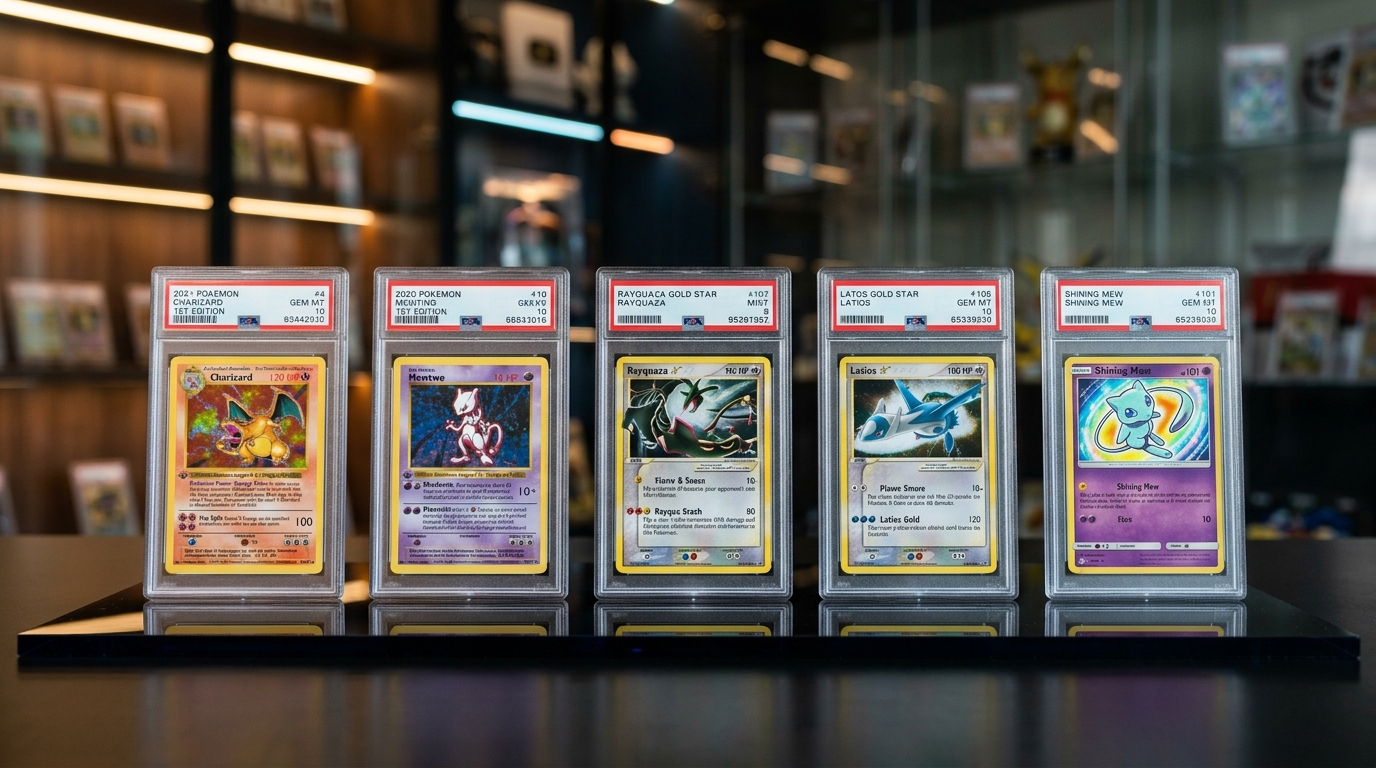
Identifying true rare pokemon cards requires analyzing rarity symbols, print run history, holographic finishes, and professional grading registry reports. Whether you are inspecting an old binder discovered in a childhood closet or evaluating five-figure investments at a high-end auction house, knowing which elements make a card genuinely scarce is essential for collector success in today’s mature trading card market.
The Pokémon Trading Card Game (TCG) has evolved from a 1990s playground craze into a multi-billion dollar alternative asset class. With over 25 years of set releases, promotional events, and regional tournament prizes, understanding the difference between common bulk cards and ultra-rare grail pieces can mean the difference between a few dollars and a life-changing financial windfall.
Key Takeaway: A Pokémon card’s rarity is defined not only by its printed icon at the bottom of the card, but also by historical distribution limits, condition survival rates, and authentic certification by top tier grading services.
Understanding Pokémon Card Rarity Tiers and Symbols
Before evaluating specific card values, collectors must understand the structural hierarchy of Pokémon TCG rarity designations. Over the decades, Nintendo and The Pokémon Company have expanded card classifications from simple black shapes into intricate secret rare systems.
1. Standard Rarity Symbols: Circle, Diamond, and Star
Every standard set card printed since the 1999 Base Set displays a small geometric icon in the bottom corner indicating its base distribution frequency:
- Circle (Common): Base level cards printed in high volume, typically basic Pokémon and standard trainer cards.
- Diamond (Uncommon): Moderately common cards, including stage 1 evolutions, special items, and energy cards.
- Star (Rare): Traditional rare cards featuring holo or non-holo artwork with significantly lower pack odds.
2. Modern Ultra Rares: Holo, EX, GX, V, and Illustration Rares
As the TCG expanded through generations like Sun & Moon, Sword & Shield, and Scarlet & Violet, new visual foil technologies and power cards entered circulation:
- Double Rare / Ultra Rare: Features full-art illustrations, textured foils, and special mechanic labels (EX, GX, VMAX, ex).
- Illustration Rares & Special Illustration Rares (SIR): Storybook-style full-bleed artwork that showcases Pokémon in detailed environments, commanding high demand among collectors.
- Hyper Rares (Gold Cards): Featuring metallic gold foiling across the entire surface, representing the top rarity tier in modern expansion packs.
3. Secret Rares: Beyond the Set Number
Secret Rare cards feature a card number higher than the printed set total (for example, #105/102). Printed with low pull rates (often 1 in every 36 to 72 booster packs), Secret Rares are prime targets for serious investors looking for long-term value retention.
Top Categories of Rare Pokémon Cards to Collect
Not all rare cards are created equal. The most valuable pieces in the hobby belong to distinct historical categories, each driven by unique market forces.
1. First Edition Vintage Base Set Holographics
The 1999 English Base Set 1st Edition remains the bedrock of Pokémon card collecting. Identified by a small black “1st Edition” stamp on the left side of the card frame, high-grade copies of holographic cards from this set represent the pinnacle of vintage scarcity. If you want to compare Base Set values against other sets, check out our most valuable pokemon cards guide.
2. Trophy and Tournament Prize Cards
Prize cards awarded to top finishers at regional, national, and world championships possess the extreme organic scarcity that collectors crave. Famous examples include:
- Pikachu Illustrator: Given exclusively to winners of the 1997-1998 CoroCoro Comic Illustration Contest in Japan, with under 40 copies in existence.
- No. 1, 2, and 3 Trainer Cards: Awarded at early World Championships, featuring custom artwork and low population numbers.
- Tropical Mega Battle & Secret Super Battle: Tournament cards issued in limited quantities to top international competitors.
3. Japanese Exclusive Promotional Cards
Many of the rarest cards were never released in English booster packs. Japanese promo cards distributed through magazines, vending machines, media subscriptions, or mail-in events (such as the Masaki Vending Pass promos or Gold Star promos) are highly sought after worldwide.
4. Error Cards and Factory Misprints
Error cards created during factory printing production runs form an exclusive sub-category of rarity. Collectors pay premium prices for documented misprints:
- Red Cheeks Pikachu (1999 Base Set): Initial print runs accidentally colored Pikachu’s cheeks red instead of yellow for the 1st Edition and Shadowless variations.
- No Stage Blastoise: Rare early printings where the evolution stage indicator box was omitted from the top left corner.
- Prerelease Clefable & Phantom Stamps: Factory errors featuring misplaced promotional foil stamps on non-standard cards.
Key Valuation Factors: What Makes a Rare Card Valuable?
Determining the exact dollar value of a rare card requires analyzing multiple intersecting factors. To accurately measure market value, use our interactive pokemon price checker tool.
1. Condition and Professional Grading Standards
Condition is the single biggest multiplier of card value. A near-mint card with minor edge wear might sell for $100, while a certified PSA 10 Gem Mint copy of the exact same card could command $5,000. Grading companies evaluate four key metrics:
- Centering: The alignment of the front and back card borders.
- Corners: Sharpness and absence of whitening or blunting.
- Edges: Smoothness along all four sides without chipping.
- Surface: Freedom from scratches, print lines, indentations, or clouding.
To learn more about professional grading company comparisons, read our guide on PSA vs BGS grading standards.
2. Character Popularity & Vintage Nostalgia
Iconic Pokémon consistently outperform secondary characters regardless of set rarity. Charizard, Pikachu, Mewtwo, Gengar, and Eeveelutions (Rayquaza, Umbreon, Espeon) generate significantly higher market premiums. For a detailed breakdown of Charizard specific values, visit our guide to most valuable Charizard cards.
3. Population Reports (Pop Control)
Grading service population reports reveal exactly how many copies of a card exist in a given grade. If a card has a total PSA 10 population of only 15 worldwide, competitive set registry collectors will bid aggressively whenever a copy appears at auction.
How to Protect and Preserve Rare Pokémon Cards
Acquiring rare cards is only half the battle; maintaining their physical condition is critical to preserving their monetary value over long holding periods. Physical degradation, UV exposure, and moisture damage can destroy thousands of dollars in equity in a short amount of time.
1. Proper Sleeving Techniques: The Two-Step Process
Every valuable raw card should immediately be placed in a archival-safe archival sleeve:
- Penny Sleeves: Soft, acid-free polypropylene sleeves that prevent surface scratches.
- Top Loaders & Semi-Rigids: Rigid PVC holders that protect against bending and corner damage during handling or shipping. Always slide the sleeved card into the top loader carefully to avoid chipping card corners.
2. Storage Environment Controls
Cards must be kept in climate-controlled environments:
- Temperature & Humidity: Store cards between 65°F and 72°F with relative humidity between 40% and 50%. High humidity causes cardboard bowing and foil clouding.
- UV Light Protection: Direct sunlight degrades card ink pigments and yellows borders over time. Store raw and graded cards in opaque boxes or UV-resistant display cases.
How to Determine What Your Rare Pokémon Cards Are Worth
If you own a collection and want to establish realistic market values, follow this step-by-step appraisal process:
Step 1: Identify the Exact Card Name and Set Number
Look at the bottom corner or bottom right frame of the card to find the set symbol and card number (e.g., 4/102 or 154/172). Note any special stamps such as “1st Edition,” “Shadowless,” or promo symbols. To evaluate baseline values, consult our pokemon card worth overview.
Step 2: Search Completed Auction Sales
Never rely on active listing asking prices, as sellers can ask any arbitrary amount. Instead, search eBay Completed/Sold listings, PWCC Auctions, Goldin Auctions, or Heritage Auctions to review real executed transactions.
Step 3: Assess Physical Condition Objectively
Examine the card under strong lighting with magnification. Check for tiny creases, hairline surface scratches, or light whitening along the back edges. If you suspect high value, consider sending the card for professional encapsulation. Read our comprehensive guide on pokemon card grading processes to prepare your submission properly.
Frequently Asked Questions
How can I tell if a Pokémon card is a rare or secret rare?
You can identify a rare card by looking at the symbol in the bottom corner: a star indicates a standard rare card. For ultra rares and secret rares, look for full-art textured foil, gold borders, or a set number that exceeds the total printed set count (such as #105/102).
Are 1st Edition Pokémon cards always valuable?
While 1st Edition cards from vintage English sets (like Base Set, Jungle, Fossil, and Team Rocket) carry a significant premium over unlimited printings, the card’s value still depends on character popularity, condition grade, and holofoil status. High-grade holographics hold the most value.
What is the most expensive rare Pokémon card ever sold?
The 1998 PSA 10 Gem Mint Pikachu Illustrator holds the world record as the most expensive Pokémon card ever sold, fetching over $5.27 million in a private transaction, making it the premier trophy card in trading card history.
Should I get my rare Pokémon cards graded before selling?
If your rare card is in exceptional condition (likely to score a PSA 9 or PSA 10 grade) and carries a raw market value above $100, getting it professionally graded almost always increases its market liquidity and final sale price.
Where is the safest place to sell valuable rare Pokémon cards?
For mid-tier cards ($50 - $1,000), marketplaces like TCGplayer, eBay, and specialized card shows offer fast transactions. For high-end rare cards valued above $5,000, reputable auction houses like PWCC, Goldin, or Heritage Auctions provide insured consignment services and buyer verification.
Pre-Grade & Track Values Instantly with CardMint
CardMint is the ultimate all-in-one scanner for sports card and TCG collectors, saving you time and money.
Simply scan the front of your card. Our AI instantly identifies the card details, checks current pricing metrics, and gives you a centering and wear pre-grade report before you submit to PSA/BGS.
